1990issue C081-6
Promoting wave degree after a near-full retracement
This archive count is taught as a classroom audit of wave degree. Promote the correction one degree when a decline erases almost the entire prior advance, reject a triangle as soon as any leg is five waves, and use thinning advance/decline only to test a late fifth-wave label.
- Promote the correction one degree when the decline erases nearly all of the prior advance, rather than forcing a fourth-wave label.
- Discard a triangle reading the moment any internal leg subdivides into five waves.
- After a zigzag, the rule of alternation expects the next same-degree correction to be a flat or a triangle.
- Use thinning advance/decline only to test whether a late fifth-wave label is still consistent, not as a standalone timing tool.
A classroom audit of degree
Editorial: TradersWeek treats this archive count as a classroom audit of elliott-wave-counting, not as a live forecast. The work is to place degree and pattern labels so later price, structure, and participation can confirm or invalidate the map.
Elliott-wave is a hierarchical map of advances and corrections in which each completed motive move is followed by a same-degree correction. The largest degree used in this case study is the grand-super-cycle, the multi-decade advance or the correction that ends that era. The archive called those legs grand-scale.
The spliced long chart
The case-study chart joined an 1855-1932 industrial average to a later industrial average from 1932, and joined an 1831-June 1932 rail index to a transport index from June 1932 onward.
Editorial: that construction is index-splicing, joining successive historical averages onto one chart so a long count is possible, at the risk of mixing incompatible scales. Later degree labels in this study sit on that joined chart.
Spliced U.S. rail and transport index, 1836–1990
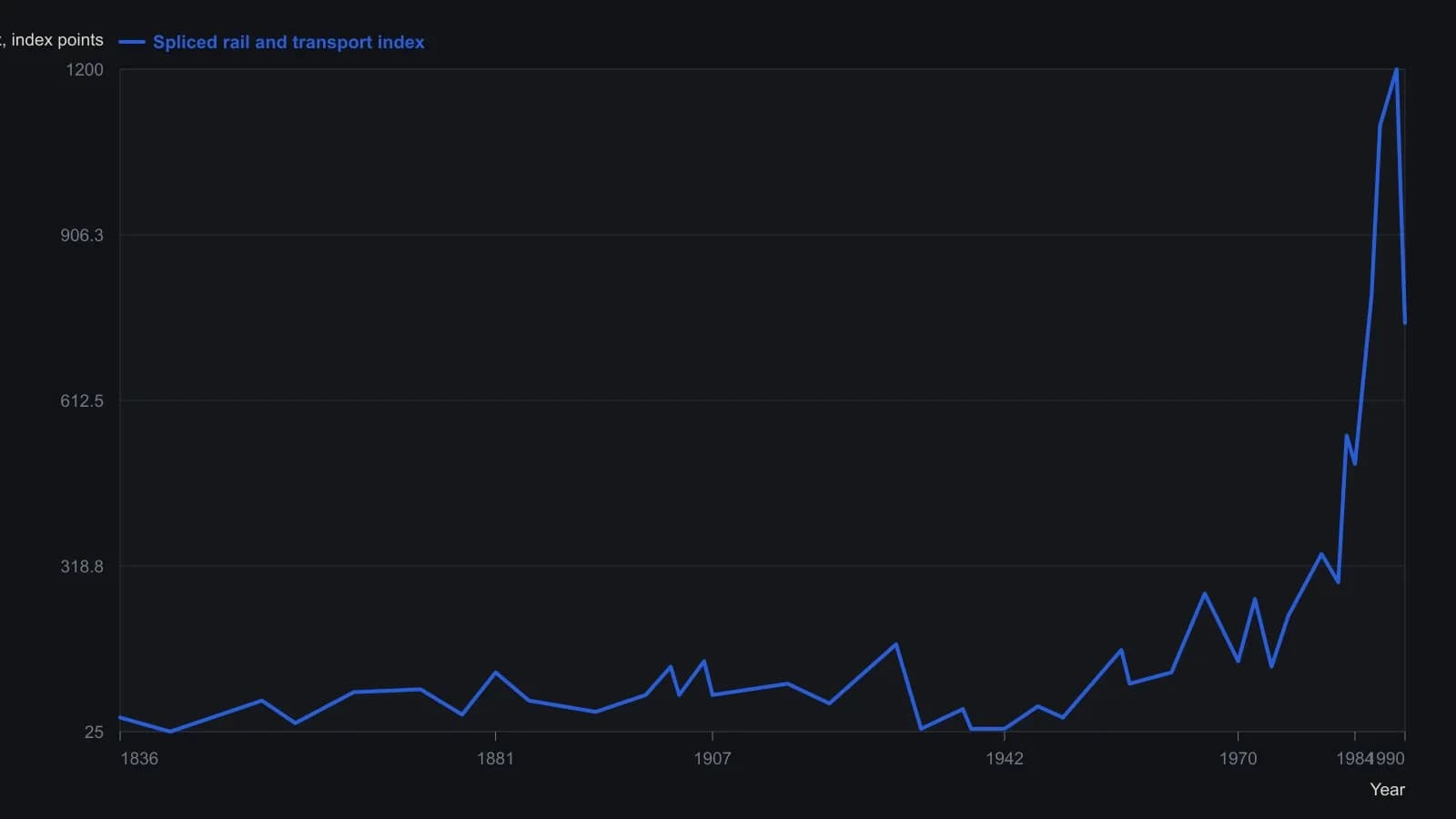
Approximate readings from the log-scale scan; turning points are rounded to the resolution the raster can support. The two source indexes are spliced at 1929.
Promote the correction when depth fails
The working count placed the first grand-scale advance from 1857 to 1929. The 1929-32 declines of 90 percent, 89.3 percent, and 88 percent on three separate series were treated as too severe for fourth-wave status. The count said a fourth wave should not erase 88-100 percent of the prior advance.
That check is the fourth-wave-depth-test: a fourth wave should not give back almost the entire preceding bull market, and an 88-100 percent retracement is treated as ending the larger cycle instead. Because the decline failed that test, the correction was promoted one degree. The second-wave low was placed in June 1932, and 1929-32 was labeled a zigzag rather than a fourth wave inside the prior advance.
Editorial: the hard fail is the depth. If the decline erases nearly all of the prior advance, the larger cycle is treated as over and the label is promoted.
A five-wave leg ends a triangle
A five-wave rally from 1932 to 1937 was used to reject a 1932-47 triangle reading because a triangle leg cannot itself contain five waves. That is the triangle-constraint: no single leg inside a triangle may itself be a five-wave motive move.
Editorial: the triangle reading is discarded the moment any internal leg subdivides into five waves. The later years of the range do not keep the pattern.
What the count held after the fails
After the depth test and the triangle rejection, the third grand-scale advance was counted from June 1932, with a hypothesized peak in August/September 1990 or February/March 1991.
After labeling 1929-32 as a zigzag, the rule-of-alternation was used to expect the next same-degree correction to be either a triangle or a flat. Consecutive same-degree corrections are expected to differ in form.
The count treated a move above 2875-2900 as keeping the third grand-scale advance intact into the 1990-91 peak window, and a break below 2485 as confirmation that the fourth grand-scale correction had begun.
Breadth only checks a late fifth
Market-breadth is a participation measure, typically an advance/decline line, used to test whether a late-degree advance is still widely supported.
U.S. advance/decline had not regained its 1959 peak even after an industrial-average rise from 776 to 2800, and was read as confirming a late fifth-wave market. The world-market series was counted as an unfinished large-degree fifth wave from the 1982 low, while the Japanese advance/decline line had been falling since 1986 as prices continued higher.
Editorial: thinning advance/decline is only a consistency check on a late fifth-wave label. It is not a standalone timing tool.
Transports already in the fourth
The transport series was described as peaking between 1500 and 1550 and already in the fourth grand-scale wave, with a hypothesized late-1990s low between 400 and 600.
Editorial: on this map the industrial third grand-super-cycle advance was still intact into the 1990-91 window unless price broke 2485, while the transport series was already labeled inside the fourth grand-super-cycle correction.
All readings on this track · 14 readings
- 1982Why wave counting stops full Elliott automation
- 1988Counting the 1987 Grand Supercycle peak as three claims
- 1990Promoting wave degree after a near-full retracement
- 1991A locked gold zigzag that had to produce two prices
- 2001Constructing Elliott wave counts with Fibonacci ratios
- 2002Constructing nested Elliott wave counts with ratio clusters
- 2002Auditing five-wave counts for overlap and length
- 2004A completed supercycle count as a Fibonacci ratio laboratory
- 2011The wave count as a falsifiable trade hypothesis
- 2014Constructing Elliott correction counts with Renko and zigzag
- 2015ABC wave labels as a square-of-nine timing hypothesis
- 2017Top-down Elliott wave count alignment
- 2019Wave-degree discipline for a 2018-2019 US long-wave top
- 2019Treat a completed cycle peak as a laboratory for repeating wave ratios