1995issue C011-6
Open-range stops after a fifty percent retracement
Invert the usual chart-then-stop sequence. Measure how far a market typically travels against its own open on days that still close in the intended direction, then use that open-to-extreme envelope to decide whether a 50 percent retracement is an acceptable same-session risk.
- A 50 percent retracement of a completed rally can be stated as a specific next-session buy level rather than as an undefined instruction to buy low.
- For a short-hold long idea aiming back toward a prior high, a stop-loss placed beyond the prior swing low can create more risk than that target can justify.
- After a higher-close-filter, about 95 percent of sessions that still closed higher never fell more than 21/32 from the open.
- A money-stop ignores usual open-to-extreme travel. The archive workflow placed the exit from that measured envelope instead.
A halfway buy still needs a bounded exit
A 50 percent retracement of a completed rally can be stated as a specific next-session buy level rather than as an undefined instruction to buy low. In this workflow the fibonacci-retracement is only a discrete price hypothesis that can be accepted or rejected during the next session.
The stop-loss is the precommitted exit that bounds how far price may travel against that idea before the position is abandoned. For a short-hold long idea aiming back toward a prior high, a stop placed beyond the prior swing low can create more risk than that target can justify.
September 1994 T-bonds and the halfway retracement of the July rally
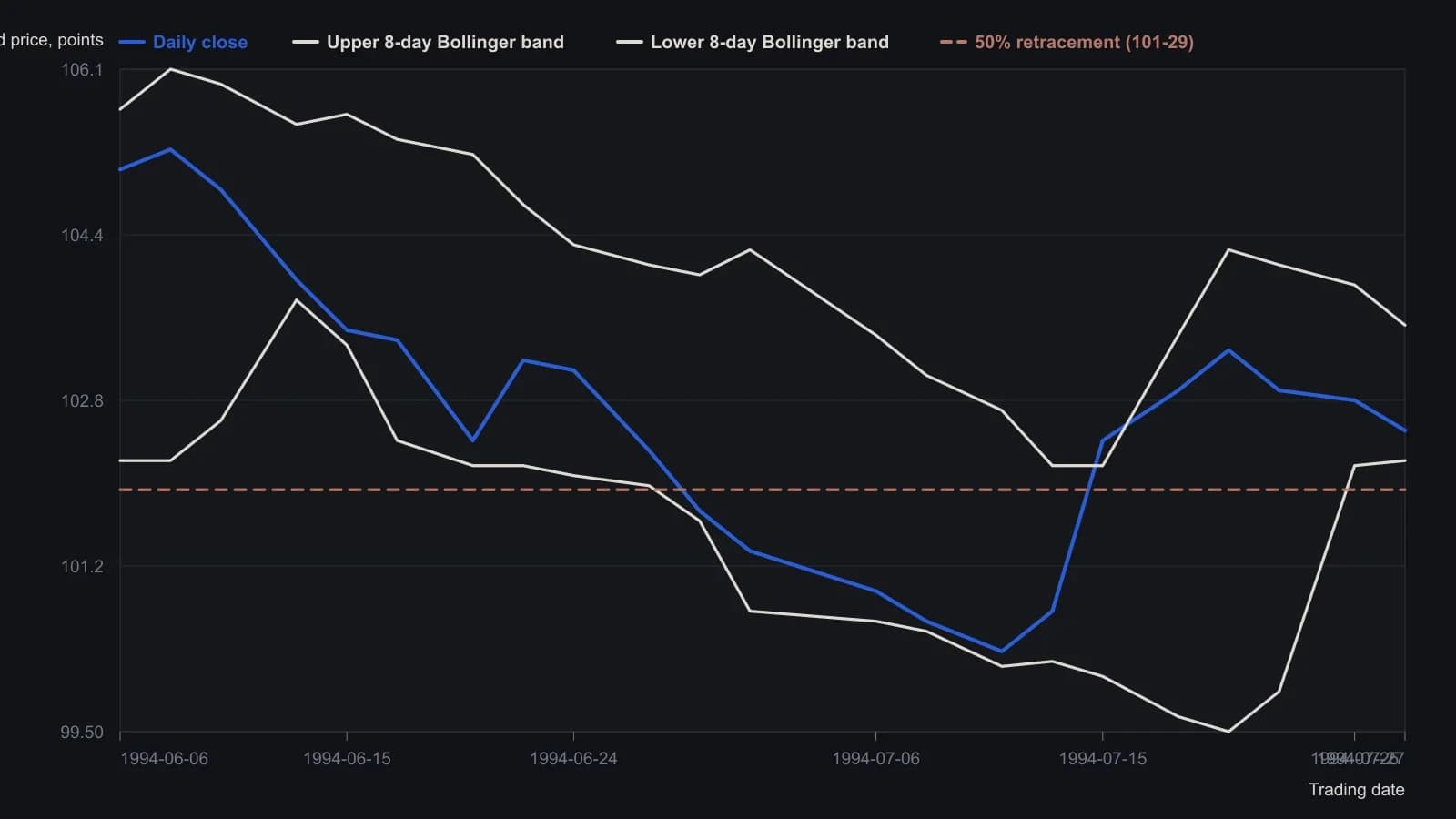
Bollinger bands follow the source’s eight-day simple moving average. Closes and band readings are approximate to about 0.1 point from the magazine raster, not exchange settlements. Bond prices are in points (32nds as decimal).
Open-to-extreme on every daily bar
ohlc-construction rebuilds each daily bar from the open, high, low, and close so sessions can be compared on the same scale. The comparison of interest is open-to-extreme, the signed distance from the session open down to the low or up to the high, used as the raw risk unit for a same-day stop.
In an unfiltered daily sample of open-to-low distances, the average decline from the open to the low was about 0.44 points, and some sessions exceeded 2 points. That mix includes days that never resolved in the buyer’s favor, so it is a poor template for a same-session long stop-loss.
What remains after a higher-close-filter
A higher-close-filter keeps only sessions that finish above the prior close, so the open-to-low distribution describes days that still resolved in the buyer’s favor. Limiting that sample to days that closed higher than the prior close cut the average open-to-low distance to about 0.25 points and compressed the largest readings to a little more than 1 point.
In the higher-close subset, about 95 percent of sessions that still closed higher never fell more than 21/32 from the open.
Rebasing each higher-close day so the open equals zero showed typical lows clustered between about 0.25 and 0.50 points below the open, with a reference line near 0.66 points, or about 21/32. That reference is a measured open-to-extreme envelope, not a money-stop set from a fixed tick or cash amount beneath entry.
The halfway level on a later session
On a later session that opened and then fell 11/32, price met the 50 percent retracement and turned. A further drop through 21/32 below the open was treated as a historically rare path to a higher close.
The mirror on down-close days
The mirror study on down-close days found an average open-to-high of about 8 ticks, with about 95 percent of those days staying within 21 ticks of the open. A move more than 22 ticks above the open made a lower close historically remote.
All readings on this track · 12 readings
- 1988Folding night auctions into daily OHLC bars
- 1989Constructing currency-translated commodity OHLC bars
- 1990Volume-width candlestick bar construction
- 1991Session-fitted bars and average-true-range risk bounds
- 1991Overnight versus session decomposition of futures bars
- 1994Constructing range overlap and bar-pattern filters from neighboring OHLC bars
- 1995Open-range stops after a fifty percent retracement
- 1997Lock the ohlc-bar before a flag or candle becomes a setup
- 2003Equal session OHLC bars for multiframe stochastic decisions
- 2003Continuous FX auctions, session-cuts, and gap proxies
- 2008Near-end-of-bar confirmation for discretionary entries
- 2018Constructing roller-and-strip charts from high-low-close pressure