1991issue C101-5
Overnight versus session decomposition of futures bars
Split every futures OHLC bar into an untradeable overnight print and a live session print. Then use overnight share and the reversal ratio to judge whether the open is a closed-market information dump that the auction often fades or a move that continues once orders can be worked.
- Close-to-close change equals overnight change plus session change, so each futures bar can be split into a print that occurs while the listed market is shut and a print that occurs while orders can be worked.
- A historical percent-allocation assigned about 43 percent of the typical day's price change to the overnight window, with contract-level averages ranging from 30 percent to 60 percent.
- Session change reversed overnight change on about 59 percent of days and continued it on about 41 percent.
- Contracts whose average overnight change was statistically significant also tended to show above-average reversal ratios.
Two prints inside one bar
A day's close-to-close change is today's close minus the prior close. That move is identically equal to overnight change plus session change.
Overnight change is the opening price minus the prior session close. It is the part of the daily move that prints while the listed market is shut and resting positions cannot be adjusted. Session change is the session close minus the same day's open. It is the part of the daily move that occurs while orders can be submitted and cancelled.
How to split a futures OHLC bar
Read the prior close and today's open as the overnight print. Read today's open and today's close as the session print. The full close-to-close bar is not one executable interval.
The historical workflow applied an inactive-contract filter, dropping observations when open interest was below 500 so thin or rolling contracts did not distort the overnight-versus-session split.
What the historical sample found
The sample covered 34 commodity futures contracts, generally from June 1990 through July 1991, after the inactive-contract filter.
Average close-to-close changes were small. Twenty-two of the 34 contracts declined on average and 12 rose, and none of those 34 averages differed statistically from zero on a mean-significance test.
Average overnight change was statistically indistinguishable from zero for 28 of the 34 contracts. The six contracts with a statistically nonzero average overnight change were the Deutschemark, orange juice, platinum, soybean meal, soybean oil, and sugar.
Soybean meal and soybean oil were the only contracts with statistically significant averages in both the overnight and session windows, and those two windows had opposite signs.
Overnight share and the reversal ratio
A percent-allocation is an equal-weighted split of each day's move between the overnight and session windows, so large and small days count the same. Equal-weighted daily splits assigned about 43 percent of the typical day's price change to the overnight window, with contract-level averages ranging from 30 percent to 60 percent.
The overnight share of the daily move was relatively low in 10-year notes, livestock, lumber, index futures, and grains, and relatively high in cocoa, metals, and foreign exchange.
The reversal ratio is the share of days on which overnight change and session change have opposite signs. Across the sample, the session change reversed the overnight change on about 59 percent of days and continued it on about 41 percent. Contracts whose average overnight change was statistically significant also tended to show above-average reversal ratios.
Overnight share of daily futures price change
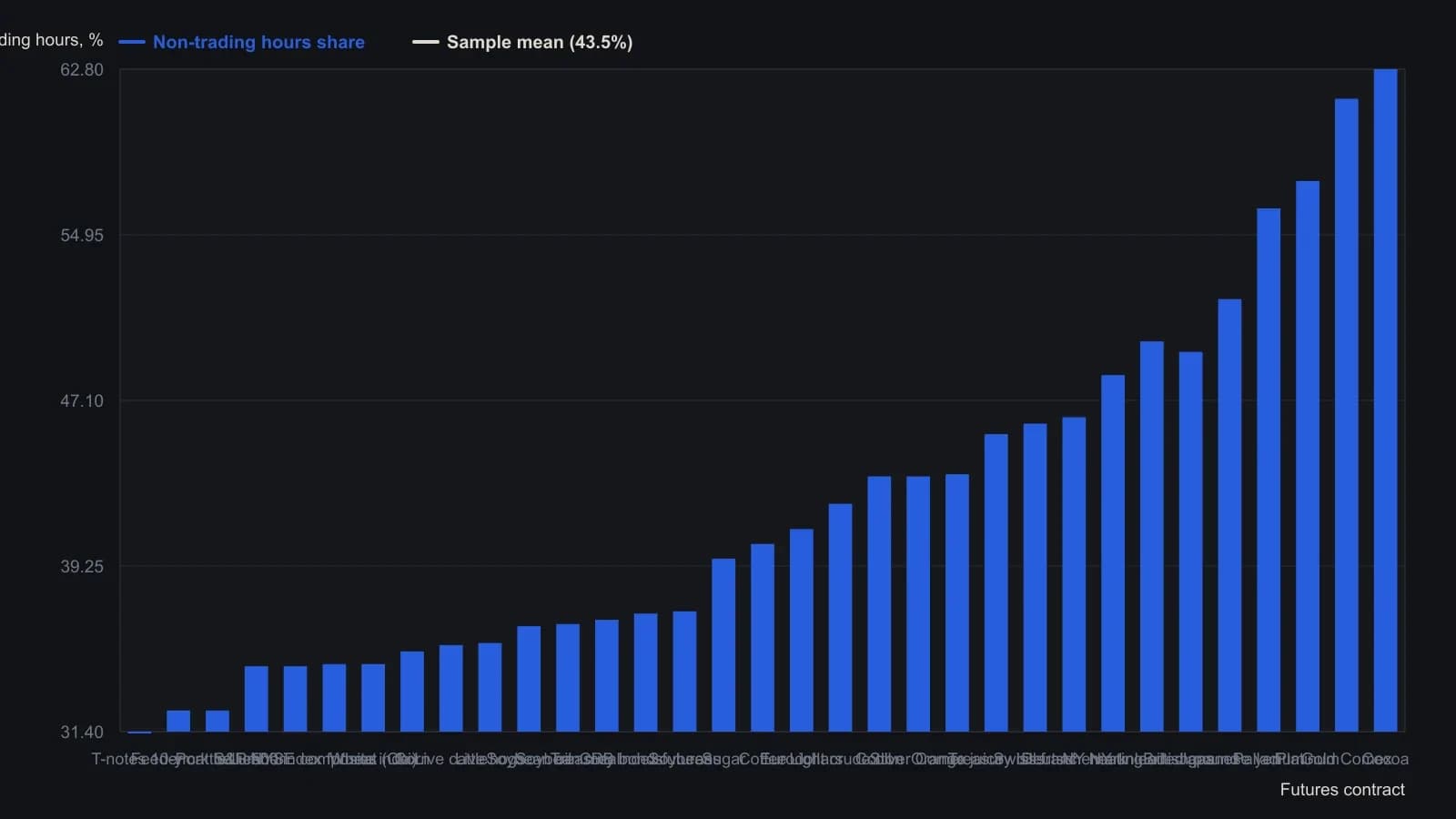
Averages give each session equal weight regardless of dollar size. Open-interest below 500 was dropped. Sample is roughly June 1990–July 1991.
Reading the open as a filter
TradersWeek editorial reading: treat overnight share as how much of the day printed before orders could be worked, and treat the reversal ratio as how often the live session faded that print. When both are high, the open looks more like a closed-market information dump. When overnight share is lower and continuation is more common, the open looks more like a move that continues into the session.
The historical sample describes that overnight-versus-session workflow. It does not establish how any contract behaves now.
All readings on this track · 12 readings
- 1988Folding night auctions into daily OHLC bars
- 1989Constructing currency-translated commodity OHLC bars
- 1990Volume-width candlestick bar construction
- 1991Session-fitted bars and average-true-range risk bounds
- 1991Overnight versus session decomposition of futures bars
- 1994Constructing range overlap and bar-pattern filters from neighboring OHLC bars
- 1995Open-range stops after a fifty percent retracement
- 1997Lock the ohlc-bar before a flag or candle becomes a setup
- 2003Equal session OHLC bars for multiframe stochastic decisions
- 2003Continuous FX auctions, session-cuts, and gap proxies
- 2008Near-end-of-bar confirmation for discretionary entries
- 2018Constructing roller-and-strip charts from high-low-close pressure