2003issue C051-2
Equal session OHLC bars for multiframe stochastic decisions
Editorial view: treat horizon choice as a construction spec. First cut the live auction into equal OHLC units, hang a stochastic crossing rule on that grid, then let the next coarser chart decide which crossings are even eligible.
- Session analysis starts from each futures contract's own open and close, then partitions that auction window into equal clock units before any OHLC bar or stochastic is computed.
- Equal-length OHLC bars keep a close-versus-range oscillator comparable across the session. A leftover shorter bar can distort the close inside the high-low range and produce a false overbought or oversold reading.
- A working chart is one rung in a stacked multiple. A daily Treasury bond futures chart can supply the higher-horizon directional filter for shorter-horizon oscillator trades.
- The archive workflow writes the horizon used on each trade into a journal and reviews it through a periodic profit-and-loss split by attempted time frame, because recall of order events is an unreliable record.
Horizon as a construction spec
This article uses an editorial construction order, not a claim that the archive ranked these steps as a finished system. First measure the live auction and cut it into equal open-high-low-close units. Then hang a stochastic crossing rule on that grid. Then let the next coarser chart decide which crossings are even eligible.
A working chart is meant to be read as one rung in a stacked multiple. Entries stay aligned with the next coarser horizon so pullbacks inside that trend are favored over isolated countertrend fades.
Start from the contract's own session
Futures auction windows differ by contract, so session analysis must start from each market's own open and close rather than a single equity-session clock.
Session analysis, in the fixed sense used here, measures a contract's actual open-to-close auction window and partitions that window into equal clock units before any bar or oscillator is computed.
Build equal-length OHLC bars
OHLC construction, in the fixed sense used here, builds open-high-low-close bars so every interval covers the same duration, avoiding a leftover short bar at the session close.
Fixed 60-minute OHLC bars on shorter futures sessions can leave a truncated final bar that is not comparable to the earlier bars in the study.
Equal-length construction comes from dividing the session into uniform units. Chicago grain hours from 9:30 a.m. to 1:15 p.m. Central are partitioned into 45-minute bars, with 5- and 15-minute bars as finer partitions of the same session.
Read the stochastic on that grid
The stochastic oscillator, in the fixed sense used here, is a close-versus-range oscillator sampled on equal-length bars and read at fixed oversold and overbought crossings.
One illustrated lower-horizon setup used a 40-minute chart and a 14-bar stochastic, with a long trigger on a cross above 30 percent and a short trigger on a cross below 70 percent.
40-minute T-bond futures with 8,3 stochastic
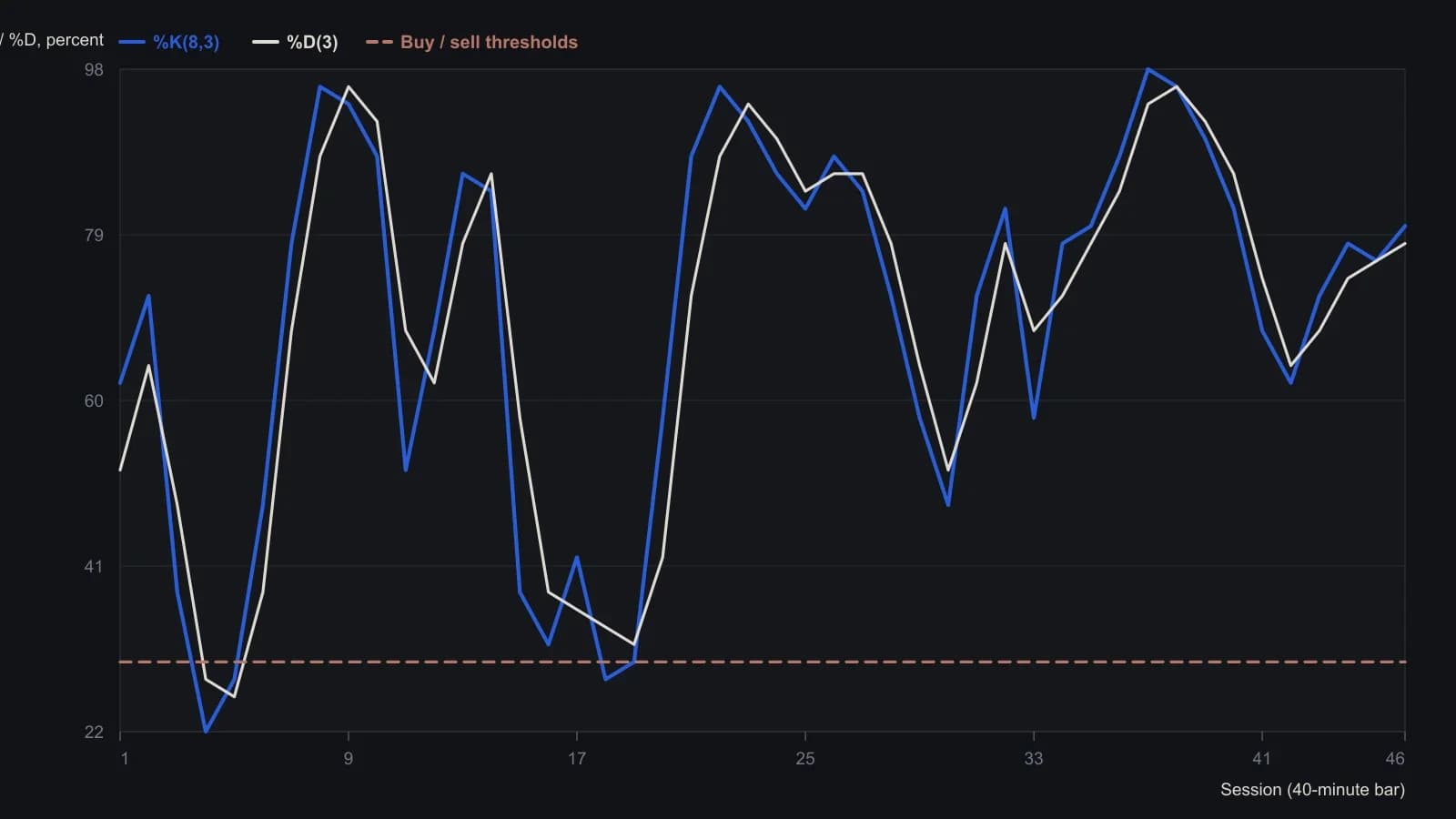
The article text calls this a 14-bar stochastic; the printed screenshot is labeled Stochastic(8,3),3 with buy above 30 and sell below 70. Values are approximate pixel reads of the raster, not exchange prints.
Let the coarser chart decide eligibility
After the equal-bar grid and the crossing rule are in place, the next coarser chart decides which crossings are even eligible.
A daily Treasury bond futures chart can supply the higher-horizon directional filter for shorter-horizon oscillator trades.
Record the horizon in the journal
The horizon used on each trade should be written into a journal and reviewed through a periodic profit-and-loss split by attempted time frame, because recall of order events is an unreliable record.
All readings on this track · 12 readings
- 1988Folding night auctions into daily OHLC bars
- 1989Constructing currency-translated commodity OHLC bars
- 1990Volume-width candlestick bar construction
- 1991Session-fitted bars and average-true-range risk bounds
- 1991Overnight versus session decomposition of futures bars
- 1994Constructing range overlap and bar-pattern filters from neighboring OHLC bars
- 1995Open-range stops after a fifty percent retracement
- 1997Lock the ohlc-bar before a flag or candle becomes a setup
- 2003Equal session OHLC bars for multiframe stochastic decisions
- 2003Continuous FX auctions, session-cuts, and gap proxies
- 2008Near-end-of-bar confirmation for discretionary entries
- 2018Constructing roller-and-strip charts from high-low-close pressure