2018issue C0428-31
Constructing roller-and-strip charts from high-low-close pressure
High-low-close bars already place the close a measurable distance from both range extremes. Roller-and-strip icons paint the close-to-extreme span that matches the close-to-close direction and leave only a handle for residual opposing pressure.
- High-low-close bars plot three values per observation, so both selling and buying pressure can be read from where the close sits inside the range.
- A roller-and-strip paints the close-to-extreme span aligned with the close change versus the prior close, and leaves a thinner handle on the opposite extreme.
- Inside-action, outside-action, non-overlapping gaps, island reversals, double and triple extremes, and head-and-shoulders formations are treated as transferable from bars and candlesticks.
- A candlestick plot can be forced to draw the strip with a modified-open, while a slim-variant marks the close with a dot and colors only part of the high-low line.
A construction problem
Editorial framing: treat the price glyph as a construction problem. Rebuild the three-value bar so the winning close-to-close direction becomes the painted mass and leftover range pressure becomes a single handle. The editorial question is whether that simpler icon still supports the same range-pattern hypotheses already used on candlesticks.
Three values already carry both pressures
High-low-close bars plot three values per observation. Candlesticks add the open and join it to the close as a body, with wicks that reach the high and the low.
Inside any high-low range the close sits a measurable distance below the high and above the low. Both selling pressure and buying pressure can therefore be read from one print.
Paint the winning close-to-close span
Roller-and-strip icons highlight the close-to-extreme span that matches the sign of the close change versus the prior close, and leave only one handle on the opposite extreme. The handle is the unemphasized remainder from the close to the opposite extreme, read as residual opposing pressure.
The same high-low-close values produce a positive strip when the close is higher than the prior close, a negative strip when it is lower, and a neutral-bar when the close is unchanged. A neutral-bar is an ordinary high-low-close bar with no preferred strip.
The painted strip emphasizes where the close sits versus the range extremes. A candlestick body emphasizes the open-to-close relationship and often shows two wicks.
Range patterns carried over from bars
Contained ranges, written here as inside-action, sit entirely inside the prior session high-low range. Engulfing ranges, written here as outside-action, fully contain the prior session range. Those formations, along with non-overlapping gaps, island reversals, double and triple extremes, and head-and-shoulders formations, are treated as transferable to roller-and-strip charts because they already appear on bars and candlesticks.
Identical prints can disagree
Identical observations can produce conflicting visuals. A spinning-top or near-doji candlestick can coincide with a positive roller-and-strip. A spinning-top plus opening-marubozu pair can coincide with a neutral-bar and then a slightly negative roller-and-strip.
A modified-open that fakes the strip
A candlestick series can be forced to draw the strip by replacing each open with a modified-open, then marking the actual close. The modified-open is set to the low after an up close, the high after a down close, or the close when the close is unchanged.
Neutrality rules and a slim-variant
Neutrality can treat every nonzero close change as directional, or withhold the colored strip until the close change exceeds a chosen fraction of that bar’s high-low range.
A slim-variant marks the close with a small dot and colors only part of the high-low line so more observations fit in the same chart area.
Euro-dollar daily spot on the roller-and-strip chart
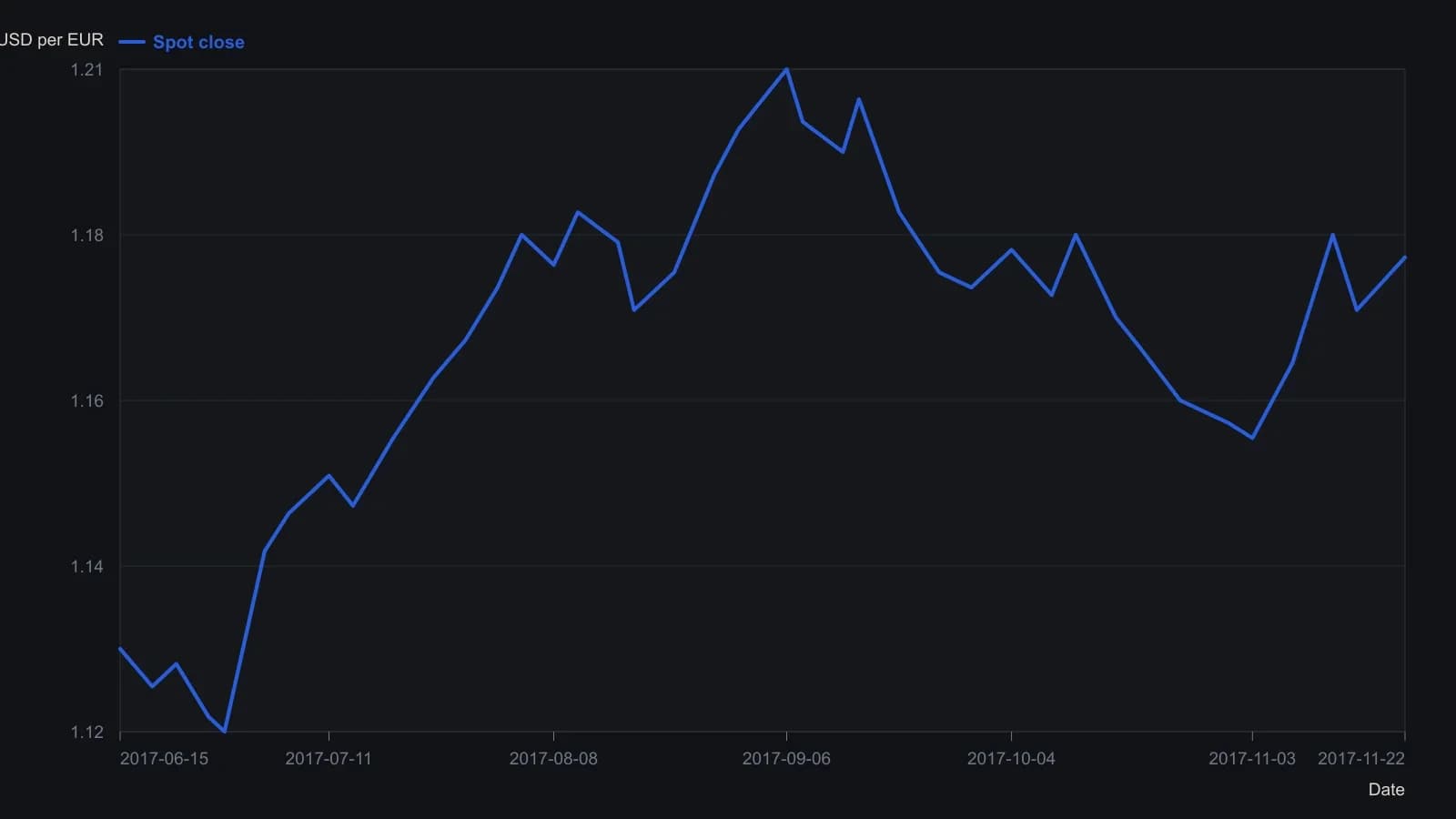
Digitized from the printed daily plate (month ticks only; year taken from the April 2018 issue). The source bars are denser than this sample, so swing levels are approximate to about 0.002.
All readings on this track · 12 readings
- 1988Folding night auctions into daily OHLC bars
- 1989Constructing currency-translated commodity OHLC bars
- 1990Volume-width candlestick bar construction
- 1991Session-fitted bars and average-true-range risk bounds
- 1991Overnight versus session decomposition of futures bars
- 1994Constructing range overlap and bar-pattern filters from neighboring OHLC bars
- 1995Open-range stops after a fifty percent retracement
- 1997Lock the ohlc-bar before a flag or candle becomes a setup
- 2003Equal session OHLC bars for multiframe stochastic decisions
- 2003Continuous FX auctions, session-cuts, and gap proxies
- 2008Near-end-of-bar confirmation for discretionary entries
- 2018Constructing roller-and-strip charts from high-low-close pressure