2019issue C0340-42
Evaluating upward breakaway gaps by changing one rule at a time
Freeze an upward breakaway-gap definition, then change only gap size, volume confirmation, breakout-bar shape, or hold-versus-stop rules. The historical workflow recorded fewer qualifying events as the gap threshold rose, and later screens changed which days were treated as executable.
- An upward breakaway gap is a sudden jump out of a congestion zone after two-way trade around a local average, treated as a directional hypothesis rather than an automatic entry.
- Baseline recognition used a gap of at least 1% of price, breakout-day volume of at least twice the prior 14-session average, and a 60-session high, with entry at the next session open.
- A time-exit of 5, 10, 15, or 20 sessions isolates post-gap drift before stops or targets are added.
- Later passes changed only gap size, the volume multiplication factor, breakout-bar body and wick screens, or stop-and-target rules.
Freeze the pattern first
This article treats an upward breakaway gap as a lab exercise. The pattern definition is frozen first. Later passes change only gap size, volume confirmation, breakout-bar shape, or hold-versus-stop rules.
An upward breakaway gap was defined as a sudden jump out of a congestion zone after price had been oscillating around a local average. A congestion zone is a stretch of two-way oscillation around a local average that precedes the jump.
Editorial. Treat the gap as a directional hypothesis rather than an automatic entry.
Sample window and baseline rules
The historical sample used Russell 3000 constituents from January 2000 through June 2018 and was chosen so that two bear markets were inside the window.
Baseline recognition required a gap of at least 1% of price, breakout-day volume of at least twice the prior 14-session average, and a breakout that was the highest price of the prior 60 sessions. The simulated entry was the open of the session after the gap, once the breakout day had already closed.
Time-exits isolate post-gap drift
First-pass tests used time-only exits of 5, 10, 15, and 20 sessions with no stop or target, to isolate post-gap direction rather than a complete strategy. A time-exit is a fixed-session hold used to study post-gap drift before stops or targets are added.
Only the gap size changes
Later passes raised the minimum gap size through 2%, 3%, 4%, and 5% of price and recorded fewer qualifying events as the threshold increased.
Editorial. Every other recognition rule stays fixed when the gap size changes, so the smaller sample is attributable to that threshold alone.
Only the volume screen changes
Volume confirmation is a participation filter that compares breakout-day volume with a recent average before the gap is treated as executable. The multiplication factor is breakout-day volume divided by the average volume of the prior 14 sessions.
Volume screens were varied around the 14-session average, including a multiplication factor below 1.0 and factors greater than 3.0 and 4.0.
Editorial. A factor below 1.0 is a looser participation filter. Factors greater than 3.0 or 4.0 are stricter screens on the same 14-session average.
Only the breakout-bar shape changes
Candlestick patterns, in this workflow, are breakout-bar body and wick geometry used as a secondary screen on the gap day. Two breakout-day candle screens were isolated: a body longer than each of the prior four sessions, and an upper wick shorter than that body.
Editorial. These candle screens sit on top of the frozen gap definition, so bar shape is not mixed with gap size or volume.
Stop and target rules change the hold
Four stop-and-target variants placed a stop just under the recent local low, set reward-to-risk near 1.0 or 1.5, and either capped the hold at 20 sessions or waited until a level was hit.
Editorial. These rules do not redefine the gap. They change how long the trade may live and where it is forced to exit after the delayed entry.
How to read the lab
Editorial. Freeze the breakaway-gap definition, then change one control. The archive recorded a smaller event count as the minimum gap rose. Volume confirmation and candlestick screens decide which gap days are treated as executable. Stop and target choices change the risk shape after that recognition step.
Qualifying upward breakaway gaps fall as the size filter tightens
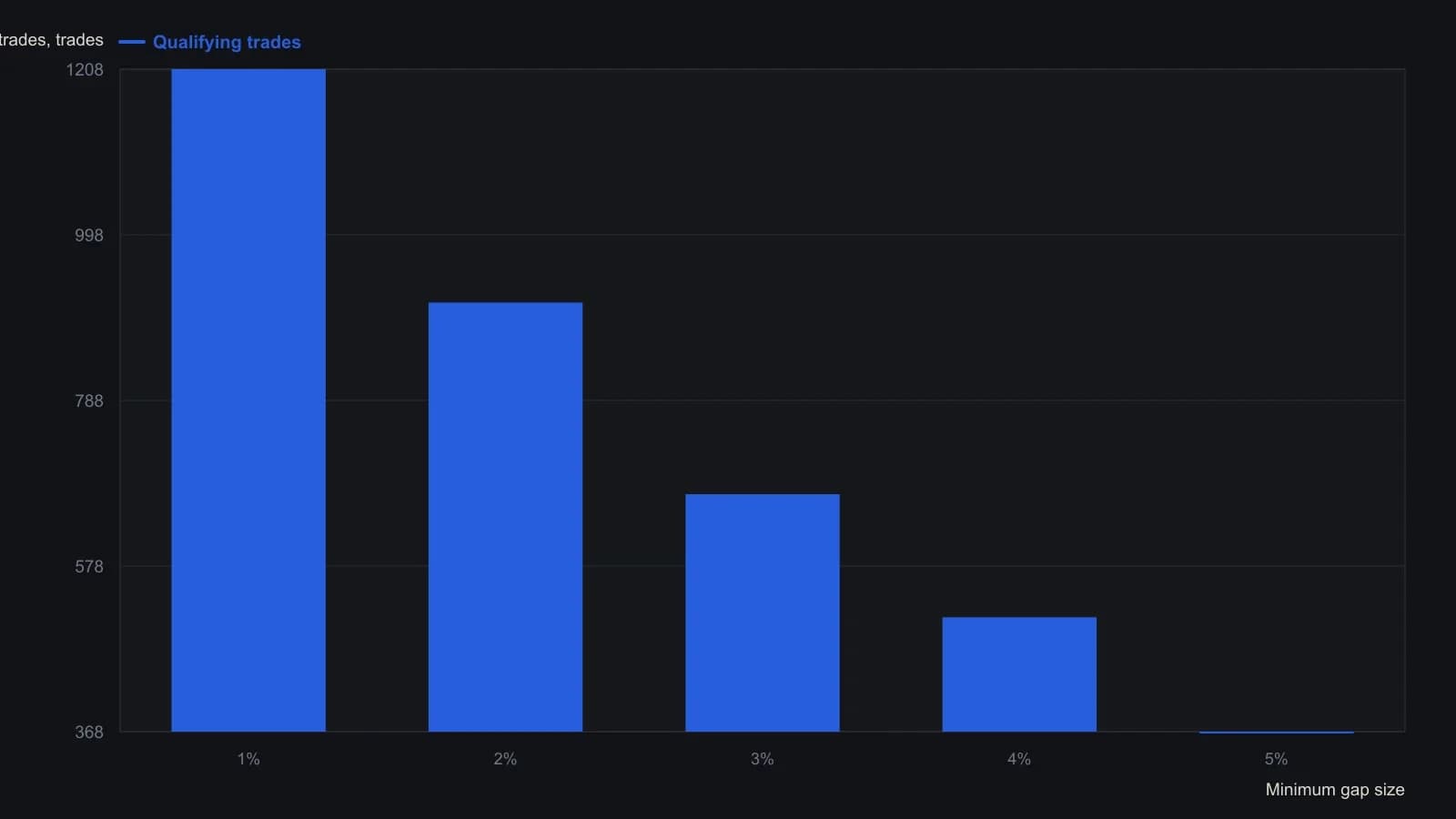
Rules held fixed across these bars: next-day open entry, breakout volume at least twice the prior 14-day average, a 60-day high, and a flat 20-session time exit with no stop or target. The sample is Russell 3000 names from January 2000 through June 2018.
All readings on this track · 7 readings
- 1991The midpoint retest after a missed breakaway gap
- 2011Constructing volume-confirmed breakaway gaps
- 2011The first close after a breakaway gap as a classroom breakout test
- 2011Constructing candlestick, breakaway-gap, and Elliott-wave signals
- 2013A PHM breakaway gap stacked with Elliott labels and mapped support
- 2019Breakaway gap after a completed double bottom
- 2019Evaluating upward breakaway gaps by changing one rule at a time