2020issue C0660-64
Cash-secured put as a crash-regime overlay
In a worked example, a 3-strike cash-secured put needed about a 73 percent further decline before assignment, collected 550 of premium on a 10-contract lot if the shares stayed above the strike, and sat inside a volatility-adjusted thematic basket so no single symbol had to be correct.
- A cash-secured short put requires posting cash equal to the strike obligation minus premium received, and that cash is the stated maximum loss if assigned shares later become worthless.
- Elevated implied volatility was treated as a large time-premium component that a short put collects only if bankruptcy and deep-drawdown paths are accepted.
- With 274 days to expiration and implied volatility near 151 percent, an unchanged stock price plus a cut in implied volatility from 151 percent to 75 percent over 60 days was calculated to drop the put's theoretical value below 0.02.
- Spreading capital across a thematic basket, with volatility-adjusted and relatively small size per name, was described as reducing the need to be correct on any single symbol.
Posted cash against the strike
A cash-secured short put requires posting cash equal to the strike obligation minus premium received, and that cash is the stated maximum loss if assigned shares later become worthless. The cash-secured put uses that cash collateral to place one name inside a volatility and market-regime frame.
The worked 3-strike put
In the worked example, a 3-strike put sold while the stock traded near 11.07 would need a further decline of about 73 percent before assignment. If assigned, the effective stock cost equals the 3 strike minus the 0.55 premium, or 2.45 a share. If the shares stay above the 3 strike until expiration, the put expires and the seller keeps the 550 of premium collected on a 10-contract lot.
AAL $3 cash-secured put: profit versus share price
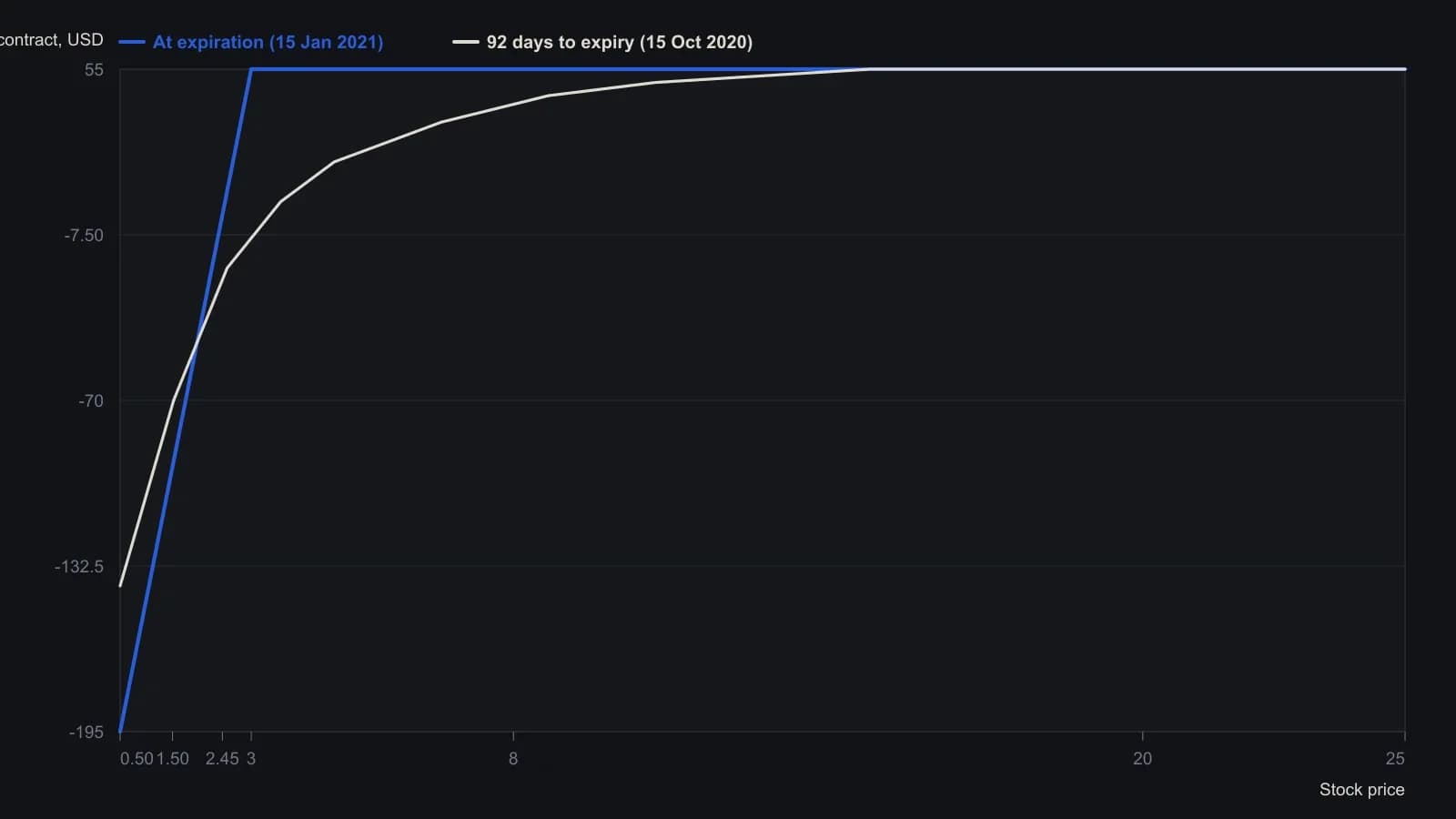
P/L is per contract, matching the figure scale of about −200 to +100 dollars; the article’s 10-lot scales every dollar by ten. The figure is dated 16 Apr 2020, with 151 percent implied volatility and 274 days to the January 2021 expiry. The 92-day path is approximate because it was read from a small raster.
Implied volatility and time premium
Elevated implied volatility on the example options was treated as a large time-premium component that a short put collects only if bankruptcy and deep-drawdown paths are accepted. Implied volatility is the options-implied uncertainty that sets time premium and can shrink a short put even when the stock price barely moves. With 274 days to expiration and implied volatility near 151 percent, an unchanged stock price plus a cut in implied volatility from 151 percent to 75 percent over 60 days was calculated to drop the put's theoretical value below 0.02.
Thematic baskets when conditions change
Spreading capital across a thematic basket, with volatility-adjusted and relatively small size per name, was described as reducing the need to be correct on any single symbol. A thematic basket is a group of names or funds sized together so capital is allocated to a theme rather than to a single symbol. Holding one thematic basket long and another short was described as a way to remove some market risk when conditions change suddenly. Equity-market results and economic conditions were described as able to diverge because they are not contractually bound to each other.
All readings on this track · 15 readings
- 1989Cash-secured puts and spreads versus buy-write overlays
- 1990Covered-call overlays fail a flexibility test until restated as puts and spreads
- 2005Covered-call supply, cash-secured puts, and conversion fair value
- 2007Covered calls and cash-secured puts as one income regime
- 2007Cash-secured puts, assignment risk, and post-entry overlays
- 2012Accumulation risk: protective puts, cash-secured puts, and spreads
- 2016Cash-secured put income, assignment, and reward-to-risk
- 2016Cash-secured puts under extreme implied volatility
- 2016A gold ETF range regime as a short-call ceiling, put floor, and short strangle
- 2017Weekly cash-secured puts filtered by intraday stochastic bands
- 2018Far out-of-the-money cash-secured puts as income and entry
- 2018Weekly equal-weight downtrend as a shared gate for VIX premium and put collateral
- 2019Bounding naked premium after a volatility spike
- 2020Cash-secured puts in a 2020 implied-volatility spike
- 2020Cash-secured put as a crash-regime overlay