2020issue C0645
Cash-secured puts in a 2020 implied-volatility spike
A 2020 airline case treats a cash-secured put as a regime-aware portfolio decision. Extreme implied volatility can enlarge the option premium, yet the same shock also raises assignment risk and the cash that must sit against the strike.
- A cash-secured put sells an out-of-the-money put while holding enough cash to buy 100 shares at the strike, and the collected premium is applied against that cash.
- If the put is exercised, assignment means buying 100 shares at the strike and effective cost equals the strike minus the premium received. If the stock stays above the strike and the put is not exercised, the seller keeps the premium.
- For one airline in 2020, 90-day implied volatility had typically ranged about 30% to 50% over roughly four years, then rose above 200% during the coronavirus-linked panic before easing, and it stayed elevated versus that usual range after the economic shutdown.
- Editorial reading: compare premium size with the multi-year implied-volatility range. An extreme print is regime context, not a standalone reason to sell, because the same shock increases assignment risk and cash commitment.
What the cash-secured put commits
A cash-secured put is described as selling an out-of-the-money put while holding enough cash to buy 100 shares at the strike. An out-of-the-money put is a put whose strike sits below the share price at the time it is sold. The collected option premium is applied against that cash set-aside.
Assignment is the obligation of the put seller to buy 100 shares at the strike if the buyer exercises. If the put is exercised, the seller must buy those 100 shares at the strike, and the effective cost equals the strike minus the premium received. If the stock stays above the strike and the put is not exercised, the seller keeps the premium received.
A worked dollar example
In a worked example with a $22 stock, a $20-strike put is sold for $1 of premium. That sale produces a $100 credit. If 100 shares are purchased at the strike, the net cost is $1,900, which is the effective cost of the assigned shares.
If that stock stays above the $20 strike and the put is not exercised, the seller keeps the $100 premium. The credit both reduces the cash set aside while the put is open and lowers the net share cost if assignment occurs.
The 2020 airline implied-volatility regime
A 2020 market panic associated with coronavirus is described as pushing implied option volatility to extreme levels on a number of stocks. Implied volatility is the options market's priced estimate of future variability, compared here on a 90-day tenor against a multi-year typical range.
For one airline name, 90-day implied volatility had typically ranged about 30% to 50% over roughly four years, then rose above 200% during the 2020 panic before easing. After the related economic shutdown, that airline's shares were severely pressured, its outlook remained uncertain, and its implied volatility stayed elevated versus its usual historical range.
AAL 90-day implied volatility versus its 2016–2019 range
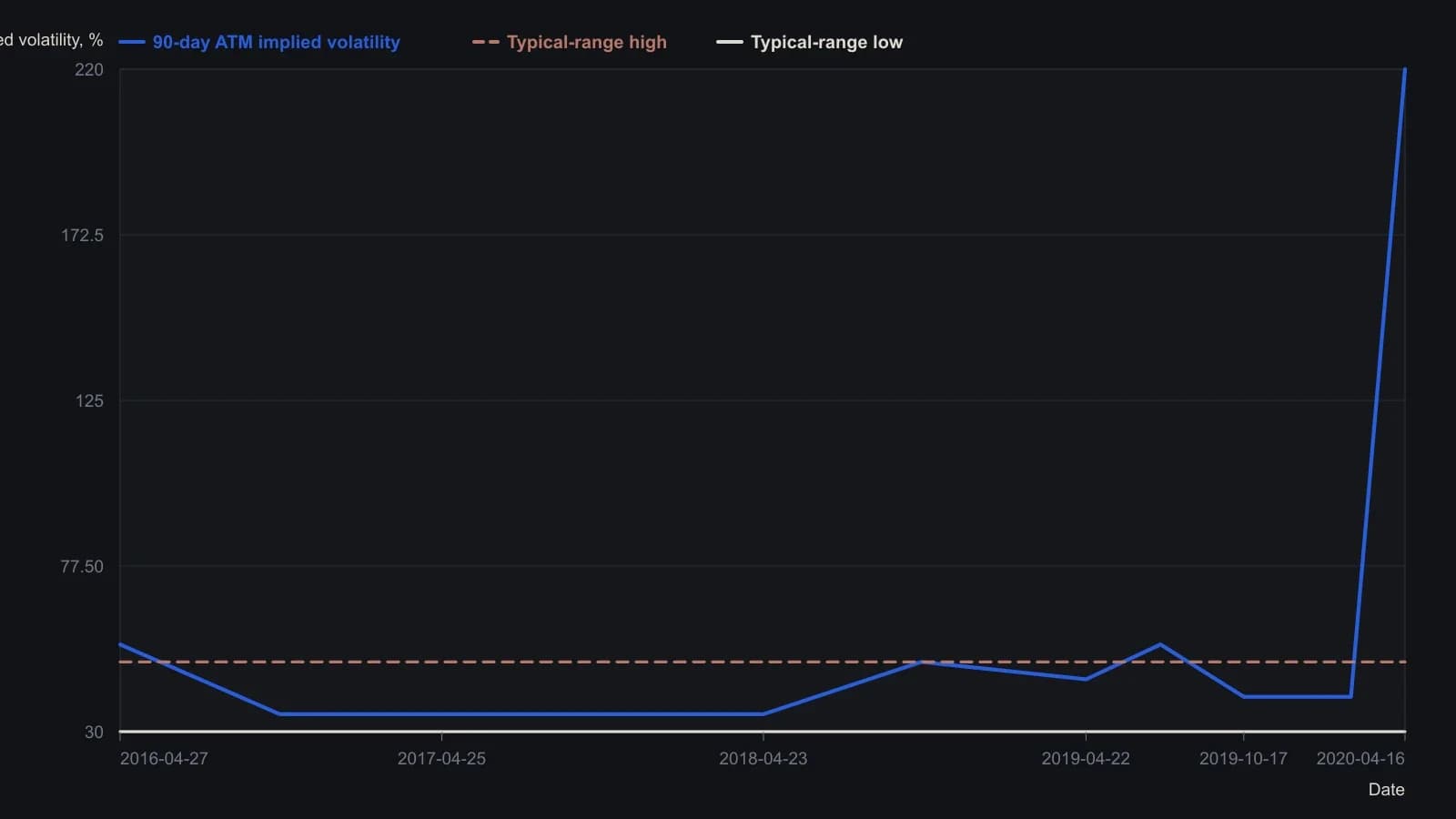
Implied-volatility readings are digitized from a small published raster and rounded to 5 percentage points. The 2020 peak is the last print on the figure, about 220, matching the author’s “above 200%” statement; the intra-spike path is not resolved on the image. Stock candles on the same figure use a separate dollar scale and are not mixed onto this axis.
Selling the put when implied volatility is high
In the variant discussed, share accumulation is not the primary goal. The stated aim is to sell a put when implied volatility is high in order to enlarge the premium, while still being willing to buy the shares if assigned.
After the put is sold, the two outcomes described as favorable for a later exit are a decline in implied volatility that cheapens a buyback, or the option expiring without value.
Premium size as a regime reading
Editorial interpretation: the 2020 airline case is useful as context for a single cash-secured put, not as a self-contained reason to sell. Implied volatility that has left a multi-year 30% to 50% range and risen above 200% can enlarge the credit. The same coronavirus-linked panic and the later economic shutdown also left the shares severely pressured and the outlook uncertain, which keeps assignment and the full cash commitment in view.
The archive's two favorable later exits, a decline in implied volatility that cheapens a buyback or expiration without value, sit inside that regime. They do not turn an extreme 90-day print into a standalone sale signal. The comparison that belongs in a portfolio reading is the size of the option premium against the longer typical range.
All readings on this track · 15 readings
- 1989Cash-secured puts and spreads versus buy-write overlays
- 1990Covered-call overlays fail a flexibility test until restated as puts and spreads
- 2005Covered-call supply, cash-secured puts, and conversion fair value
- 2007Covered calls and cash-secured puts as one income regime
- 2007Cash-secured puts, assignment risk, and post-entry overlays
- 2012Accumulation risk: protective puts, cash-secured puts, and spreads
- 2016Cash-secured put income, assignment, and reward-to-risk
- 2016Cash-secured puts under extreme implied volatility
- 2016A gold ETF range regime as a short-call ceiling, put floor, and short strangle
- 2017Weekly cash-secured puts filtered by intraday stochastic bands
- 2018Far out-of-the-money cash-secured puts as income and entry
- 2018Weekly equal-weight downtrend as a shared gate for VIX premium and put collateral
- 2019Bounding naked premium after a volatility spike
- 2020Cash-secured puts in a 2020 implied-volatility spike
- 2020Cash-secured put as a crash-regime overlay