2019issue C0246-47
Bounding naked premium after a volatility spike
A specialist book that sold far out-of-the-money commodity futures options for more than 20 years failed when short natural-gas calls met a futures spike and a surge in implied volatility. Margin expansion then ran above client equity. The extract treats every open premium sale as able to meet that shock, and it withholds the trade unless the short is cash-secured, defined as a vertical spread, or given a stop-loss before the credit is taken.
- A far out-of-the-money income book can still fail when a price spike and a rise in implied volatility produce margin expansion larger than client equity.
- A cash-secured put funds the obligation to buy at the strike, but it does not cap the loss if the underlying falls far below that strike.
- A vertical spread removes the unbounded profile of a naked option. A high chance that the sold strike finishes worthless does not shrink the stated maximum loss.
- If an option income strategy has no stop-loss or other pre-written bound on the worst case, the extract treats that premium sale as one that should not be opened.
A long-running premium book met one shock
A specialist book had sold far out-of-the-money commodity futures options for more than 20 years. It failed after short natural-gas calls, struck about 50 percent above the then-current price, met a September to November 2018 futures spike.
Implied volatility is the uncertainty priced into options. A sharp rise can mark short options against the seller even before the strike is reached. In this case that surge arrived with the futures spike. Margin expansion then increased the good-faith deposit required on the short futures options when price and volatility moved against the book, and that deposit ran above client equity.
The operator described the shock as unlike anything previously seen. The extract still treats extreme adverse moves as events every open premium sale should be assumed able to encounter.
Natural-gas futures through the late-2018 spike
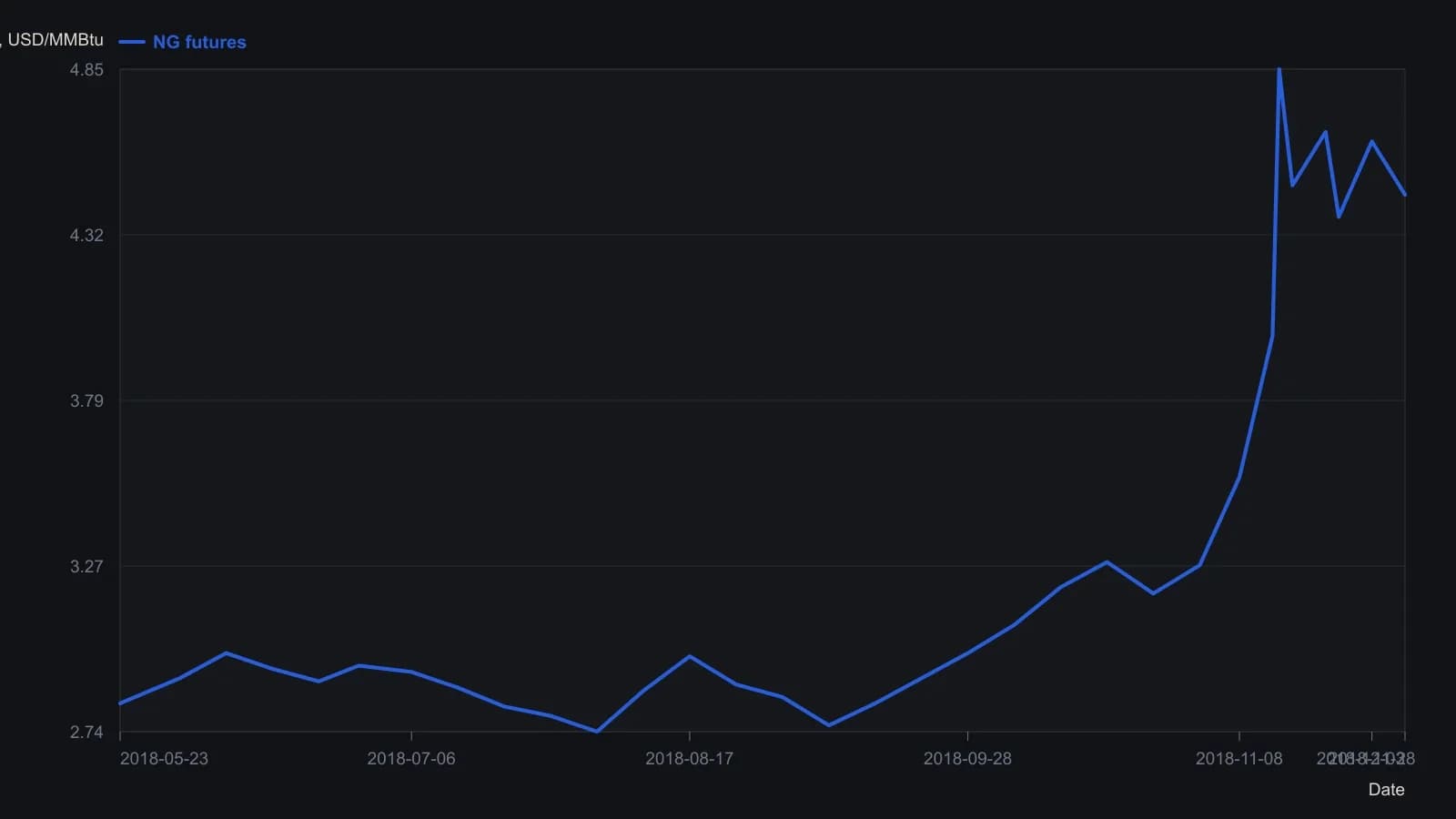
Except for the 28 June 2018 session printed in the chart header (open 2.99, high 3.02, low 2.93, close 2.95), prices are visual readings from daily bars against a 0.25 grid, so individual dates are approximate.
A naked short call has no stated ceiling
An unhedged short call is a naked option. With no offsetting long option, residual directional exposure can grow with the underlying. That short call has no fixed upper loss bound because the underlying price has no stated ceiling. If that structure is used, size relative to capital is presented as the binding control.
Cash-securing funds the strike
A cash-secured put is a short put backed by enough cash to buy the shares at the strike if assigned, so the obligation is funded in advance. In the walkthrough, a stock at 92 supports a 90-strike put sold for 2. Cash of 9,000 stands ready to buy 100 shares. Premium of 200 is kept if the stock stays above 90, and assignment implies an 88 effective purchase price.
The same short put still requires paying 90 if shares are put to the seller. An overnight drop to 50 therefore leaves a large loss. Cash-securing funds assignment. It does not remove downside below the strike.
A vertical spread states a cap
Pairing a short nearer-the-money option with a long farther out-of-the-money option of the same type and expiry is a vertical spread. That pairing removes the unlimited-loss profile of a naked short and gives the loss a stated cap. A high chance the sold strike finishes worthless does not shrink that stated maximum loss.
No bound means no sale
A stop-loss is a pre-commitment that caps loss or exposure before entry and while the position is open, rather than relying on the move remaining moderate. If no plan exists for how the worst case will be cut or otherwise bounded, the extract treats the premium sale as one that should not be opened.
An option income strategy is a repeatable premium-collection procedure whose entry, hold, exit, and stand-aside rules can be stated as one process.
The wrong lesson is to abandon the class
Avoiding options as a class is presented as the wrong lesson. The required response is to inventory the risks a given structure creates and take steps that reduce them.
Editorial reading: that inventory asks whether each short is a cash-secured put, a vertical spread, or a naked option given a stop-loss, and whether the book can absorb margin expansion if implied volatility rises with an adverse price move.
All readings on this track · 15 readings
- 1989Cash-secured puts and spreads versus buy-write overlays
- 1990Covered-call overlays fail a flexibility test until restated as puts and spreads
- 2005Covered-call supply, cash-secured puts, and conversion fair value
- 2007Covered calls and cash-secured puts as one income regime
- 2007Cash-secured puts, assignment risk, and post-entry overlays
- 2012Accumulation risk: protective puts, cash-secured puts, and spreads
- 2016Cash-secured put income, assignment, and reward-to-risk
- 2016Cash-secured puts under extreme implied volatility
- 2016A gold ETF range regime as a short-call ceiling, put floor, and short strangle
- 2017Weekly cash-secured puts filtered by intraday stochastic bands
- 2018Far out-of-the-money cash-secured puts as income and entry
- 2018Weekly equal-weight downtrend as a shared gate for VIX premium and put collateral
- 2019Bounding naked premium after a volatility spike
- 2020Cash-secured puts in a 2020 implied-volatility spike
- 2020Cash-secured put as a crash-regime overlay