2016issue C0627-28
Cash-secured puts under extreme implied volatility
In mid-April 2016 a distressed single-digit name was trading below fifty cents a share, and near-money option quotes showed implied-volatility readings described as among the highest seen on any listed option over a ten-year lookback. TradersWeek's editorial reading treats that window as a classroom for how solvency fear can lift option premium, so a cash-secured put is a funded, strike-defined bid against possible binary failure rather than a way around that failure.
- In the mid-April 2016 observation the featured equity was trading below fifty cents a share, while a related long-stock position had been averaged in at five dollars a share.
- Near-money option quotes showed implied-volatility readings described as among the highest seen on any listed option over a ten-year lookback, tied to still-pending scheduled reports and market speculation that the issuer could run out of cash.
- Selling a put rather than buying one was framed as collecting option premium for a bullish obligation at a chosen strike, with the contract cheapening if the stock stayed at or above that strike until expiration.
- The same short-put construction was characterized as still risky because the loss profile can outweigh the premium collected, and after that window the issuer entered bankruptcy on April 21, 2016.
A distressed single-digit name
In the mid-April 2016 observation, the featured equity was a distressed single-digit name trading below fifty cents a share. A related long-stock position had been averaged in at five dollars a share.
Share volume was described as sitting at all-time highs as both bullish and bearish bets concentrated in the name.
Extreme implied volatility
Near-money option quotes on that name showed implied-volatility readings described as among the highest seen on any listed option over a ten-year lookback. Implied volatility is the options market's priced expectation of how far the underlying may move over the remaining life of the contract, compacting fear and greed into a single reading.
The implied-volatility spike was tied to still-pending scheduled reports and market speculation that the issuer could run out of cash. A near-money strike sits close to the current share price, where premium and implied-volatility readings are most sensitive to a binary outcome.
Collecting premium at a chosen strike
Selling a put rather than buying one was framed as collecting option premium for a bullish obligation at a chosen strike. Option premium is the price paid or received for an option; a short put collects that price up front, and the contract cheapens if the underlying stays at or above the sold strike through expiration.
SunEdison 7–30 day at-the-money implied volatility, November 2015–April 2016
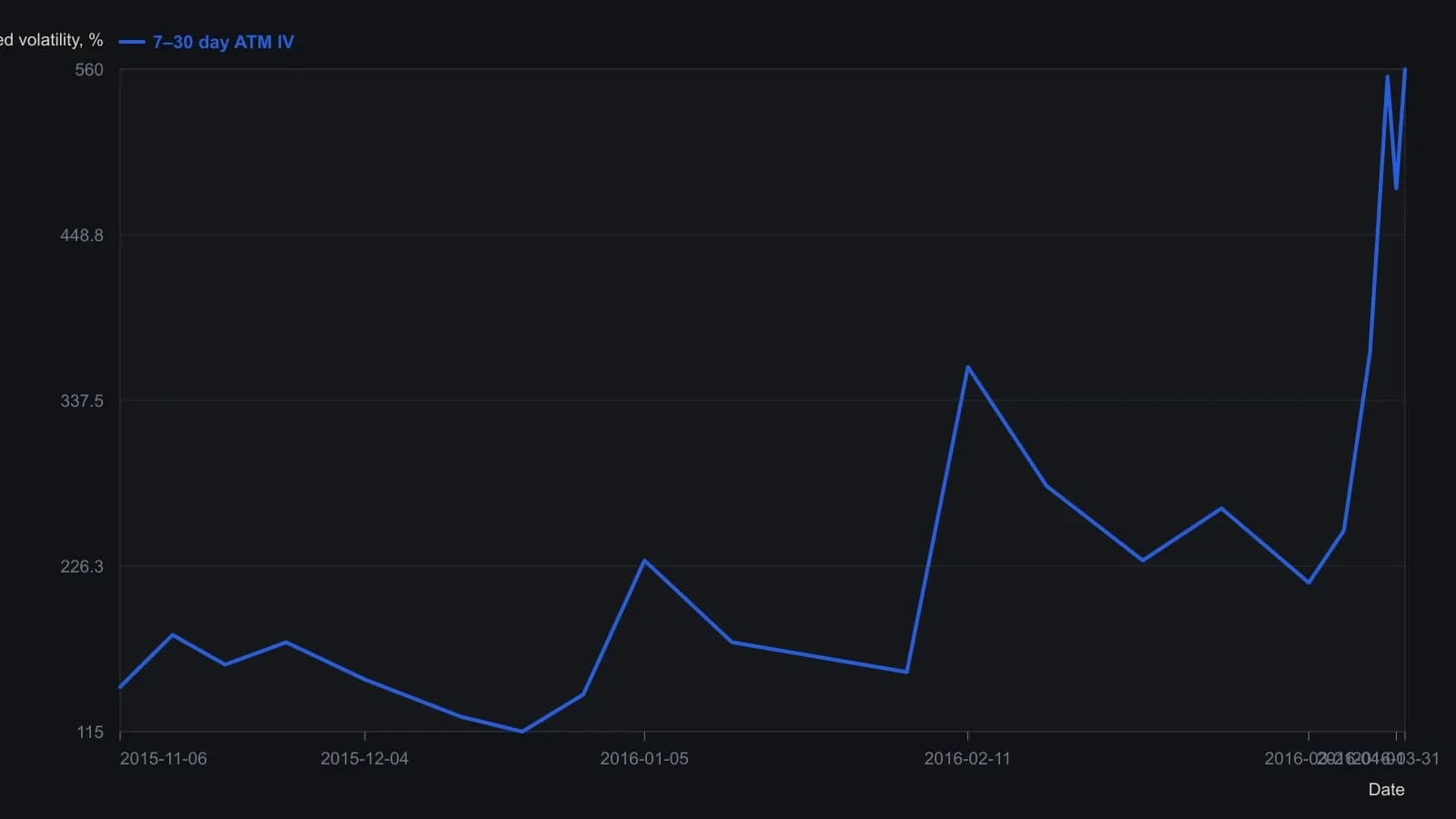
Digitized from the raster. After the last labeled tick (21 March 2016) dates are placed from axis spacing; the final session is 1 April 2016, matching the chart header (earnings in 12 days, 13 April 2016 estimate) and 49 days to the 20 May 2016 expiry on the companion chain. Implied-volatility levels rounded to the nearest 5 points.
Risk after the window
The same short-put construction was characterized as still risky because the loss profile can outweigh the premium collected. After that mid-April window, the issuer entered bankruptcy on April 21, 2016.
An editorial classroom reading
TradersWeek's editorial reading treats this distressed, sub-dollar equity as a classroom for implied-volatility extremes. The same solvency fear that makes outright share ownership unattractive can inflate put prices.
On that editorial view, a cash-secured short put becomes a way to place a funded, strike-defined bid against a possible binary failure rather than a way around that failure.
All readings on this track · 15 readings
- 1989Cash-secured puts and spreads versus buy-write overlays
- 1990Covered-call overlays fail a flexibility test until restated as puts and spreads
- 2005Covered-call supply, cash-secured puts, and conversion fair value
- 2007Covered calls and cash-secured puts as one income regime
- 2007Cash-secured puts, assignment risk, and post-entry overlays
- 2012Accumulation risk: protective puts, cash-secured puts, and spreads
- 2016Cash-secured put income, assignment, and reward-to-risk
- 2016Cash-secured puts under extreme implied volatility
- 2016A gold ETF range regime as a short-call ceiling, put floor, and short strangle
- 2017Weekly cash-secured puts filtered by intraday stochastic bands
- 2018Far out-of-the-money cash-secured puts as income and entry
- 2018Weekly equal-weight downtrend as a shared gate for VIX premium and put collateral
- 2019Bounding naked premium after a volatility spike
- 2020Cash-secured puts in a 2020 implied-volatility spike
- 2020Cash-secured put as a crash-regime overlay