2017issue C1048
Call-ratio overlay versus averaging down on a losing stock
A classroom case contrasts averaging down a 100-share long marked from 20 to 13 with a same-expiry call-ratio overlay that rewrites recovery strikes while the extra short calls stay covered by the shares.
- A 100-share long opened at 20 and later marked at 13 is down 7 per share, or about 700 on that lot, which is the classroom starting point for both repairs.
- Dollar-cost-averaging by adding a second 100-share lot at 13 requires 1300 more cash, blends the stock cost to 16.50, and makes each further one-point decline lose 200 rather than 100.
- The illustrated stock-repair-overlay is a same-expiration call-ratio-spread that buys one lower-strike call and sells two higher-strike calls, usually aimed at little or no net cash outlay.
- On the original shares the extra short calls are treated as covered-call-writing, the package is described as a covered call plus a vertical call spread, and the overlay is presented as a way to lower the blended-breakeven without averaging-down cash.
Two classroom repairs
This archive case uses one underwater long-stock holding to contrast two repair procedures.
Editorial reading: the comparison is a classroom setup, not a ranking of which path a holder should take and not a claim about later results.
The marked-down lot
A 100-share long opened at 20 and later marked at 13 is down 7 per share, or about 700 on that lot.
Averaging down adds cash and share count
Dollar-cost-averaging here means buying more of an already-owned stock at a lower price to reduce the blended share cost, which also raises the dollars lost on each further decline.
Adding a second 100-share lot at 13 requires 1300 more cash and blends the stock cost to 16.50.
After that second lot, each further one-point decline loses 200 rather than 100 because the position is then 200 shares.
A same-expiry call-ratio overlay
The illustrated options repair is a same-expiration call-ratio-spread: buy one lower-strike call and sell two higher-strike calls, structured for little or no extra cash.
A stock-repair-overlay of this kind is an options adjustment added to a losing long-stock holding after the trader still expects a rebound rather than an exit.
The overlay is presented as a way to lower the stock-position breakeven without the added cash outlay of averaging down.
The SNAP strikes and prices
The SNAP case uses January 2019 13-strike calls at 3.93 and January 2019 20-strike calls at 2.13, lining the long call up with the then-market price and the short calls with the original stock purchase.
Overlayed on the original long stock, the extra short calls are treated as covered, and the package is described as looking like a covered call plus a vertical call spread.
That pairing is covered-call-writing: owned shares stand behind the sold strike, and the repair package is treated as this pairing plus a vertical call spread.
SNAP January 2019 call quotes by strike
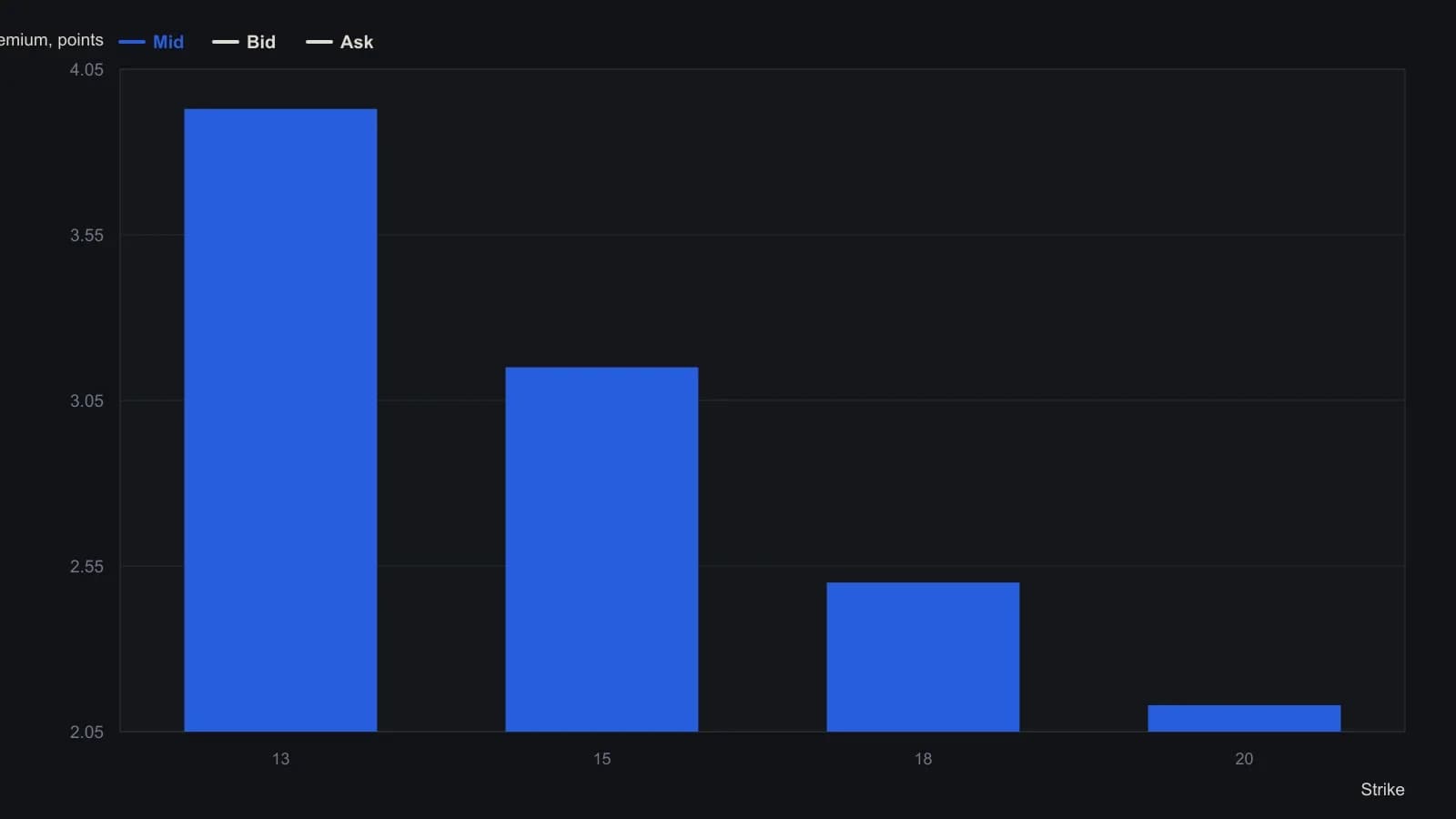
Chain is the 18 January 2019 SNAP calls with the stock last at 12.78. The table marks the overlay as +1 of the 13-strike and −2 of the 20-strike.
What blended-breakeven means here
Blended-breakeven is the recovery price at which the enlarged or overlaid position offsets the original stock loss.
Averaging down moves the blended share cost to 16.50 after the extra cash is spent. The overlay is presented as a way to lower the stock-position breakeven without that added cash outlay.
All readings on this track · 11 readings
- 1989Testing dollar-cost and scale-in averaging as position-sizing procedures
- 1994Quality screens and dividend-yield regime maps
- 1998Cash recovery grids for residual share construction
- 2001Building custom stock baskets with weights and averaging
- 2012Evaluating dollar-cost averaging as an entry-slot procedure
- 2013Treat a short-term valuation oscillator as an entry-timing filter
- 2014Equal-dollar staging versus lump-sum and residual scaling
- 2015A fund pick is unfinished until cost-drag and the mix are tested
- 2016Broad index allocation, a cash reserve, and staged entries
- 2017Call-ratio overlay versus averaging down on a losing stock
- 2019Overfunding smaller index futures to set leverage