2007issue C071-3
When dollar rebounds meet carry and reserve outflows
In the first weeks of 2007 the dollar firmed toward 1.2850 versus the euro, then fell to a new record low above 1.36 by April. This archive article treats that bounce as a market-regime test that runs through policy-rate-spreads, yen-funded carry-trading, and official currency-translation.
- In late January 2007 the dollar firmed toward 1.2850 versus the euro, then fell to a new record low above 1.36 by April, even though near-term US labor and spending were still described as firm.
- Policy-rate-spreads among a 5.25% Federal Reserve, a 3.75% European Central Bank, and a 0.5% Bank of Japan priced both carry-trading income and the chance that a later US hike or a yen unwind would reprice the dollar.
- Official reserve-diversification was expected to treat dollar rallies as a chance to cut the dollar share of reserves, so currency-translation could place a medium-term ceiling on the rebound.
- Editorial reading: intermarket-analysis of the current-account deficit, yen-funded carry-trading, and cross pairs decides whether a single greenback position sat inside a durable book or a rally other markets were already set up to sell.
A rebound that still needed a market-regime check
In the first weeks of 2007 the dollar firmed toward 1.2850 versus the euro in late January, then fell to a new record low above 1.36 by April.
Near-term US labor and spending conditions were still described as firm, with the three-month payroll average remaining above 150,000 after a weak February reading rebounded in March.
Editorial reading: that sequence is a case study in market-regime, not a standalone dollar long. Intermarket-analysis asks whether the bounce sat inside a durable book or inside a rally that other markets were already set up to sell.
Policy-rate-spreads across three official rates
After holding the policy rate at 5.25% since mid-2006, the Federal Reserve's next move was finely balanced. First-half cut odds had been reduced to nearly zero, while a later-2007 hike remained a small possibility that would reprice the dollar sharply.
The European Central Bank had already raised its policy rate to 3.75% in March, with annual money growth still above 9.5% and markets pricing a move to at least 4.0% later in 2007.
In February the Bank of Japan raised its policy rate to 0.5% by an eight-to-one vote, the highest setting in more than ten years, even though 2006 core consumer prices rose only 0.1%.
Editorial reading: the policy-rate-spread priced both carry-trading income and the expected drift of the currency pair. The wide gap versus the yen left the dollar and the euro as destinations for Japan-funded flows. The narrower gap versus the euro, and the small chance of a later Federal Reserve hike, left the dollar's next move finely balanced.
Yen-funded carry-trading as a regime risk
By February the yen had reached its weakest level versus the dollar since late 2002 and its weakest level ever versus the euro, as carry flows left Japan for higher-yielding currencies including the dollar and the euro.
A reversal of those yen-funded carry positions was identified as a regime risk that would tend to weaken the dollar, even if some defensive buying appeared in US Treasuries.
Editorial reading: carry-trading made the interest differential a testable holding-period signal. The same books were also a market-regime risk, because a yen-funding reversal could place a single dollar long inside a rally that cross pairs were already set up to sell.
Dollar-yen cash rate across the 2002–2007 carry stretch
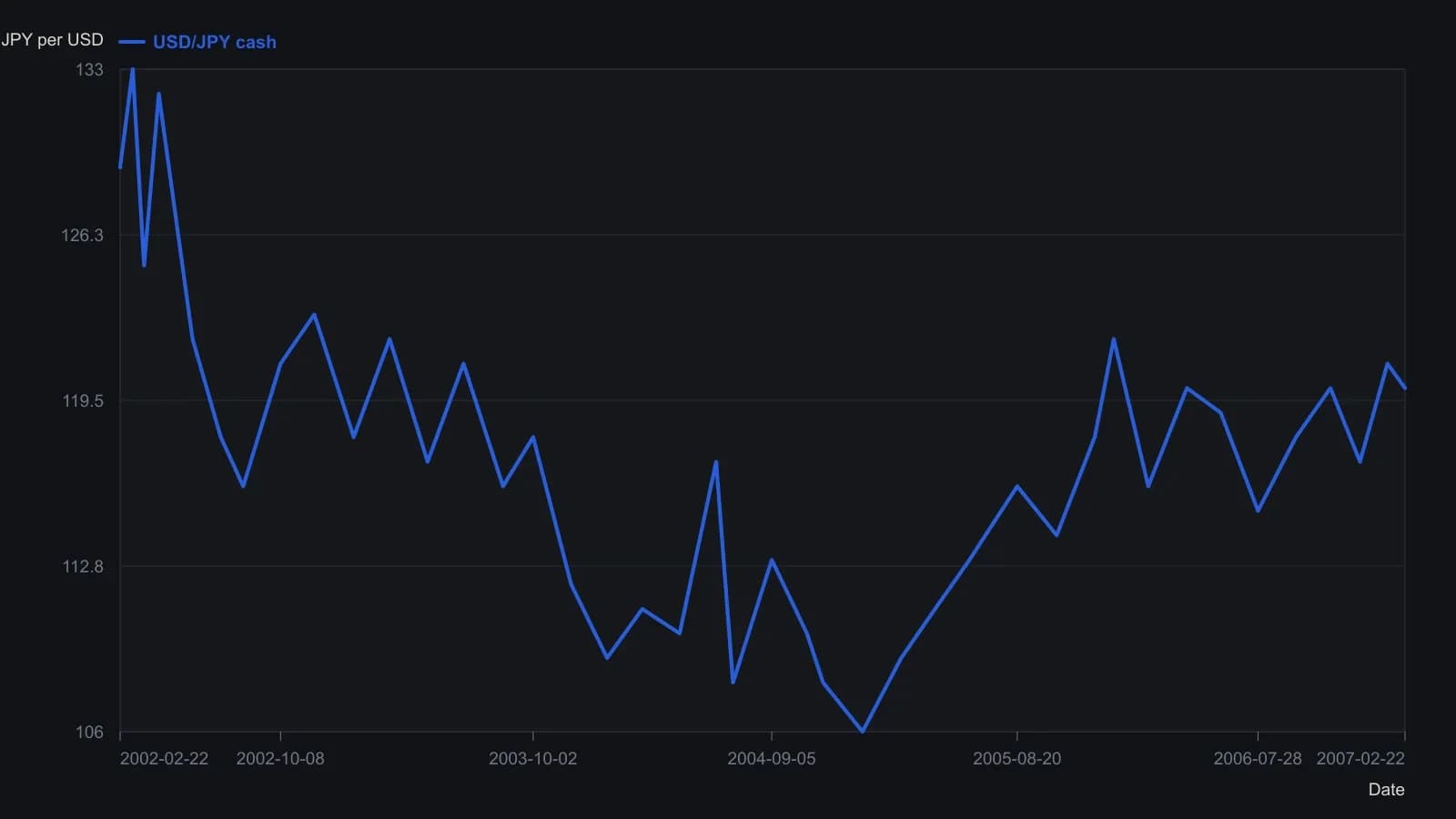
Approximate turning points from the VantagePoint print; the raster supports about one yen of resolution, not daily ticks. The published scale is labeled 105–135.
Currency-translation and reserve-diversification
The current-account deficit was still running above 6% of GDP, and the apparent first-quarter trade-gap stabilization was attributed mainly to lower energy prices rather than a structural rebalancing.
Official reserve managers were expected to treat dollar rallies as an opportunity to cut the dollar share of reserves, creating a medium-term ceiling on how far a rebound could extend.
Editorial reading: currency-translation reweights reserve or current-account exposure from one currency into another. Reserve-diversification into strength can cap a rally even when local labor and spending still look firm.
One dollar position inside the broader book
Editorial reading: the 2007 bounce is useful as a weeks-to-months market-regime check. Policy-rate-spreads, yen-funded carry-trading, and official currency-translation decide together whether a single greenback position is aligned with a diversified book or sitting in a rebound that other markets are already set up to sell.
Editorial reading: local US data can stay firm while those same links already treat the rebound as a reserve-diversification opportunity and as a vulnerability if yen-funded carry-trading reverses. The archive workflow keeps the dollar chart next to the policy-rate-spread, the yen crosses, the current-account gap, and the expected path of official reserve-diversification.