2006issue C041-3
Three-bank carry calendar when dollar spreads stop widening
Teach a 2005 to 2006 dollar-support question as a three-market carry calendar. Mark when each major policy path stops widening the yield gap, then ask whether the dollar is still a destination for translated capital or has flipped back into a funding currency.
- In 2005, US short-term policy rates rose at every scheduled committee meeting while the euro area recorded only one increase, widening the dollar's interest-rate-differential.
- A US short-term rate near 1.0% in 2004 had made the dollar a typical funding-currency for higher-yielding and commodity exposures; that role shifted toward the euro and especially the yen as US short rates rose.
- Short-term rates were treated as the main driver of near-term carry-trading, while longer-term yields were treated as more relevant to structural-investment-flow.
- Nominal US yields were still expected to stay above euro and yen yields, but the gaps were judged unlikely to widen further and more likely to narrow from late in the second quarter of 2006.
A calendar, not a single-currency forecast
The archive case is a workflow for judging dollar support after a long stretch of widening rate gaps. TradersWeek editorial reading: do not treat the episode as a standalone dollar forecast. Mark when each major policy path stops widening the interest-rate-differential, then ask whether currency-translation still sends capital toward the dollar or has started to treat the dollar as a funding-currency again.
Intermarket-analysis, in the terms used here, means reading that support through simultaneous policy and yield-curve conditions across the dollar, euro, and yen blocs, together with the commodity-linked exposures that carry-trading often financed.
How the dollar's advantage was built
During 2005, US short-term policy rates rose at every scheduled committee meeting. Over a comparable stretch the euro area recorded only one increase. That contrast widened the dollar's interest-rate-differential.
A US short-term rate near 1.0% in 2004 had made the dollar a typical funding-currency for higher-yielding and commodity exposures. As US short rates rose through 2005, that funding role shifted toward the euro and especially the yen. Carry-trading, in this usage, means using the low-yielding currency as the funding side of a higher-yielding or commodity-linked exposure, then changing that funding choice when short-rate gaps stop widening.
Three policy paths at a turning point
The US policy rate reached 4.25% in December 2005 from a 1.0% low in 2004. Further mechanical tightening was judged unlikely beyond the second quarter of 2006 if growth cooled. That judgment is a monetary-cycle-turning-point on the US side of the calendar: a shift from one-way tightening toward a peak or pause.
The euro-area policy rate rose by 0.25 percentage points to 2.25% in December 2005, the first increase in five years. A year-end 2006 level near 3.0% was described as realistic. Japan was described as ready to end an emergency quantitative-easing stance in the first half of 2006, possibly around April, while leaving administered rates low.
Taken together, the three paths no longer pointed to a still-widening dollar advantage. Nominal US yields were expected to stay above euro and yen yields, but the gaps were judged unlikely to widen further and more likely to narrow from late in the second quarter of 2006.
Short rates, long yields, and translation
Short-term rates were treated as the main driver of near-term capital flows and carry-trading. Longer-term yields were treated as more relevant to structural-investment-flow.
US 10-year yields peaked near 4.85% in June 2004 just before the tightening cycle. They later printed a peak just below 4.7% in early November 2005, then eased to just below 4.5% as two-year yields stood above 10-year yields. That configuration is the yield-curve-inversion noted in the case.
Currency-translation converts a still-positive nominal yield advantage into an expected capital-flow and exchange-rate effect once those cross-market gaps stabilize or narrow. TradersWeek editorial reading: the question after late in the second quarter of 2006 is not whether US yields remain higher, but whether the dollar is still a destination for translated capital or has flipped back into a funding-currency.
US Dollar Index continuous futures, 2004–2006
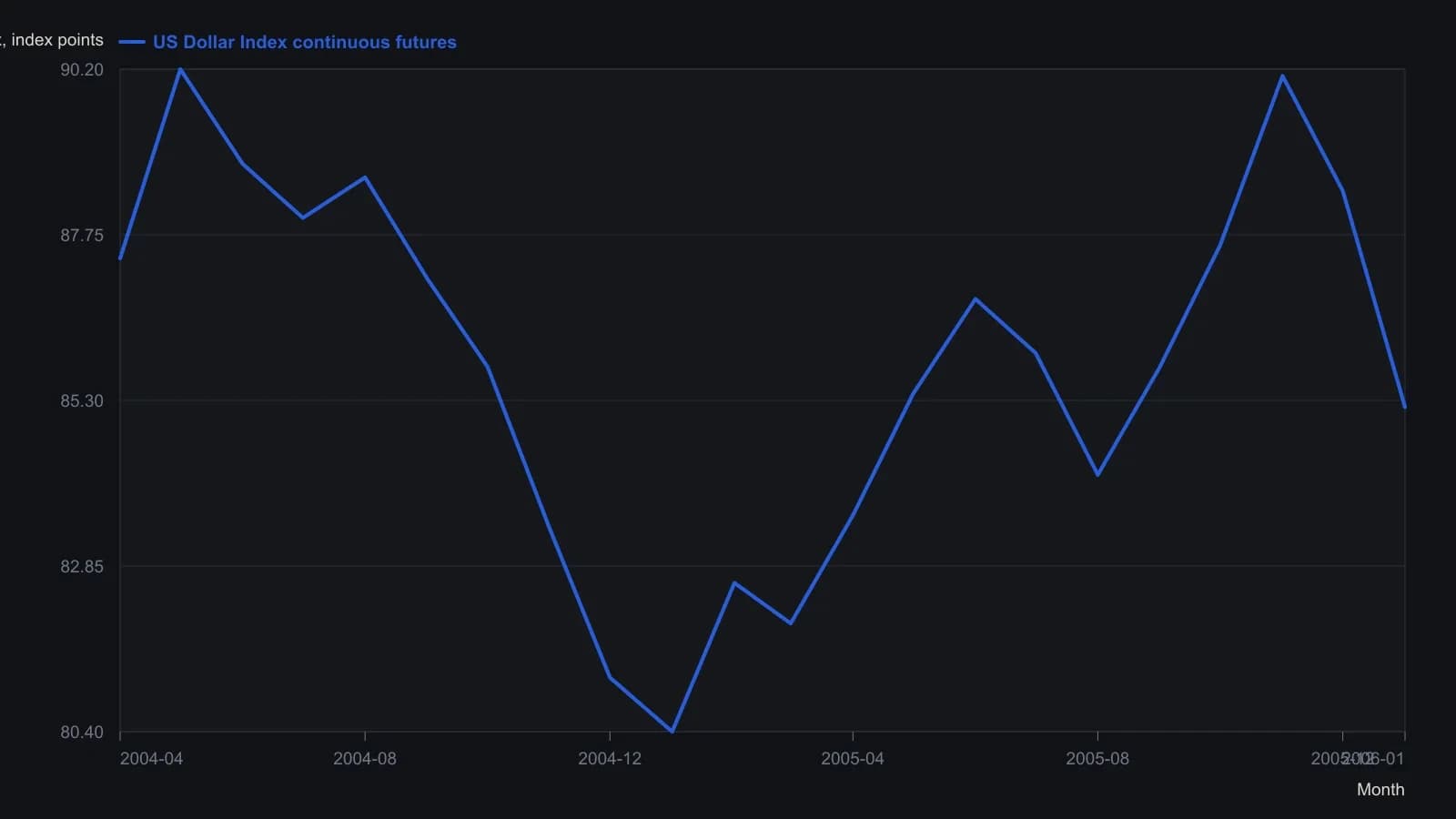
The raster has no numeric ticks on the plot itself; y-values are mapped to the article’s printed scale (about 79.8–90.4). Dates are inferred from the month axis in the source figure, so both axes are approximate.