2006issue C121-4
Selecting a currency pair by policy, carry, and oil translation
A long currency pair is a two-sided stance, so pair choice has to weigh both legs. This archive case ranks candidates by whether the two policy paths disagree, whether an interest-rate gap still has directional cover, and whether a commodity view can be expressed through a tightly linked exchange rate.
- A long pair is a purchase of the base currency and a sale of the counter currency, so both countries' economic and monetary conditions have to be weighed.
- A strong-weak-pairing, in which the two central banks are moving in opposite directions, is treated as a clearer study candidate than a strong-strong-pairing, in which both sides face similar tightening.
- A carry-trade collects an interest-rate-differential by selling a funding-currency, but it stays exposed if the high yielder depreciates and can reverse in a carry-unwind.
- A commodity view can be expressed through currency-translation when an exchange rate is tightly linked to that asset, as with oil and the Canadian dollar versus the US dollar.
Pair choice as a regime screen
A long position in a currency pair is simultaneously a purchase of the base currency and a sale of the counter currency. Selection therefore has to weigh the economic and monetary conditions of both countries rather than only one.
TradersWeek editorial reading treats pair choice as a three-layer intermarket-regime screen rather than a liquidity menu. Candidates are ranked first by whether the two central banks are moving in opposite directions, then by whether an interest-rate gap still has directional cover or is already unwinding, and finally by whether a commodity view can be expressed through a tightly linked exchange rate.
Policy direction first
In mid-2005 the Federal Reserve was raising policy rates toward a perceived neutral midpoint. Eurozone inflation sat at 2.5 percent, at or above a 2 percent ceiling, and the European Central Bank was preparing to tighten after a long hold at 2 percent. That produced a same-direction tightening backdrop for EUR/USD. Under the fixed vocabulary, that is a strong-strong-pairing: both currencies face similar tightening, so relative-value follow-through is expected to be smaller and more easily reversed.
In the same mid-2005 period the United Kingdom faced housing-market strain, inflation, and slowing growth, and the Bank of England signaled possible rate cuts. GBP/USD therefore paired a currency on an easing path with a dollar on a tightening path. That is a strong-weak-pairing: a two-sided stance that lines a tightening or improving backdrop against an easing or deteriorating one.
Over 28 June to 8 July 2005, GBP/USD kept declining through the final four daily sessions while EUR/USD rebounded. Sterling's decline of about 4.6 percent versus its own rate exceeded the euro's about 2 percent decline versus its own rate. TradersWeek editorial reading treats that split as the reason the pair whose policy paths disagree stays in the study set.
Carry cover, then unwind
A carry-trade sells a relatively low-yielding currency to fund a higher-yielding one in order to collect the interest-rate-differential. It is treated as a longer-horizon approach that remains exposed if the high-yielding currency depreciates.
Japan's interest rate was cited at 0.25 percent and Switzerland's main rate at 1.75 percent. Those currencies were treated as the main funding-currency legs against higher-yielding sterling, Australian dollar, and New Zealand dollar positions.
A weekly NZD/JPY uptrend into the end of 2005 reversed after discussion of ending Japan's zero-rate policy, prompting liquidation of leveraged long carry positions in that pair. Because those carry positions were typically highly leveraged, a small adverse move in the exchange rate could produce large losses if the exposure was not hedged.
In the TradersWeek reading, that reversal is the carry-unwind check. The second layer asks whether the interest-rate-differential still has directional cover, or whether the funding-currency outlook has tightened enough that leveraged long-high-yielder positions are being liquidated.
NZD/JPY weekly: carry-supported climb and 2006 unwind
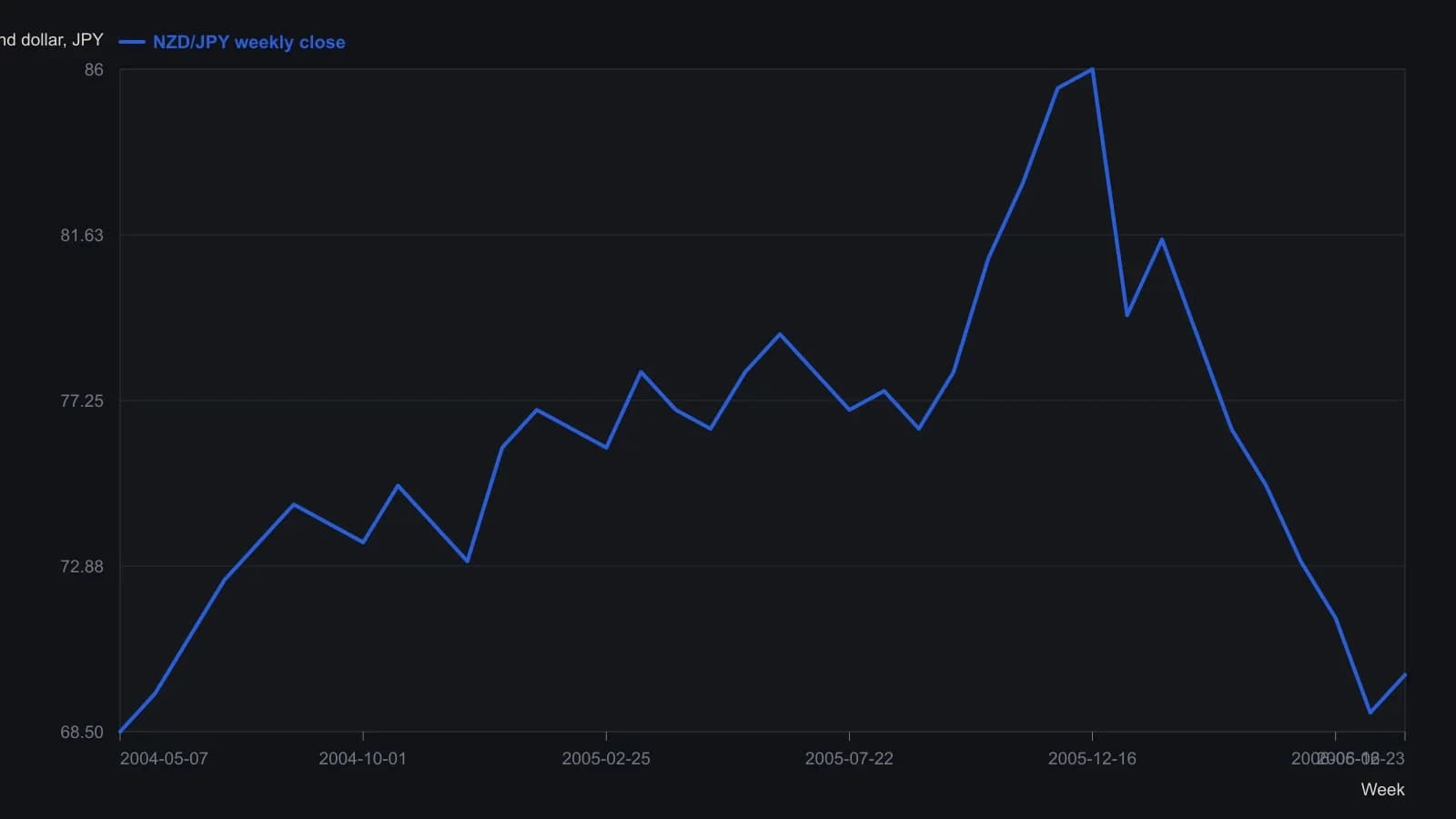
Weekly bars, about May 2004 through June 2006, read from a two-yen grid so levels are approximate to the nearest half yen. The article’s carry example is New Zealand 7.25% versus Japan 0.25%.
Oil expressed through the Canadian dollar
Canada was described as holding the second-largest crude-oil reserves globally, with the United States taking 85 percent of Canadian oil exports. A rising oil-price regime was mapped to a stronger Canadian dollar versus the US dollar.
USD/CAD's 2006 low had last been seen in 1978. The described mapping was that rising oil prices tended to coincide with a weaker USD/CAD while falling oil prices tended to coincide with a stronger USD/CAD. That mapping is currency-translation: expressing a view on a related asset, such as crude oil, through the exchange rate of a country whose economy is tightly linked to that asset.
Which pair belongs in the study set
The archive workflow ranks pairs inside an intermarket-regime rather than by liquidity alone. Policy disagreement distinguishes a strong-weak-pairing from a strong-strong-pairing. Carry then asks whether the interest-rate-differential still has cover or has entered a carry-unwind. Commodity linkage asks whether the same view can be expressed through currency-translation.
TradersWeek editorial conclusion: study the pair whose two legs disagree.