2014issue C0256-60
Walk-forward complexity in Donchian breakout systems
A Donchian breakout can be written as one entry-and-exit procedure and then extended with a volatility gate and an ATR multiple stop. The archive workflow judges those added factors by how results change from the fit sample to held-out data.
- A two-length Donchian breakout can be expressed as one procedure: enter on a longer-window high or low break and exit on a shorter-window opposite-channel stop.
- The same procedure can add an average-true-range volatility gate and an ATR multiple stop without changing the channel-break entry logic.
- A four-parameter version turns the volatility coefficient and stop multiple on; setting both to zero recovers the basic two-parameter system.
- Walk-forward analysis compares the simpler model with successively more factors by measuring how results change from the fit sample to held-out data.
One procedure for entry and exit
A two-length Donchian channel can be expressed as one procedure. The system enters on a longer-window high or low break and exits on a shorter-window opposite-channel stop.
Extra factors that leave the entry unchanged
The same procedure can be extended with an average-true-range volatility gate and an ATR multiple stop without changing the channel-break entry logic.
A four-parameter version is obtained from the two-parameter version by turning the volatility coefficient and stop multiple on. Setting both to zero recovers the basic system.
Fit sample versus held-out data
Walk-forward analysis compares a simpler model with successively more factors by measuring how results change from the fit sample to held-out data.
System optimization over the two channel lengths can be run as a grid of length pairs, then inspected on a later segment that was not used for the grid.
Out-of-sample Donchian stops on the Dow
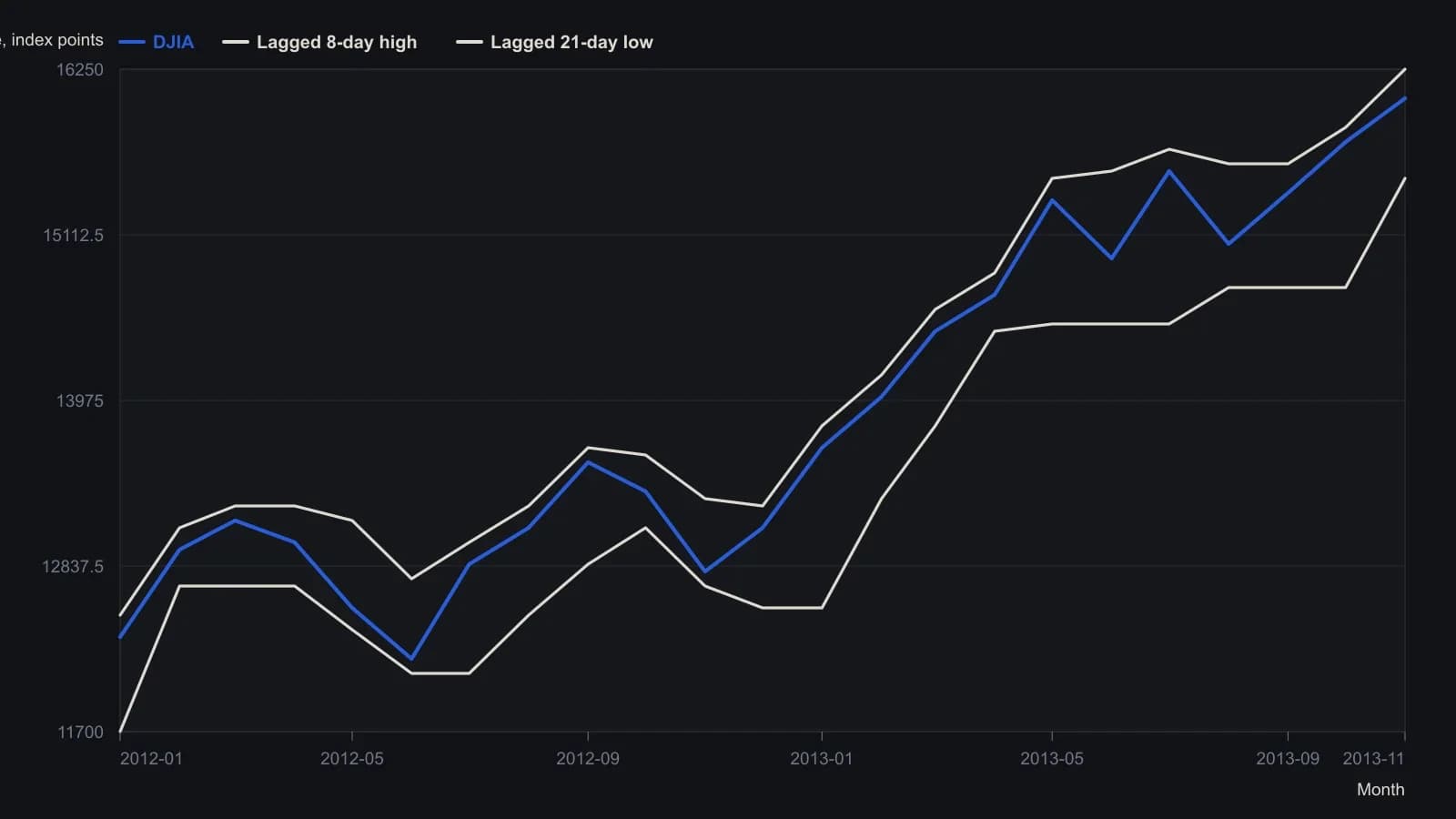
The chart legend uses optimized lengths of a lagged 8-day high and a lagged 21-day low, not the article’s default 40/15. The only printed time label is 2013; other months are spaced from that year marker across the daily window. Y readings are approximate to the nearest 50 points.
All readings on this track · 6 readings
- 1989Evaluating channel breakout with intraday and close-only stops
- 1990Delayed channel breakout stop construction
- 2000Fixed-horizon walk-forward tests of first-print breakouts
- 2013Z-score value filter on reversals and Donchian entries
- 2014Length fit versus later window for a two-length Donchian breakout
- 2014Walk-forward complexity in Donchian breakout systems