1990issue C091-4
Delayed channel breakout stop construction
This breakout system computes tomorrow's buy and sell levels from an older price channel, then flips with an intraday reversal stop one point beyond that envelope. Window width and lookback offset are separate construction choices, and the delayed stop can later migrate against the open trade.
- The delayed construction flips with an intraday reversal stop one point beyond an x-bar price channel whose newest bar is y bars earlier than the current bar.
- Unlike a simple Donchian breakout that reads the latest x bars, this breakout system first counts back y market days and then uses that older x-bar window.
- A short channel with a long lookback offset, for example six bars delayed by 40 bars, is presented as a way to keep initial dollar risk smaller than a simple 40-bar channel while still tracking longer trends.
- After entry, stop migration can move the live reversal stop against the position, so live risk can grow far beyond the risk measured at the fill.
A delayed price channel, not the latest bars
The delayed construction flips with an intraday stop one point beyond the high or low of an x-bar price channel whose newest bar is y bars earlier than the current bar. That lookback offset is the count of completed bars between today and the newest bar allowed inside the channel window.
Unlike a simple Donchian breakout that reads the latest x bars, this breakout system computes tomorrow's buy and sell levels from an older x-bar window reached by counting back y market days first. The reversal stop sits one increment beyond the opposite channel extreme and flips the position when touched.
Width sets the band, offset sets the horizon
A price channel is the high-low envelope of a chosen bar window, and it is the chart condition that defines the breakout or reversal level. In a simple Donchian breakout, buying above the window high and selling below the window low usually means using the most recent bars. Adding an offset changes which bars are allowed inside that envelope.
A short channel paired with a long offset, for example six bars delayed by 40 bars, is presented as a way to keep initial dollar risk smaller than a simple 40-bar channel while still tracking longer, well-defined trends.
Closer stops and choppy markets
Because the delayed stop sits closer than a wide undisplaced channel, choppy markets can generate more whipsaws than a looser simple channel would.
Stop migration on an open trade
After entry, the delayed price channel can migrate the reversal stop against the open position, so live risk can grow far beyond the risk measured at the fill. Stop migration includes cases where the delayed window walks the stop farther from the fill.
In the illustrated short, initial stop distance of 212 points later became 1021 points when a four-bar channel delayed 30 bars referenced a higher older high.
Historical search space
The historical search space used channel lengths of 4 to 14 bars and delays of 15 to 50 bars on continual futures data spanning five and a half years, with a 100-dollar commission-and-slippage charge.
Delayed channel breakout net profit by market
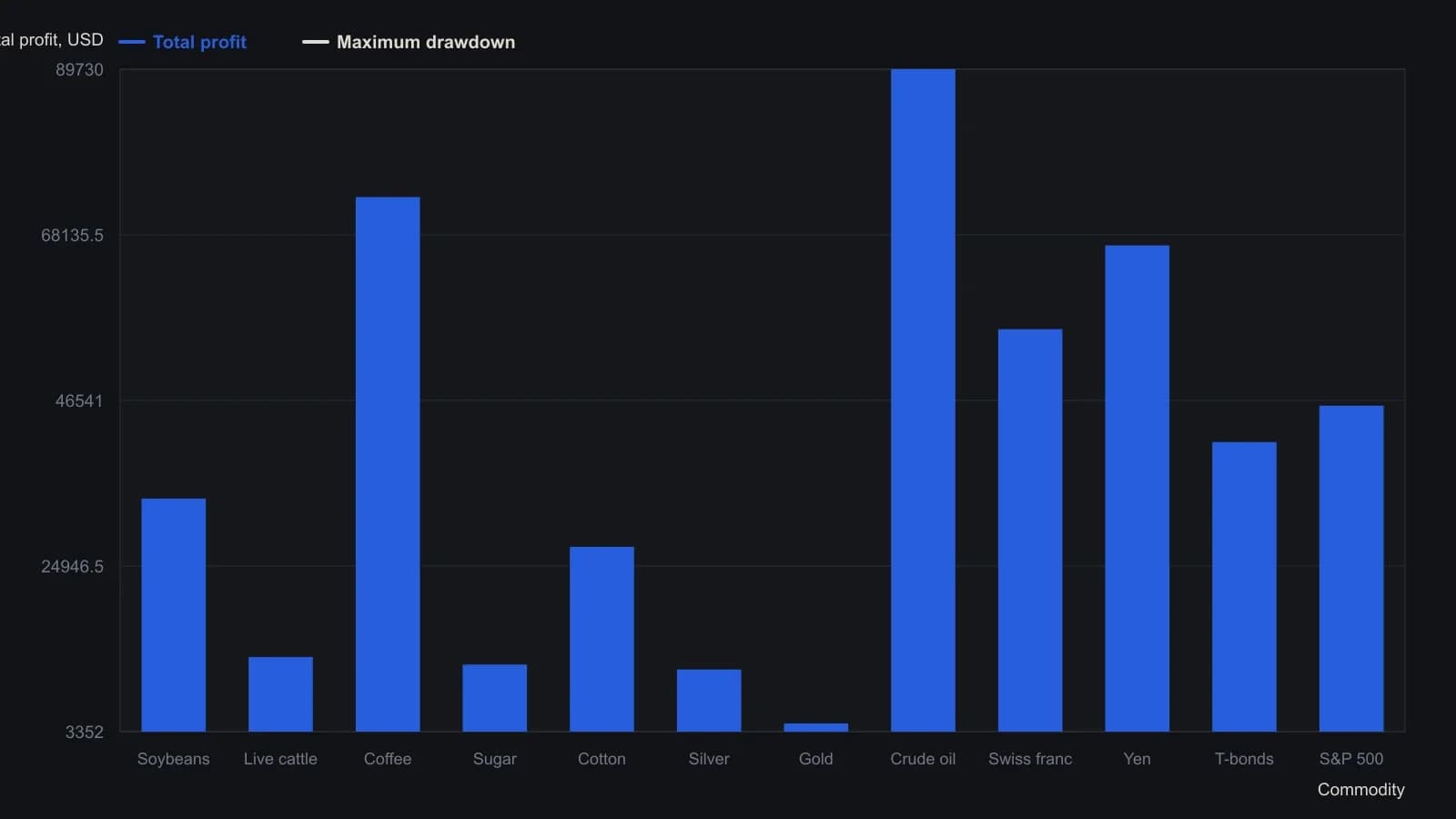
Search space was 4- to 14-day channels and 15- to 50-day delays on continual contracts in System Writer Plus. Each bar uses that market's winning pair, not one shared parameter set.
All readings on this track · 6 readings
- 1989Evaluating channel breakout with intraday and close-only stops
- 1990Delayed channel breakout stop construction
- 2000Fixed-horizon walk-forward tests of first-print breakouts
- 2013Z-score value filter on reversals and Donchian entries
- 2014Length fit versus later window for a two-length Donchian breakout
- 2014Walk-forward complexity in Donchian breakout systems