2004issue C121-3
Scale-in on a two-close reversal instead of using a price stop
A long-only two-close reversal entered after two down closes, added size on further down closes, and exited after two up closes, with price stops dropped in favor of smaller holdings. Editorial reading: the rule is a sizing lab for whether equal-size, barbell, or martingale adds stay inside a pre-set equity budget.
- A conventional price stop was framed as requiring the trader to be right about both the market's destination and the path it takes to get there.
- Loss size was treated as a function of position size, with the proposed control being much smaller holdings instead of a price stop.
- The long-only two-close reversal entered after a second down close, exited after a second up close, and added size on each extra down close before that exit.
- Equal-size fixed-contract adds were compared with heavier first and last entries and with martingale increases on later adds.
Price stops replaced by smaller size
A conventional price stop was framed as requiring the trader to be right about both the market's destination and the path it takes to get there.
Loss size was treated as a function of position size. The proposed control was to drop price stops in favor of much smaller holdings, so dollar loss was bounded by how large the position was rather than by a pre-set price exit.
The two-close reversal
The working long-only rule entered after a second consecutive down close and exited only after a second consecutive up close. Further size was added on each extra down close before that exit, as a scale-in rather than buying the full intended size at the first signal.
The procedure used only the prior two daily closes and no technical indicators.
Color streaks as context
Daily color streaks were described as roughly even over short runs, with longer up streaks appearing more often than longer down streaks.
Time spent above versus below a short average of the same index was used as a second check on an upward bias in longer runs.
DJIA red versus green streak counts by length since 1930
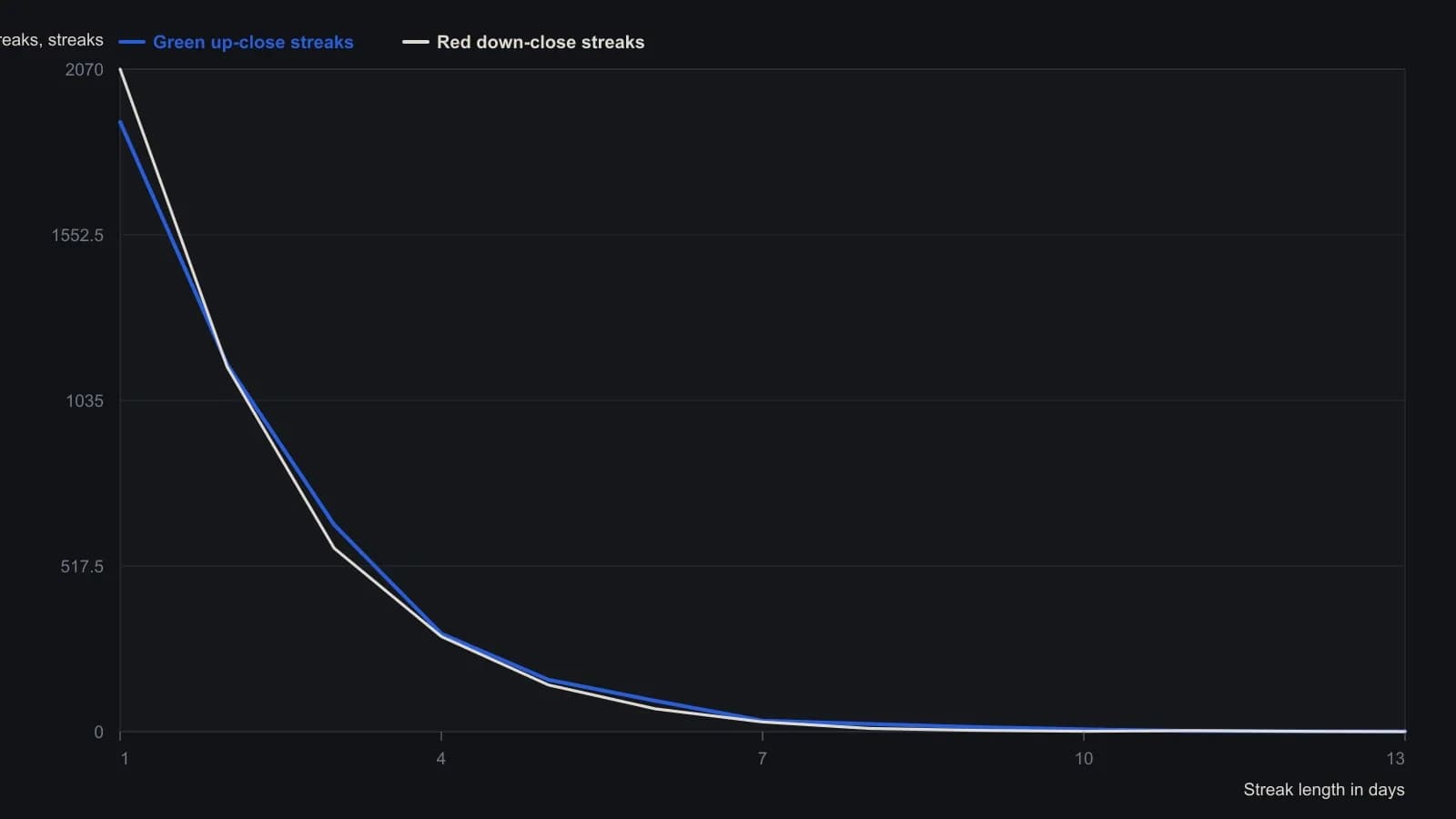
Figure 1 reports streaks of exact length, not cumulative 'at least N' totals. The printed continuation percentages under each count are omitted.
Three add schedules
An equal-size, fixed-contract add schedule was included so later slices did not automatically enlarge exposure.
Two other add schedules were compared with that equal-size case: heavier first and last entries, and a martingale-style increase on later entries.
Martingale-style adding was justified by arguing that listed equities do not share casino traits of total-loss outcomes, hard bet caps, and fixed payouts.
All readings on this track · 9 readings
- 1988Modified-martingale progression lists and ruin bounds
- 1989Scale-in-on-loss on a tempered-martingale-series with a fixed unit-factor
- 1989Shorter series need fewer recovery hits and raise scale-in cash
- 1990Recovery sizing as a series procedure
- 1990Reverse-martingale pyramiding after clustered wins
- 1993Test Martingale against fixed size before you pyramid
- 1998The runs-test as a contract-sizing gate
- 2004Scale-in on a two-close reversal instead of using a price stop
- 2012Four-level risk sizing when stock margin caps fixed fractions