1998issue C071-4
The triangle is a waiting room until a two-touch line breaks
The archive waits for two-touch boundaries and a decisive break before a triangle is treated as a directional hypothesis. TradersWeek editorial: the contraction is a waiting room, and the first return to the broken line is the exam that either confirms a support-resistance flip or cancels the idea.
- Editorial: a triangle is a waiting room, not a forecast. The directional idea starts only after a two-touch boundary breaks.
- Each triangle trendline needs at least two connected extremes before a breakout is considered, and extra unpenetrated touches raise that line's significance.
- In the archive case, a failed bounce back through broken support turned that line into resistance, which is the boundary-role-reversal exam.
- A symmetrical-triangle chart rarely indicates the break side, a sloping-side right-triangle exit is treated as weaker, and a quick recross of both boundaries is a false-breakout that keeps stops inside the method.
A contraction is not yet a trade
TradersWeek editorial: a triangle is better read as a waiting room than as a forecast. Price is only compressing. The directional idea starts later, when a completed boundary gives way.
The archive workflow is sequential. Each trendline needs at least two connected extremes before a breakout is considered. Extra unpenetrated touches raise that line's significance. Only a decisive move through a completed triangle boundary turns the contraction into a directional hypothesis.
Right triangles funnel into one flat side
A right-triangle contracts price into narrower swings against one horizontal boundary while the opposite boundary slopes toward that flat side.
An ascending-triangle uses a horizontal top and a rising sequence of lows. A descending-triangle uses a horizontal bottom and a falling sequence of highs.
Trendline validity comes before the break
Trendline-validity is a two-extreme rule. A boundary is drawn only after at least two extremes can be joined, and extra unpenetrated touches raise confidence in that line. A breakout is a decisive move through a completed triangle boundary, not a reading taken from a half-drawn side.
Smith International daily: coil under $49 and the May break
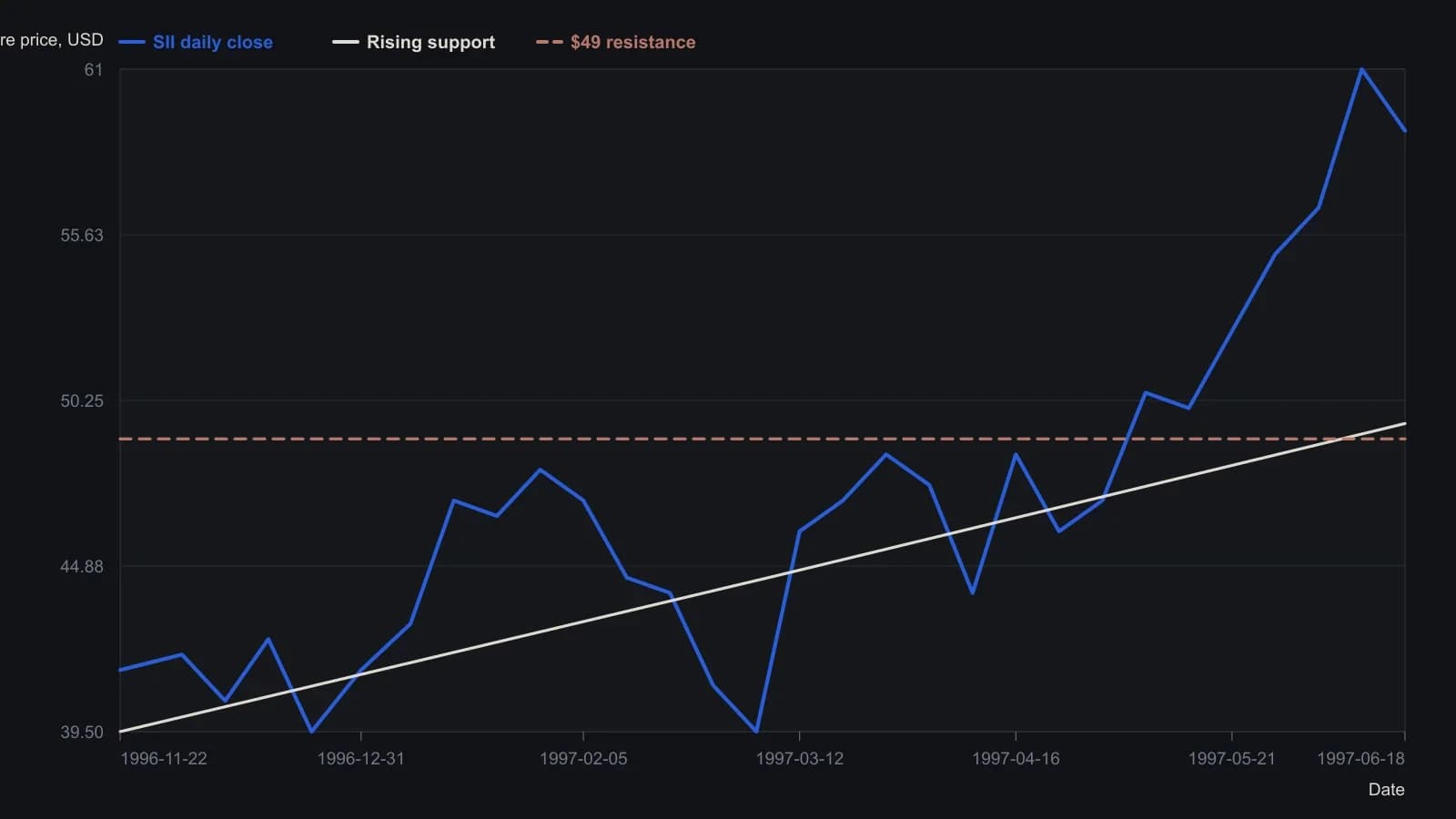
Daily closes are approximate to about half a dollar, the finest reading the raster’s $2 price ticks will support. The $49 ceiling is the level stated in the text; the rising support is the lower boundary drawn on the source chart, not a tabulated series.
One year, two right-triangle resolutions
In one 1997 case, an ascending-triangle resolved after repeated failures near 49 gave way in early May. Months later a descending-triangle resolved when 73 support failed in November.
After that November breakdown, a bounce to the broken horizontal line failed to recapture it. The former support was then treated as resistance. That is the archive form of boundary-role-reversal: after an exit, a later return to the same horizontal line may find former support acting as resistance.
TradersWeek editorial: that first return is the exam. If the broken line holds in its new role, the hypothesis stays open. If price recaptures the line, the idea is cancelled.
A sloping-side exit is the weaker event
A right-triangle exit through the sloping side rather than the horizontal side is treated as a weaker event. That path may stall near a prior reaction extreme.
A symmetrical triangle does not pick a side
A symmetrical-triangle is a contracting range bounded by descending highs and ascending lows. The two sloping sides need not be equal in length.
The symmetrical-triangle price chart itself rarely indicates which side will break. Related-group action plus money-flow and on-balance-volume comparisons are offered as secondary directional clues.
Chart scale sets the horizon
Weekly charts framed the multi-month symmetrical cases. Daily charts were reserved for shorter-horizon work. A longer construction period was associated with a longer ensuing move.
A failed exit puts stops inside the method
A completed symmetrical-triangle upside break can reverse quickly and recross both boundaries. That failed-exit case is a false-breakout: an exit that quickly fails and recrosses the pattern, invalidating the first directional reading. The archive uses that case to show why stops are treated as part of the method.
All readings on this track · 5 readings
- 1990Constructing continuation patterns from congestion geometry
- 1996Construct the coil first, then time the apex and the measured move
- 1998The triangle is a waiting room until a two-touch line breaks
- 2004Construct a mechanical rank for triangular formations
- 2004Compact structure as a two-step candlestick and triangle test