2004issue C041-4
Compact structure as a two-step candlestick and triangle test
Compact daily setups last only a few sessions and are drawn as high-low-close bars that omit the open. This article first names the candlestick range rule, then asks whether the same bars also form a three-session symmetrical triangle around a shared midpoint. That two-step test is an editorial frame.
- Compact daily setups last only a few sessions and are drawn as high-low-close bars that omit the open.
- Inside-day, outside-day, and narrow-range-4 are named from high and low conditions. Volume trend, bar-to-bar alignment, symmetry, and a required close are not identification rules for those setups.
- Shark-32 is a three-session symmetrical triangle: a wide first range, then successively lower highs and higher lows that stay centered on a shared midpoint.
- Editorial reading: name the range rule first, then let the next few bars confirm or drop both that rule and the triangle picture.
A short-horizon picture
Compact daily setups last only a few sessions. They are drawn as high-low-close bars that omit the open.
The candlestick range rules below sit on that short picture. A three-session symmetrical triangle sits on the same compact timescale. On the weekly scale, the outside idea appears as a weekly reversal.
Name the range rule first
An inside-day setup is a second session with a strictly lower high and a higher low than the prior session. It does not require a shared extreme, a specific open or close, or centering inside the first range.
A narrow-range-4 setup is identified when the last of four sessions has the smallest high-low span. Volume trend and bar-to-bar alignment are not identification rules.
An outside-day setup is identified solely by a second session that posts both a higher high and a lower low than the prior session. Identification does not add a symmetry, volume, or close requirement. On that wider session, a close within 25 percent of the session high or low was used as a directional cue for the following breakout.
A one-session downside reversal is a wide daily range that finishes near its high after a decline. Unusually heavy activity is treated as a confirming observation. A one-session upside reversal is a wide range that finishes near its low on heavy activity, often near a yearly high. These one-session reversals are also described as climax or key-reversal days. Any turn is treated as potentially brief rather than a change in the intermediate or longer trend.
A weekly reversal is identified on the weekly scale as an outside week. The second-week close finishes above the prior week for an upward test, or below it for a downward test.
Then ask if the same bars form a triangle
The shark-32 setup is a three-session symmetrical triangle. It starts with a wide first range, then posts successively lower highs and higher lows that stay centered on a shared midpoint.
Editorial reading: after the range rule is named, check whether those same few sessions also keep that centered triangle. If the later sessions do not post successively lower highs and higher lows around a shared midpoint, the triangle step fails even when a candlestick range rule still holds.
Let the next few bars test the picture
Editorial reading: the compact horizon is the point of the exercise. The hypothesis is only that the named range rule, and then the three-session triangle, still describe the next few bars. If those bars no longer match the definition, the picture has failed and the hypothesis is dropped. That is how a short-horizon chart condition becomes a falsifiable trade hypothesis.
Bull-market outcome rates for inside days and shark-32
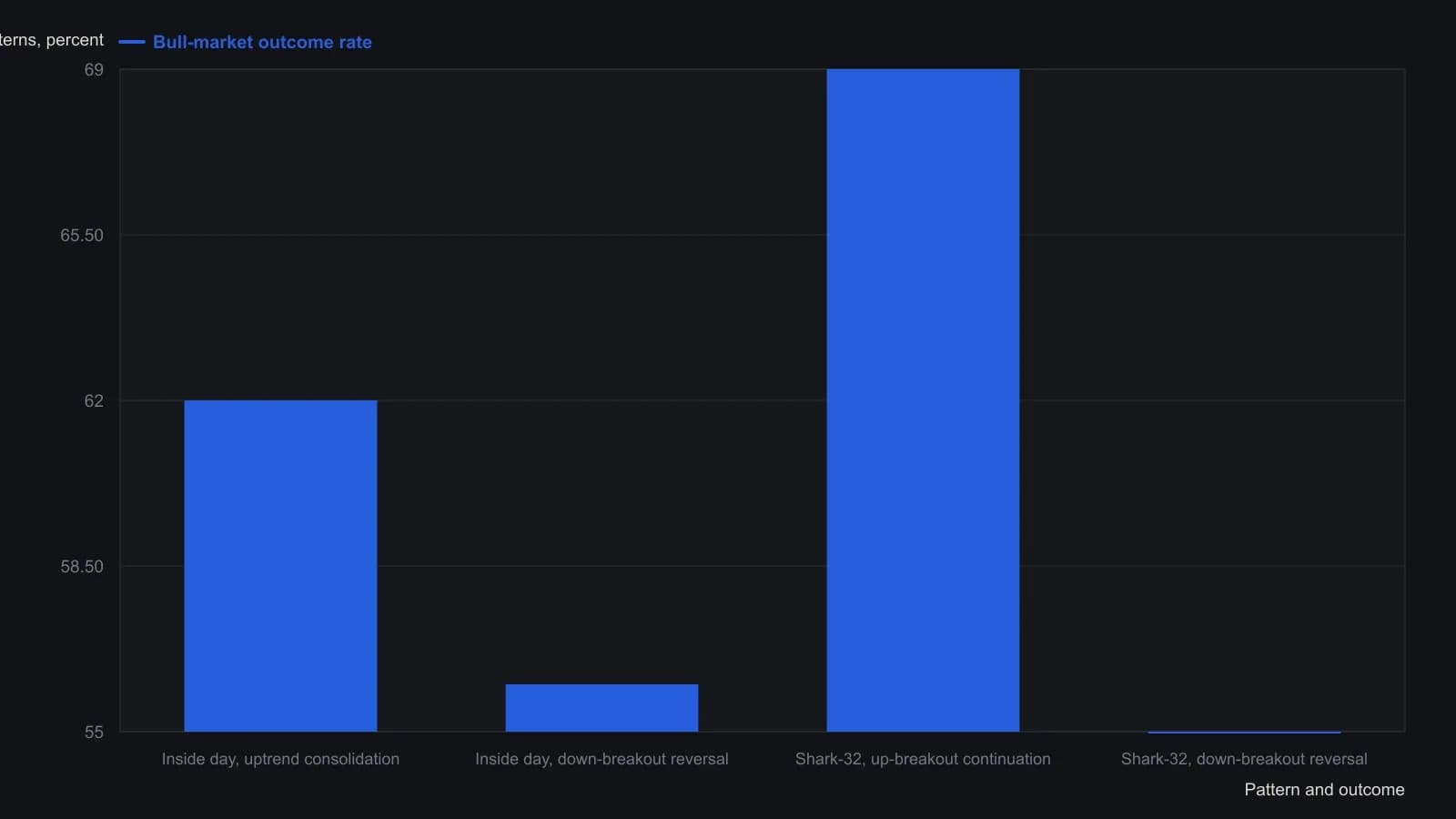
The author measured common stocks in a bull market only and did not test bear markets or inside weeks.
All readings on this track · 5 readings
- 1990Constructing continuation patterns from congestion geometry
- 1996Construct the coil first, then time the apex and the measured move
- 1998The triangle is a waiting room until a two-touch line breaks
- 2004Construct a mechanical rank for triangular formations
- 2004Compact structure as a two-step candlestick and triangle test