1996issue C101-6
Construct the coil first, then time the apex and the measured move
A symmetrical triangle is delimited only after four reversals form a contracting coil whose boundaries meet at a future apex. This article walks through that construction and, as an editorial reading, times the breakout by apex location and turns the same geometry into a measured-move hypothesis that is falsified if price never reaches the projection.
- A symmetrical triangle is delimited only after at least two minor highs and two minor lows create four reversals, a downsloping upper line, and an upsloping lower line that must meet at a future apex.
- Volume typically fades as the coil tightens and then rises sharply on an upside breakout, while stronger breaks tend to occur from one-half to three-quarters of the way to the apex.
- A measured move can be taken from the triangle height or from a line drawn at the opposite corner parallel to one boundary, but those constructions are guidelines rather than fixed rules.
- Most symmetrical triangles resume the prior trend as consolidations, yet they can reverse, so the construction still has to be watched through the breakout.
A coil is a construction, not a conclusion
Editorial reading: treat a symmetrical triangle as a construction job. First prove the coil is valid. Then time the breakout by where price sits relative to the apex. Then turn the same geometry into a measured-move hypothesis that is falsified if price never reaches the projection.
A symmetrical triangle is a contracting congestion pattern in which successive minor highs are lower and successive minor lows are higher, so a downsloping upper line and an upsloping lower line meet at an apex.
That form is the most common member of the triangle-pattern family, a group of contracting price structures distinguished from rectangles, wedges, flags, and pennants by how the two bounding lines slope and meet.
The same structure is a coil when it tightens as volume fades and then releases in a burst once price leaves a boundary.
Prove the coil with four reversals
A symmetrical triangle is delimited only after at least two minor highs and two minor lows. Those four reversals form the downsloping upper line and the upsloping lower line.
A minor high is a clearly defined peak where price rises, then withdraws, leaving a hill that can be connected to other highs. A minor low is a clearly defined trough where price declines, then lifts, leaving a valley that can be connected to other lows.
The two boundary lines must intersect at a future apex. Parallel lines describe a rectangle, two upsloping lines a rising wedge, and two downsloping lines a falling wedge.
Ben & Jerry's 1995 symmetrical triangle and upside breakout
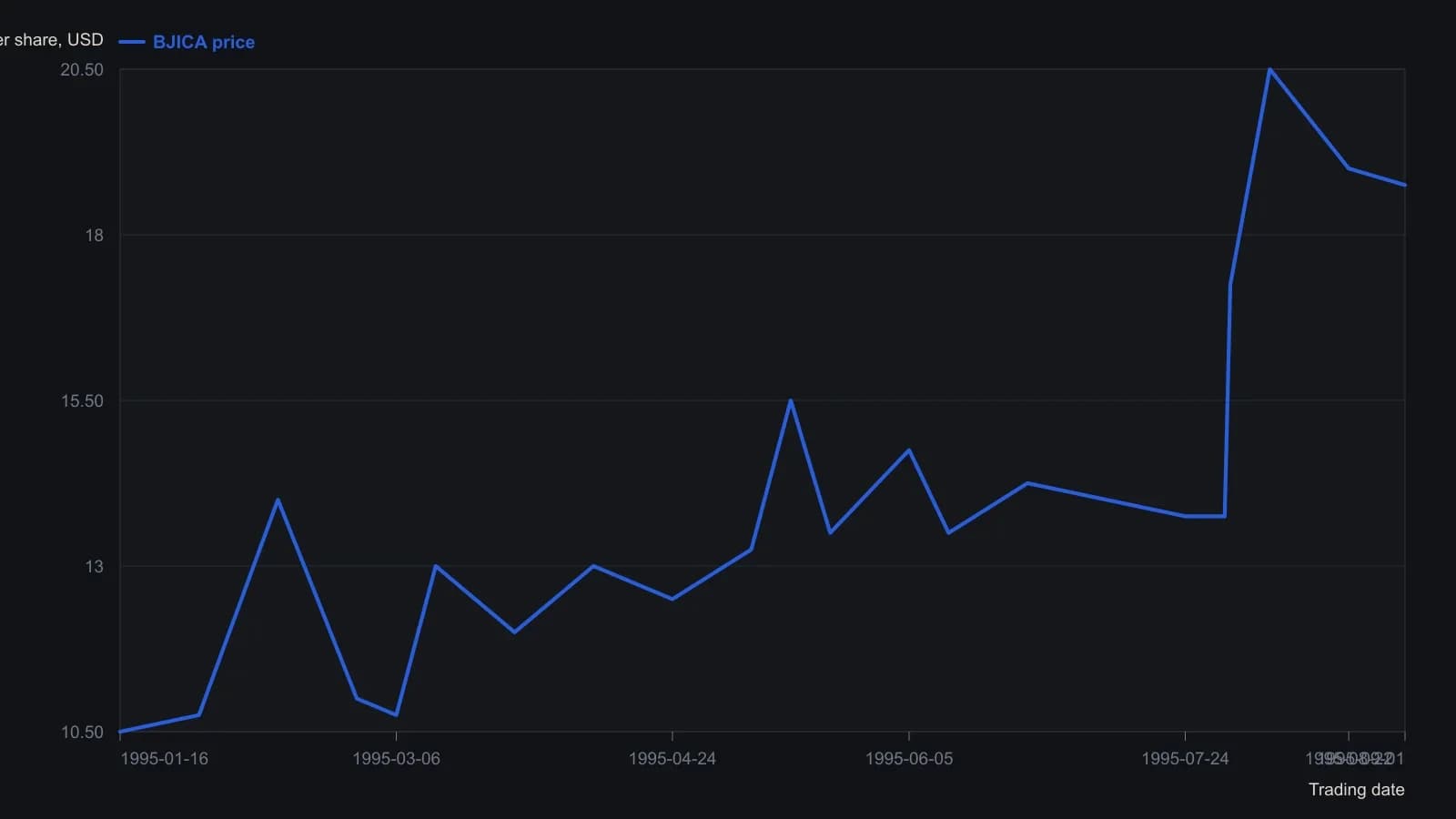
Raster prices are taken to the nearest quarter-dollar from monthly-labeled daily bars. Exact text prints: May high 15.50, retreats at 13.50, rebound 14.75, July 31 high/low 14 and 13.75, next day 17.25. Volume on those last two sessions was 10,500 then 300,000 shares.
Read volume as the coil tightens
Volume typically fades as the coil tightens, then rises sharply on an upside breakout. A downside breakout need not show a large volume increase at the first breach.
Time the breakout by the apex
The apex is the future intersection of the two sloping boundaries. Breakouts are typically judged stronger when they occur well before this point.
Stronger breakouts tend to occur from one-half to three-quarters of the way to the apex. Closer to the apex, the release is generally weaker, absent, or prone to failure on heavy volume.
Keep the formation on a time-sensitive chart
Daily charts are preferred for spotting the pattern. Weekly charts can show intermediate coils with the same construction rules. Monthly charts are seldom useful because the formation is time-sensitive.
Turn the same geometry into a measured move
A measured move is a geometric projection of the expected post-breakout path, used only as a timing and distance guideline. The estimate can be taken from the height of the triangle, or by drawing a line from the opposite corner parallel to one boundary so both the projected price and the approximate arrival time can be read off the chart.
Those measurement constructions are guidelines, not fixed rules. The height method is described as most applicable to consolidating triangles inside an extended advance.
Watch the breakout rather than assume continuation
Most symmetrical triangles act as consolidations that resume the prior trend, but they can also reverse. The construction still has to be watched through the breakout rather than assumed to continue.
All readings on this track · 5 readings
- 1990Constructing continuation patterns from congestion geometry
- 1996Construct the coil first, then time the apex and the measured move
- 1998The triangle is a waiting room until a two-touch line breaks
- 2004Construct a mechanical rank for triangular formations
- 2004Compact structure as a two-step candlestick and triangle test