2013issue C0918-27
Time-price boxes for wave-four construction
A weekly EUR/RON fourth wave was constructed as a time-price box that retraced 33.3% of the prior third wave to 4.0564, with duration set to 4.333 times a 28-bar second wave. Internal W-X-Y turns were then read against Gann, Fibonacci, and Dow-thirds ratios on that same scale.
- Editorial: lock the corrective box with a measured price retrace and a bar-count multiple of the prior correction, then test internal turns on the same Gann, Dow, or Fibonacci time ratios instead of labeling first.
- The weekly EUR/RON box retraced 33.3% of the third wave to 4.0564 and projected 121 corrective bars from a 28-bar second wave under a 4.333 Dow-thirds multiple.
- Lower-degree W-X-Y subdivisions on that 4.333 time scale terminated at 0.5, 1.0, 1.5, 2.25, 2.75, 3.0, 3.333, and 4.333, mapped to Gann, Fibonacci, or Dow ratios, sometimes with a plus-or-minus one-bar margin.
- Alternation is checked on price distance, bar duration, Fibonacci retracement severity, subdivision count, and mono versus polywave construction, with n less than 1 treated as rare.
Measure the fourth wave as a box
The archive records a weekly EUR/RON fourth wave constructed as a time-price-square. The swing was mapped as a box whose price height and bar-count width were measured together, so the later correction could be projected as a multiple of the earlier one.
The box retraced 33.3% of the prior third wave to 4.0564. Duration was set equal to n times the wave-two duration, with n equal to 4.333. Wave two lasted 28 weekly bars, which projected wave-four termination after 121 corrective bars.
Scale duration with the n-coefficient
The n-coefficient is the multiple that scales the bar duration of wave two to estimate the duration of wave four. Values of 1 and above are common. Values below 1 are described as rare. The 4.333 multiple is treated as one of the dow-thirds, the family of third-based ratios that also includes 0.333, 0.666, 1.333, 1.666, 2.333, 2.666, and so on.
Check alternation before the label stands
Elliott-wave construction of the two impulse corrections was checked on five parameters: price distance, bar duration, Fibonacci retracement severity, number of subdivisions, and mono versus polywave construction. The alternation-principle is the working rule that those two corrections differ on at least one of price, time, severity, intricacy, or construction. Typical alternation expects wave four to last longer than wave two, retrace less, contain more subdivisions, and show greater structural complexity.
Read internal turns on the same grid
On the 4.333-times-wave-two time scale, lower-degree W-X-Y subdivisions of the weekly EUR/RON wave four terminated at 0.5, 1.0, 1.5, 2.25, 2.75, 3.0, 3.333, and 4.333 multipliers. Those terminals were mapped to Gann, Fibonacci, or Dow ratios, sometimes with a plus-or-minus one-bar margin.
Keep the label incomplete until the checks are met
Wave labeling is presented as incomplete until origin, destination, most probable time-price terminal, sideways energy, trend kinetic energy, and classic versus extended, failure, or embryonic mode are checked.
Advance the next box when one is overcome
A live geometric construction uses confluence-boxes and 45-degree gann-angles drawn from the first swing. If a box or angle is overcome, the next one is drawn and monitored as the working confluence.
Weekly EUR/RON W(4) subwave durations
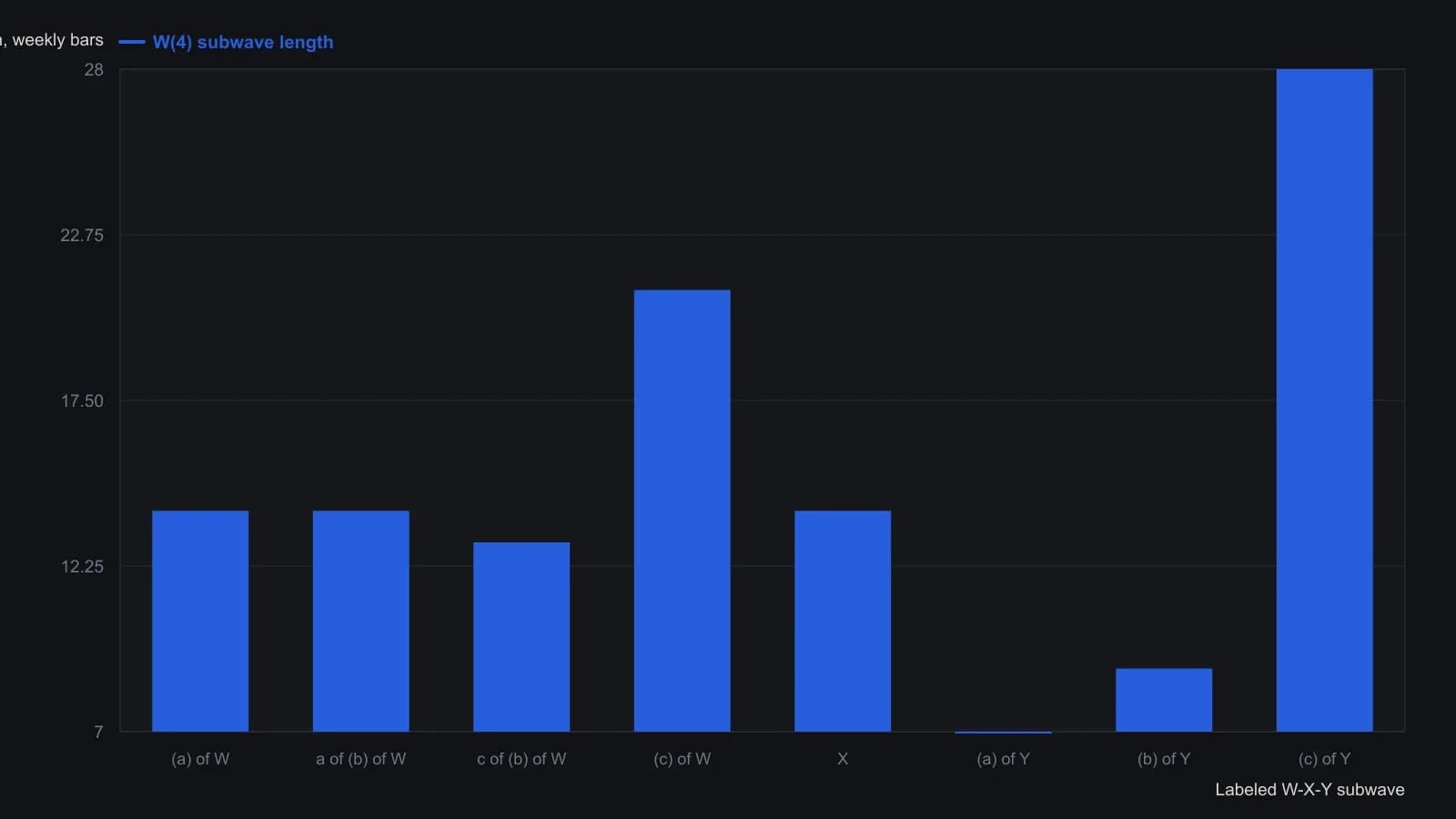
W(2) was counted as 28 weekly bars and n = 4.333 is a Charles Dow third, giving a 121-bar W(4). Subwave c of (b) of W is given as 13 bars at the 1.5 multiple, one bar short of 0.5 × 28. The listed legs sum to 120 bars versus that 121-bar total. A further 14-bar reading for b of (b) of W at the same 1.0 multiple as a of (b) of W is omitted because it does not add a new interval. Hindsight count on EUR/RON spot.
All readings on this track · 12 readings
- 1988Four sugar-futures turns as a ranked wave-ratio audit
- 1989Cluster-first construction of change-in-trend days from two ratio families
- 1992Wheat bull leg from a squared counterswing and Gann angles
- 1999Log-spiral wave construction from seed pivots
- 1999Compound pivots and market symmetry
- 1999Squaring charts for Gann angles
- 2007Constructing Gann time-price squares, angles, and 144 grids
- 2010Constructing Gann angles to square price and time
- 2011How a Lucas time series is built onto an Elliott wave map
- 2013Time-price boxes for wave-four construction
- 2016Gann circle eighths, Fibonacci neighbors, and time-price squares
- 2016Constructing wave cycles, Fibonacci spans, and time-price squares