2014issue C0540-47
A swing procedure with a checklist, layered stops, and an emotion handoff
The archive records a swing workflow that replaced ready-made indicators with a price-based bar, then used one pre-trade checklist, a layered stop that still executed if the terminal failed, and an emotion handoff that closed the live decision.
- Ready-made indicators were tested for durable long-horizon results and were not found to supply them, so the workflow moved to smoothed inputs and then to a price-based bar.
- One pre-trade checklist, kept to a short instrument list, could accept a long, arm a drawn level, or stand aside around high-impact currency news.
- A layered stop placed a wide emergency exit and target at the broker and kept a tighter technical stop local, then raised the venue stop to breakeven.
- Once stops and targets were set, the emotion handoff closed the decision so the live screen was no longer used as an emotional decision surface.
What the archive recorded
The archive records a swing workflow that left ready-made indicators behind and then specified the bar type, the pre-trade checklist, the stops, and the rule for leaving a live decision alone.
The same pre-entry template served an equity-index future and currency pairs. The working set stayed short so follow-up did not produce missed or mistaken actions unless part of the process was automated.
From ready-made indicators to a price-based bar
Ready-made indicators, used alone or together, were tested for durable long-horizon results and were not found to supply them. Later work replaced raw closes with smoothed inputs and then with a price-based bar, which completes only after price travels a stated distance so clock time does not dictate bar length.
Clock-timed bars mixed long quiet stretches with sudden large moves, which made trendlines hard to place and left a stochastic RSI late or twitchy. Range bars, which complete only after a set price travel, were treated as giving those same tools a smoother structure.
A modified brick chart aligned with execution
Plain brick charts omit wicks and fill gaps with synthetic bricks, so a later fill is not at the price a tester might assume. A modified brick chart that keeps real open and close prices, and optional wicks, was used so those prices stayed aligned with execution when the session notation contains gaps.
Candlestick patterns and several classical price patterns were dropped from the pre-trade checklist as not applicable on that bar type.
The pre-trade checklist
One pre-entry template served the equity-index future and the currency pairs. It used directional bar colors, an outer volatility band and a faster inner band, 50-, 100- and 200-period averages as active support and resistance, and a fast and slow stochastic RSI.
A long was accepted only when the bar closed above the 50-period average of the lows. A news calendar was used to stand aside around high-impact currency events.
The working set was kept to a short list of instruments because a longer list made follow-up harder and raised missed or mistaken actions unless part of the process was automated. Drawn support, resistance and trendlines could be armed as stop or limit signals, and the first compatible signal was allowed to act.
Trend-aligned swings
A larger trend was treated as a run of swings whose pullbacks usually stayed inside half of the prior swing. The next upswing was a trend-aligned swing: a shorter impulse taken only in the direction of the larger trend, entered on a break of the previous swing high.
A trend change was assumed only after a deeper pullback failed to make a new high and then broke the prior swing low. One stochastic RSI supplied overbought and oversold context, with regular divergence treated as reversal evidence and hidden divergence as continuation evidence.
Layered stops after the fill
On a daily swing horizon, stop distance was described as about 10 percent of price, versus about 25 percent for a hold-through approach, and was allowed to vary from 5 to 15 percent with the instrument's volatility.
After a fill, a layered stop was used. A wider emergency stop and a wider target were placed at the broker so they would still execute if the local machine or connection failed. A tighter technical stop and target stayed on the local strategy and were not shown to the market. The venue stop was moved to breakeven once that price was reached, and a manual stop and target could be adjusted at any time.
The emotion handoff
Opening a trade was treated as low-friction when entry rules were explicit or the system was fully automatic. Doubt about holding or exiting was handled by checking nearby support and the remaining loss, then setting stops and targets or acting at once.
After those levels were set, the emotion handoff applied: the operator stopped using the live screen as a fresh decision surface. Open profit was often taken at a nearby resistance with a planned re-entry after a small reaction large enough to cover the round-trip cost.
S&P 500 daily swings into the 261.8 percent projection
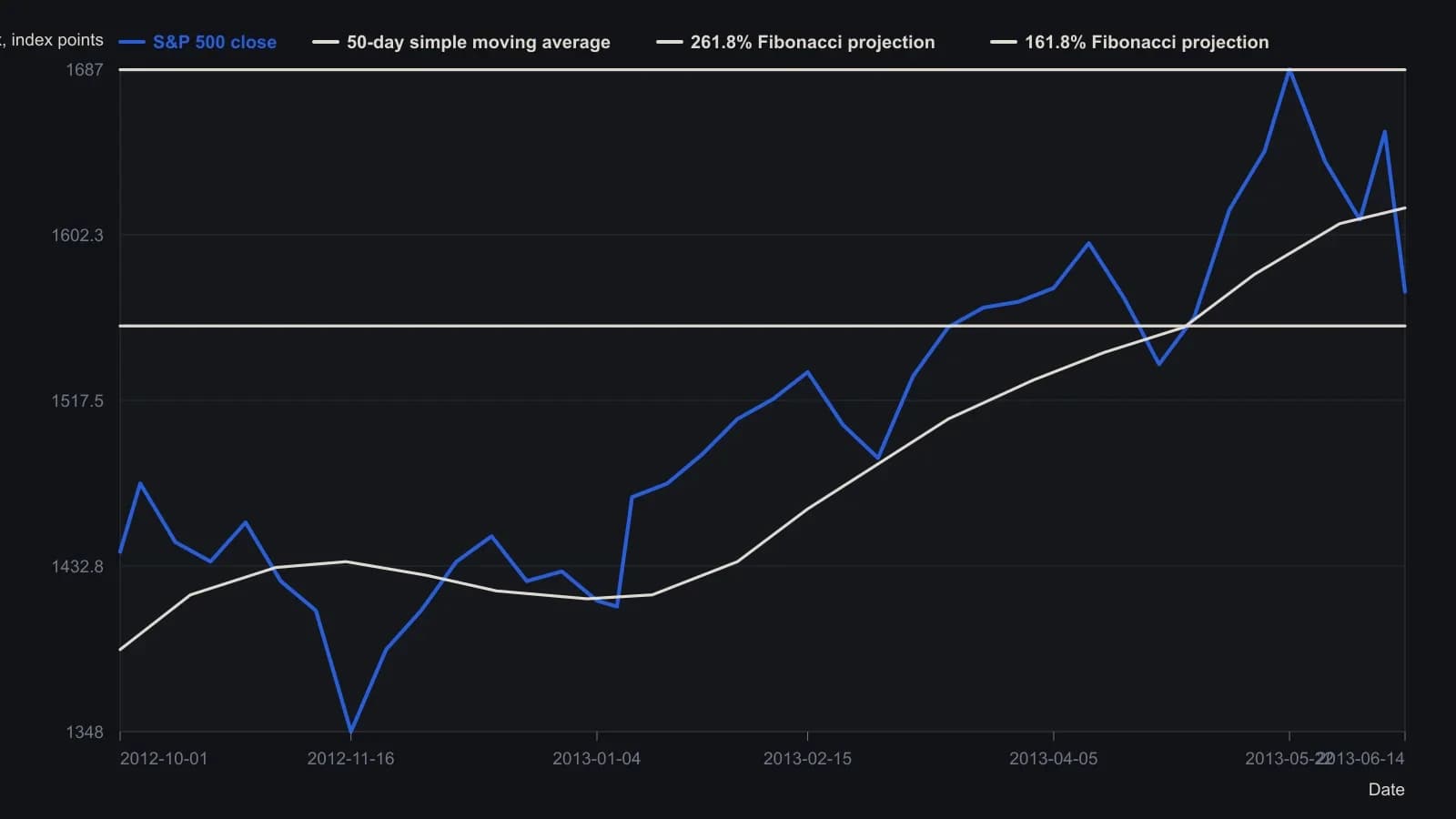
Closes and the 50-day average are approximate reads from the raster. Fibonacci percentages and the last print are the exact labels on the source chart.
All readings on this track · 135 readings
- 1987Pair each checklist step with its decision state
- 1987Position secrecy as decision-process control
- 1987When profits break the trading process
- 1988Treat action-seeking as a veto before any signal
- 1988Entry, exit, and abstention as one practiced procedure
- 1988Making inner conflict a testable trading rule
- 1988The chart is only half the trading procedure
- 1988Negotiate conflicting parts before the signal
- 1989Commitment turns trading rules into one procedure
- 1989Confidence, discipline and the fit of a trading procedure
- 1990Encoding expert hunches into a mechanical trading loop
- 1991The consecutive-loss halt as the trading system
- 1991A fuzzy membership checklist for trade signals
- 1991Overconfidence as a skipped pre-trade checklist
- 1991A source-reliability audit for trade signals
- 1991Shared rules fail without an execution checklist
- 1991The daily study block as a low-risk checklist
- 1992A bear-market loss review that rewrites the pre-trade checklist
- 1993Unspoken beliefs that veto system rules
- 1993Why a mechanical system beats betting harder when the story looks cheaper
- 1993A usable process over a perfect trader standard
- 1993Remold the decision-map after a traumatic trade
- 1994Keep entry, exit and sit-out as one procedure
- 1994Pre-trade gates for belief and state
- 1994Known failure points inside the yen triangle phase checklist
- 1994When a comfort ceiling, not market state, is the failure mode
- 1994Trading commitment as a balanced decision process
- 1994Constructing a pre-trade discipline checklist
- 1995Futures systems start with whether to trade
- 1995Stopping points as checklist and stop failures
- 1995When analysis and execution must become one procedure
- 1995A decision-process database from analyst to trader
- 1995Decisive execution as one tested procedure
- 1996The unfinished-system trap in simple decision rules
- 1996When risk breaks practiced system execution
- 1996Treat the mechanical signal as a draft, not a decision
- 1996Critique of decision states that break system rules
- 1996State-gate checklist for trading decisions
- 1996Personality-fit rules before earned intuition
- 1996The commitment gap as a testable decision process
- 1996Test decision style as one trading procedure
- 1997Mechanical trading before subjective judgment
- 1997Belief checklists that invalidate mechanical systems
- 1998Mechanical rules against mindtraps
- 1999The profit target as a trading discipline lens
- 1999When mechanical rules replace judgment in the trade process
- 1999Trading discipline as one testable procedure
- 1999Daily pre-open map as one procedure
- 2000Session veto from daily readiness
- 2000Anger buildup as an untested system input
- 2000Construct separate research and live-trade question checklists
- 2000Operator-state as a first-class trading rule
- 2001Day-trading rules need a pre-trade decision process
- 2001Review the operator before you rewrite the plan
- 2001Critique of the informal trading pause
- 2001Specificity turns wishes into checkable trading rules
- 2002The pre-entry plan that locks exits and size
- 2002Risk identity as a pre-trade system gate
- 2002When elapsed time rewrites trade rules
- 2002One written system, faster exits, and the belief gate
- 2003Countable decision trees for entry and abstention
- 2003Constructing a pre-trade stop and review procedure
- 2004Psychological wounds that override a tested system
- 2004A hot streak does not retire the trading checklist
- 2005Why mechanical trade plans fail without execution discipline
- 2005Resentment as a construction input for trade decisions
- 2005A daytrade as one written procedure
- 2006Write the pre-trade plan as one procedure before entry
- 2006When a winning streak makes the trade checklist optional
- 2007An entry needs a pre-trade risk bound and a post-trade debrief
- 2007A pre-session futures plan that locks entries, exits, and stops
- 2007Maxims fail without one testable procedure
- 2007Personality-fit and holding horizon before the pre-trade checklist
- 2008Push-button systems versus a testable decision process
- 2008Written rules omit the operator and the implicit filters
- 2008A Pre-trade checklist before emotion takes over
- 2008System design between the mechanical black box and checklist judgment
- 2008Trade history as a checklist for entry, exit, and abstention
- 2008Mechanical rules without a decision process
- 2008Parable checklists for entry, exit and abstention
- 2010Keep rule-based entries clear of news bias
- 2010Self-control zones before the pre-trade checklist
- 2010Treat the pair-desk day as one testable procedure
- 2010Use a five-factor checklist instead of pattern labels
- 2010Listed currency futures versus spot forex as a pre-trade venue checklist
- 2010Rule overload, unfinishable checklists, and tight stops
- 2010Pre-trade checklist versus automatic stops
- 2010Skipping signals after a losing streak is a new system
- 2010Stand aside until the relationship breaks
- 2010A software catalog fails the checklist without one testable procedure
- 2011Checklist rules versus unwritten indicator judgment
- 2011The handoff test for self-coached trading plans
- 2011Unify locate status, written rules, and self-talk on one checklist
- 2012A pocket card and a setup-chart as the session-plan
- 2012Close system construction with a review checklist
- 2012A pre-trade checklist versus in-trade emotion
- 2013The ten-question alignment gate when traders lose the path
- 2013A stuck-point audit for stalled trading decisions
- 2013Why rule-based entries need false-trigger checks
- 2013One procedure for liquidity rules and abstention
- 2013The month-open window is unfinished without cash default and a substitution checklist
- 2014Waiting fails when the pre-trade checklist is too wide
- 2014A swing procedure with a checklist, layered stops, and an emotion handoff
- 2014System design as a critique of forecast-worship
- 2014Consultant hiring as an accept-or-abstain checklist
- 2014One procedure for entry, exit and abstention
- 2014A trading system that cannot decide before the chart opens
- 2014The checklist veto when tools override the plan
- 2014Write the holding-period style before any daytrading rules
- 2015A pre-trade checklist when volatility turns rules into panic
- 2015A checklist, psychology gate, and moving-average procedure
- 2015Write forex entry and sit-out rules before you score the links
- 2015Daily if-then checklists versus year-ahead market forecasts
- 2015Workstation readiness in the pre-trade execution checklist
- 2015An unprepared trade fails the pre-trade checklist
- 2015Evaluate a system with one pre-trade checklist
- 2015The pre-trade checklist as one testable procedure
- 2015News-aware forex process with defined stops
- 2016Slow thinking over gut feel in complex markets
- 2016When a market-structure story rewrites a checklist yes
- 2017Constructing an options trading-plan from a self-inventory
- 2017A price-first checklist for noncooperative market games
- 2017A pre-trade risk checklist versus profit-first thinking
- 2018A forex onboarding ladder is not a decision process
- 2018Pre-trade regret scripts for entry and abstention
- 2018Audit the plan while the tape stays forgiving
- 2018Constructing a sortable pre-trade checklist
- 2018Forex myths that break a testable decision process
- 2018Why trading checklists must beat inherited confidence
- 2019Leverage as a pre-trade gate in mechanical systems
- 2019Critique of impulse trading as a testable system
- 2020One checklist for breakout entry, stops, and sitting out
- 2020A continuity checklist for a blank Sunday-night system desk
- 2020After an extended bar, the checklist must still be able to refuse
- 2020Write one procedure before outsourcing system decisions