2015issue C0735
Daily if-then checklists versus year-ahead market forecasts
Year-ahead forecasts gathered for the same period disagreed on direction and the size of expected total return. Editorial: audit those calls as language, write an if-then-statement for each defined scenario, and rehearse the pre-trade-checklist daily so open-position-bias cannot rewrite the book.
- A forecast-language-audit scores year-ahead wording and usefulness. It does not treat the call as a trade input.
- Certainty-wording is a weaker decision input than phrasing that treats an outcome as one possible path.
- A wide return band, a restated missed thesis, and a uniformly negative outlook do not become operational trade rules.
- Write if-then-statements and rehearse the pre-trade-checklist daily, including a 5 percent rise and a 5 percent decline, so open-position-bias cannot rewrite the scenario-stance mid-trade.
Public year-ahead calls disagreed
Multiple unnamed year-ahead market forecasts gathered for the same period disagreed on both direction and the size of expected total return.
Editorial: do not resolve that disagreement by treating any one call as a signal. Run a forecast-language-audit instead.
2015 year-ahead total-return calls already disagreed
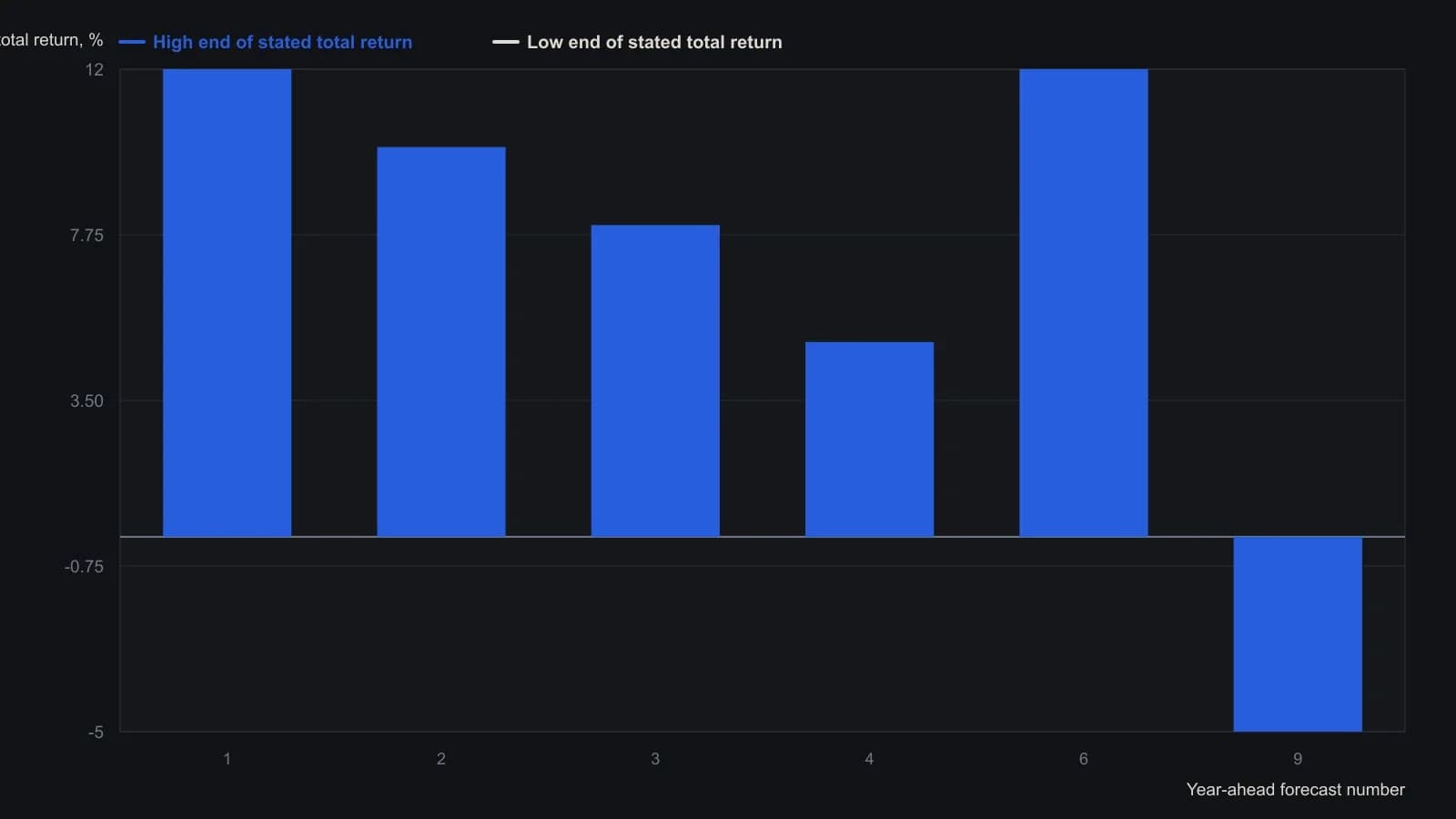
Bright scored the calls in mid-May, not at year-end. SPY rose from 206.38 at the 2 January 2015 open to 211.62 at the 8 May close, about 2.5% year-to-date, or roughly 5.5–6% if that pace held through December; he judged call 2 (6–10%) the closest. Calls 5, 7, 8, 10 and 11 named no total-return number and are omitted. Call 1’s extra phrase “or even a little higher” is not given a number.
Score wording, not conviction
A forecast-language-audit is a review of outside market calls that scores wording and usefulness instead of treating the call as a trade input.
Forecast wording that states what the market will do is treated as a weaker decision input than wording that frames an outcome as possible. Certainty-wording is that stronger-sounding style: it states an outcome as what the market will do rather than as one possible path.
Editorial: in a forecast-language-audit, certainty-wording loses usefulness even when it sounds decisive.
A close-looking band can still fail as a rule
A wide return band can look closest after a partial-year path and still be too broad to function as an operational trade rule.
Restating a missed prior call and postponing the same thesis is judged as having little relevance for current decisions.
A uniformly negative year-ahead outlook is flagged as a biased stance rather than an analytical input.
Open holdings pull the reading off-center
Open positions are described as influencing how incoming information is read, which makes staying objective difficult. Open-position-bias is that tendency: existing holdings color how new information is read and which actions still look acceptable.
Editorial: decision-objectivity means keeping the written procedure in control when forecasts, news, and open risk all pull interpretation off-center.
Write the stance before the path arrives
The recommended alternative to following outside prognostication is to build personal analytical tools and write if-then responses for defined market scenarios. An if-then-statement maps a defined market scenario to a predetermined stance before that scenario arrives. The scenario-stance is the planned posture for that named path, including staying in, exiting, or remaining flat.
A daily rehearsal of those if-then stances, including a 5 percent rise and a 5 percent decline, is proposed regardless of holding period so the trader already knows where each path leaves the book.
The pre-trade-checklist is the repeatable procedure that turns those scenario rules, current market state, and execution constraints into one testable decision. Editorial: rehearse that checklist daily so open-position-bias cannot rewrite entry, exit, or stand-aside rules mid-trade.
All readings on this track · 135 readings
- 1987Pair each checklist step with its decision state
- 1987Position secrecy as decision-process control
- 1987When profits break the trading process
- 1988Treat action-seeking as a veto before any signal
- 1988Entry, exit, and abstention as one practiced procedure
- 1988Making inner conflict a testable trading rule
- 1988The chart is only half the trading procedure
- 1988Negotiate conflicting parts before the signal
- 1989Commitment turns trading rules into one procedure
- 1989Confidence, discipline and the fit of a trading procedure
- 1990Encoding expert hunches into a mechanical trading loop
- 1991The consecutive-loss halt as the trading system
- 1991A fuzzy membership checklist for trade signals
- 1991Overconfidence as a skipped pre-trade checklist
- 1991A source-reliability audit for trade signals
- 1991Shared rules fail without an execution checklist
- 1991The daily study block as a low-risk checklist
- 1992A bear-market loss review that rewrites the pre-trade checklist
- 1993Unspoken beliefs that veto system rules
- 1993Why a mechanical system beats betting harder when the story looks cheaper
- 1993A usable process over a perfect trader standard
- 1993Remold the decision-map after a traumatic trade
- 1994Keep entry, exit and sit-out as one procedure
- 1994Pre-trade gates for belief and state
- 1994Known failure points inside the yen triangle phase checklist
- 1994When a comfort ceiling, not market state, is the failure mode
- 1994Trading commitment as a balanced decision process
- 1994Constructing a pre-trade discipline checklist
- 1995Futures systems start with whether to trade
- 1995Stopping points as checklist and stop failures
- 1995When analysis and execution must become one procedure
- 1995A decision-process database from analyst to trader
- 1995Decisive execution as one tested procedure
- 1996The unfinished-system trap in simple decision rules
- 1996When risk breaks practiced system execution
- 1996Treat the mechanical signal as a draft, not a decision
- 1996Critique of decision states that break system rules
- 1996State-gate checklist for trading decisions
- 1996Personality-fit rules before earned intuition
- 1996The commitment gap as a testable decision process
- 1996Test decision style as one trading procedure
- 1997Mechanical trading before subjective judgment
- 1997Belief checklists that invalidate mechanical systems
- 1998Mechanical rules against mindtraps
- 1999The profit target as a trading discipline lens
- 1999When mechanical rules replace judgment in the trade process
- 1999Trading discipline as one testable procedure
- 1999Daily pre-open map as one procedure
- 2000Session veto from daily readiness
- 2000Anger buildup as an untested system input
- 2000Construct separate research and live-trade question checklists
- 2000Operator-state as a first-class trading rule
- 2001Day-trading rules need a pre-trade decision process
- 2001Review the operator before you rewrite the plan
- 2001Critique of the informal trading pause
- 2001Specificity turns wishes into checkable trading rules
- 2002The pre-entry plan that locks exits and size
- 2002Risk identity as a pre-trade system gate
- 2002When elapsed time rewrites trade rules
- 2002One written system, faster exits, and the belief gate
- 2003Countable decision trees for entry and abstention
- 2003Constructing a pre-trade stop and review procedure
- 2004Psychological wounds that override a tested system
- 2004A hot streak does not retire the trading checklist
- 2005Why mechanical trade plans fail without execution discipline
- 2005Resentment as a construction input for trade decisions
- 2005A daytrade as one written procedure
- 2006Write the pre-trade plan as one procedure before entry
- 2006When a winning streak makes the trade checklist optional
- 2007An entry needs a pre-trade risk bound and a post-trade debrief
- 2007A pre-session futures plan that locks entries, exits, and stops
- 2007Maxims fail without one testable procedure
- 2007Personality-fit and holding horizon before the pre-trade checklist
- 2008Push-button systems versus a testable decision process
- 2008Written rules omit the operator and the implicit filters
- 2008A Pre-trade checklist before emotion takes over
- 2008System design between the mechanical black box and checklist judgment
- 2008Trade history as a checklist for entry, exit, and abstention
- 2008Mechanical rules without a decision process
- 2008Parable checklists for entry, exit and abstention
- 2010Keep rule-based entries clear of news bias
- 2010Self-control zones before the pre-trade checklist
- 2010Treat the pair-desk day as one testable procedure
- 2010Use a five-factor checklist instead of pattern labels
- 2010Listed currency futures versus spot forex as a pre-trade venue checklist
- 2010Rule overload, unfinishable checklists, and tight stops
- 2010Pre-trade checklist versus automatic stops
- 2010Skipping signals after a losing streak is a new system
- 2010Stand aside until the relationship breaks
- 2010A software catalog fails the checklist without one testable procedure
- 2011Checklist rules versus unwritten indicator judgment
- 2011The handoff test for self-coached trading plans
- 2011Unify locate status, written rules, and self-talk on one checklist
- 2012A pocket card and a setup-chart as the session-plan
- 2012Close system construction with a review checklist
- 2012A pre-trade checklist versus in-trade emotion
- 2013The ten-question alignment gate when traders lose the path
- 2013A stuck-point audit for stalled trading decisions
- 2013Why rule-based entries need false-trigger checks
- 2013One procedure for liquidity rules and abstention
- 2013The month-open window is unfinished without cash default and a substitution checklist
- 2014Waiting fails when the pre-trade checklist is too wide
- 2014A swing procedure with a checklist, layered stops, and an emotion handoff
- 2014System design as a critique of forecast-worship
- 2014Consultant hiring as an accept-or-abstain checklist
- 2014One procedure for entry, exit and abstention
- 2014A trading system that cannot decide before the chart opens
- 2014The checklist veto when tools override the plan
- 2014Write the holding-period style before any daytrading rules
- 2015A pre-trade checklist when volatility turns rules into panic
- 2015A checklist, psychology gate, and moving-average procedure
- 2015Write forex entry and sit-out rules before you score the links
- 2015Daily if-then checklists versus year-ahead market forecasts
- 2015Workstation readiness in the pre-trade execution checklist
- 2015An unprepared trade fails the pre-trade checklist
- 2015Evaluate a system with one pre-trade checklist
- 2015The pre-trade checklist as one testable procedure
- 2015News-aware forex process with defined stops
- 2016Slow thinking over gut feel in complex markets
- 2016When a market-structure story rewrites a checklist yes
- 2017Constructing an options trading-plan from a self-inventory
- 2017A price-first checklist for noncooperative market games
- 2017A pre-trade risk checklist versus profit-first thinking
- 2018A forex onboarding ladder is not a decision process
- 2018Pre-trade regret scripts for entry and abstention
- 2018Audit the plan while the tape stays forgiving
- 2018Constructing a sortable pre-trade checklist
- 2018Forex myths that break a testable decision process
- 2018Why trading checklists must beat inherited confidence
- 2019Leverage as a pre-trade gate in mechanical systems
- 2019Critique of impulse trading as a testable system
- 2020One checklist for breakout entry, stops, and sitting out
- 2020A continuity checklist for a blank Sunday-night system desk
- 2020After an extended bar, the checklist must still be able to refuse
- 2020Write one procedure before outsourcing system decisions