2016issue C0856
Same-dollar liquidity-filter for listed futures
Listed futures can be ordered by a relative-liquidity score so names at the top of the list are easier to buy and sell than names at the bottom. The liquidity-filter keeps only contracts a trader can actually enter and exit at comparable implementation cost, using a same-dollar rank from the equal-dollar contract count, open-interest, and a volume-factor.
- A liquidity-filter is a pre-trade screen that keeps only contracts a trader can actually enter and exit at comparable implementation cost.
- Relative-contract-liquidity is the product of the equal-dollar contract count, total open-interest, and a volume-factor, so every listed name is ranked on one dollar scale.
- Each column in the ranking is a proportional comparison and is meaningful only against other values in the same column.
- For listed stocks, share-turnover treats period volume as a share of shares outstanding and can stand in as a trading-liquidity proxy.
A liquidity-filter before the order
Listed futures can be ordered by a relative-liquidity score so that names at the top of the list are easier to buy and sell than names at the bottom. The liquidity-filter is a pre-trade screen that keeps only contracts a trader can actually enter and exit at comparable implementation cost.
The archive workflow ranks the listed names on that score first. The rank is a cross-market comparison, not a chart pattern and not a margin quote.
How relative-contract-liquidity is built
Relative-contract-liquidity is a cross-market rank built from the equal-dollar contract count, outstanding open-interest, and a volume adjustment. The relative-liquidity score is the product of the equal-dollar contract count, total open-interest, and a volume-factor.
The equal-dollar contract count equals tick dollar value times the largest price excursion observed over the prior three years, so every figure in that comparison shares the same dollar scale. Contracts-to-trade states that same quantity as how many units of one listed future are required to match another contract's three-year dollar price excursion.
Open-interest is the outstanding futures positions used as the size input to the liquidity rank.
The volume-factor is a floor-at-one exponential adjustment that scales unusually thin or heavy volume relative to a 5000-contract log reference. In the archive construction, the volume-factor equals the larger of 1 and the exponential of the natural log of volume divided by the natural log of 5000, minus 2. Unusually low or high volume can be scaled by a multiplier that is typically between 1 and 4 when the liquidity rank is constructed.
Same-dollar contract count across listed futures
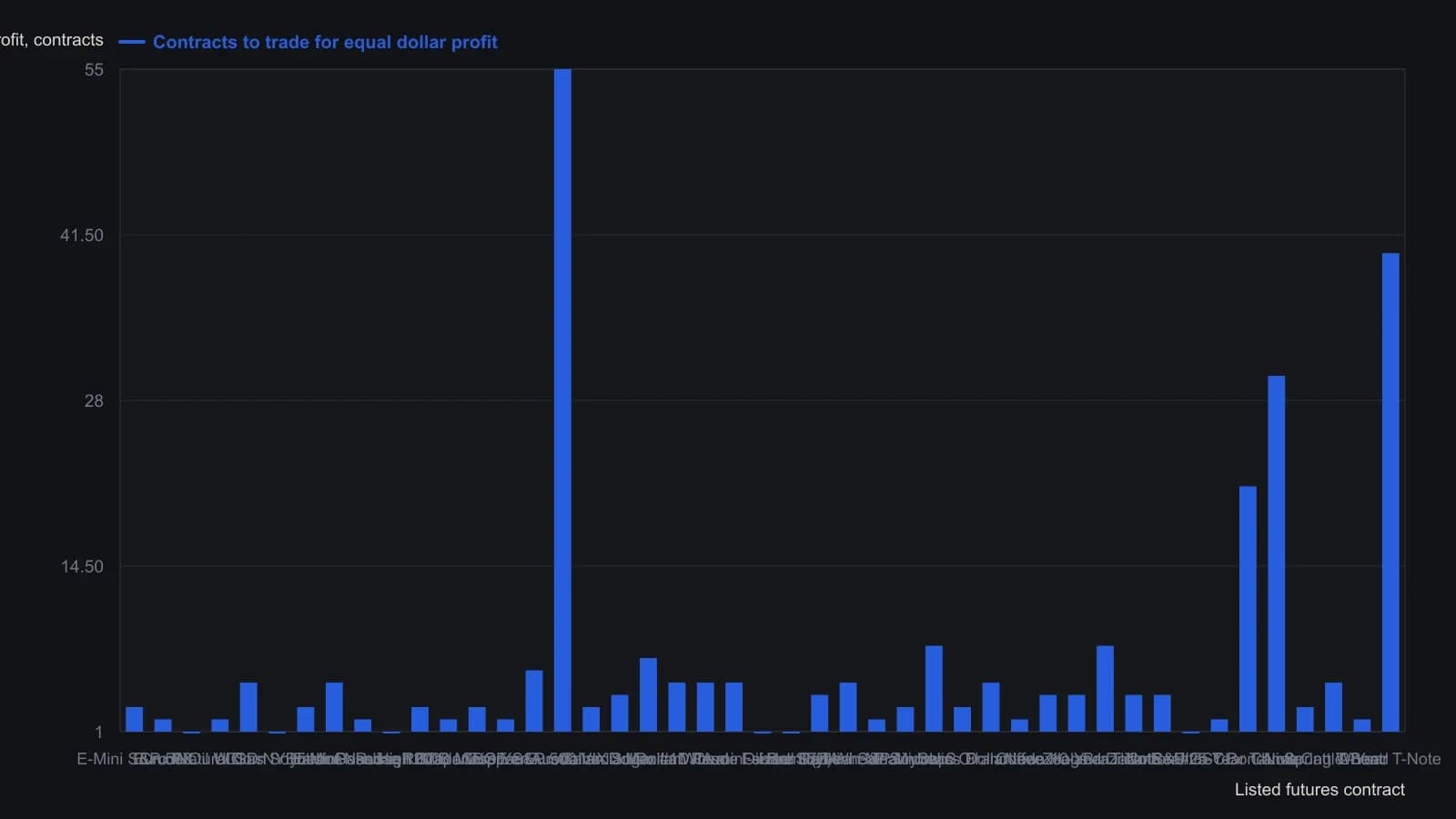
The publisher sizes every name with tick value times the three-year maximum price excursion so the column is an equal-dollar rank. The printed relative-liquidity order also multiplies by open interest and a volume factor, which this series does not reprint. Compare names only inside this list.
Columns compare only within the same list
Each column in the ranking is a proportional comparison and is meaningful only against other values in the same column.
In the illustrated ranking, the E-mini S&P 500 sits at the most liquid end and the two-year Treasury note sits at the least liquid end of the listed names.
Effective-percent-margin equals posted margin dollars divided by the three-year dollar range of the contract, then multiplied by 100. The term is posted margin dollars expressed as a percentage of the contract's three-year dollar price range.
Share-turnover as a stock-market proxy
For listed stocks, period volume as a share of shares outstanding can be treated as a turnover-rate proxy for trading liquidity. Share-turnover is that ratio: period equity volume divided by shares outstanding.
All readings on this track · 10 readings
- 2012Filter listed futures by relative contract liquidity
- 2013Score option liquidity before you commit the order
- 2013Evaluate futures liquidity before committing margin
- 2014A two-gate liquidity filter for listed futures
- 2015A liquidity filter to choose executable futures
- 2016Lookback and direction-test parameters for a liquidity-plus-trend screen
- 2016Same-dollar liquidity-filter for listed futures
- 2016Liquidity filter for executable futures orders
- 2017How to read a futures liquidity filter
- 2020Pre-trade liquidity filter for listed futures