1988issue C031-7
Name the stop, then decide if the account can pay
This archive article separates risk from exposure, prices a planned stop as an expected-loss bill, and treats an unaffordable bill as a reason to stay out. After entry, the same stop still governs when a bounce runs against the position.
- Risk is the chance of an adverse outcome. Exposure is the dollar amount lost if the planned stop is reached. The two terms are not interchangeable.
- The expected value of a planned loss is exposure times the chance the stop is hit. In this workflow it is a pre-entry affordability check, not a forecast of the next move.
- A money-management plan sets risk, exposure, and profit parameters before a position is opened. If the planned expected loss cannot be afforded, the setup is skipped.
- After entry, a planned short stays bounded by an 18-day or 20-day moving-average stop or by recent session highs. An adverse bounce tests whether that stop still governs the exit.
Three gates before a position
TradersWeek editorial: survival is taught here as a three-gate habit. Name the stop first. Convert that stop into an expected-loss bill. Refuse the position whenever the bill exceeds what the account can pay. A violent bounce then tests the plan, not the trader's nerve.
The archive workflow keeps those gates in order. Risk, exposure, and profit parameters are named before a position is opened. After entry, the same stop still bounds the exit.
Risk is not exposure
Risk is a probability of an outcome, while exposure is the dollar amount staked on that outcome. The two terms are not interchangeable.
Risk, in this vocabulary, is the probability that an adverse outcome occurs, not the dollar amount that would be lost. Exposure is the dollar amount that would be lost if the planned stop is reached.
Expected value as an affordability check
The expected value of a discrete loss event can be computed as exposure multiplied by the probability of that loss.
A coin-flip illustration keeps the probability fixed at 50% while raising the stake from $1 to $1,000. Exposure and expected value both multiply by the same factor. The chance of the loss does not change. The size of the bill does.
Expected value, used this way, is the product of dollar exposure and the chance a planned stop is hit. It is a pre-entry affordability check rather than a forecast of the next move.
When volatility prices a large stop
Pre-crash volatility was described as large enough to require a stop of $2,500 or more, with daily ranges implying more than a 40% chance of being stopped out.
With a $2,500 stop and a stopout probability above 40%, the trade's expected value was framed as a $1,000 loss before any offsetting profit was considered.
TradersWeek editorial: that $1,000 figure is the expected-loss bill for the planned stop. It is not a prediction that the next session will be a loser. It is the number the exposure cap has to be able to pay.
December S&P 500, 1987: 310 support and the October bounce
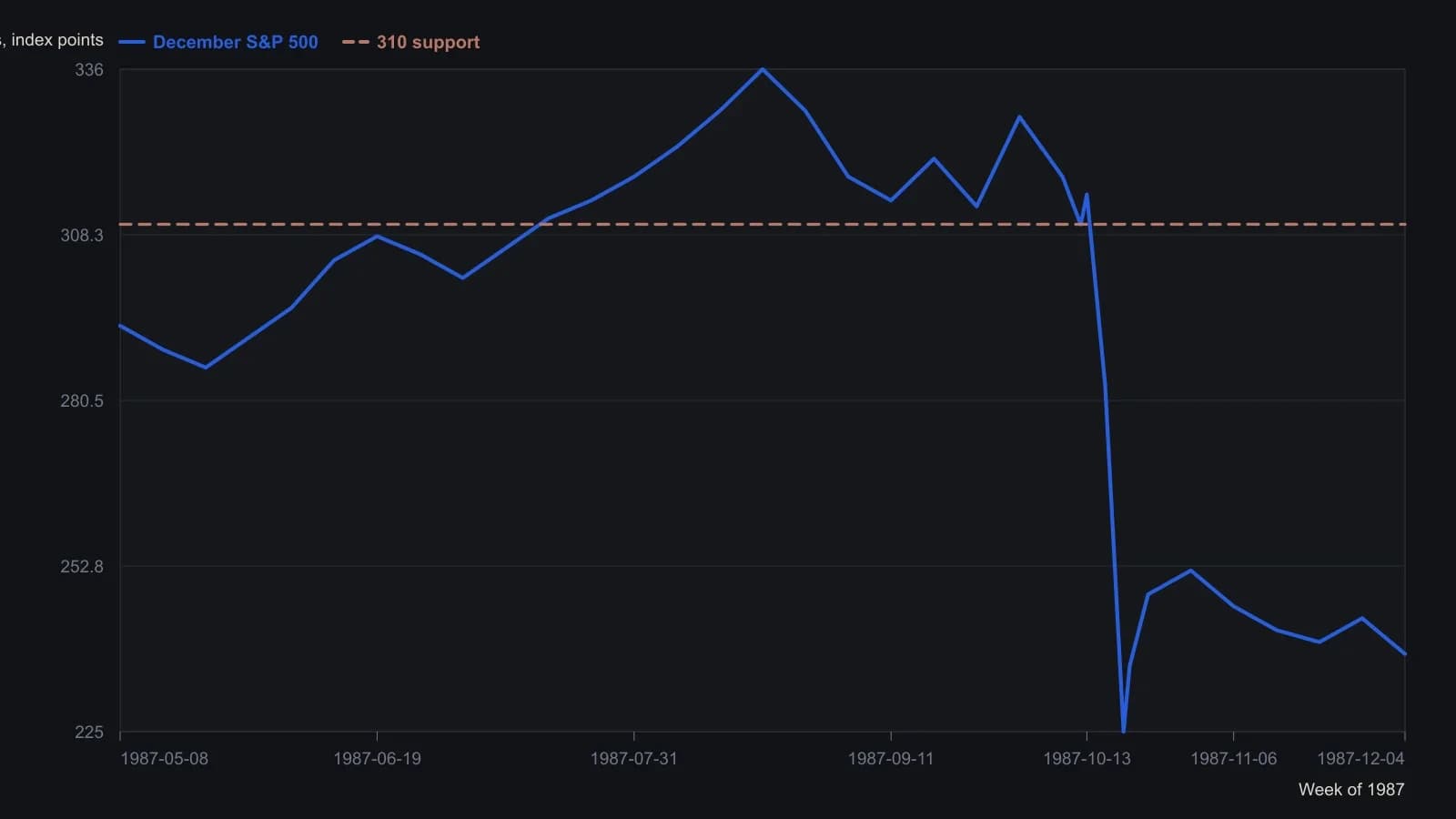
The scan is inverted on the page; prices were read against the printed 180–320 scale after restoring the usual high-at-top orientation. About one point per week plus the October break and bounce. Support at 310 and the 315 bounce are the same figures the article states.
The exposure cap is a skip rule
A money-management plan sets risk, exposure, and profit parameters before a position is opened. If that planned expected loss cannot be afforded, the setup is skipped.
An exposure cap is a hard limit on how much account equity may be placed at risk on one position. If that limit cannot cover the planned stop, the trade is not taken.
After entry, the same stop still governs
A stop-loss is a pre-chosen price, average, or recent-high exit that bounds the loss if the market moves against the position.
After entry, a planned short could be bounded with an 18-day or 20-day moving-average stop or with recent session highs rather than abandoned because a bounce looked like a reversal.
An adverse bounce after the short was placed moved the position more than $1,900 per contract against the trader, testing whether the pre-set stop still governed the exit.
TradersWeek editorial: the bounce is not a new vote. If the three gates were passed before entry, the stop already names the exit. Nerve is not a fourth gate.
Survival after staying out
After reviewing the large loss exposure between October 5 and 21, remaining on the sidelines was framed as capital preservation that left the trader able to participate later.
Survival means keeping enough capital to keep trading after a high-volatility episode, whether by holding a planned risk or by staying out.
All readings on this track · 6 readings
- 1988Name the stop, then decide if the account can pay
- 1988Limited-risk labels versus exposure and ruin
- 1992Risk of ruin and exposure caps as a pre-trade filter
- 1994When standing puts fail the drawdown test
- 2017The minimum-margin habit is not commodity-market risk
- 2018Evaluating a normalized risk index for drawdown and exposure limits