2019issue C1016-21
A consecutive Renko brick count as a mechanical entry-exit procedure
A historical GBPUSD case encoded a consecutive modified Renko brick count and one average filter as an automatic long or short procedure. Extra chart labels stayed around those signals as confirmation, not as a second trigger.
- A consecutive modified Renko brick count can be encoded as an automatic expert that alerts once a chosen up-bar or down-bar count is reached, with the expert, new-trade, auto-trade, and auto-close switches enabled.
- A long entry required the count to flip from zero to 1 after three up bricks while the close was above a 21-brick median-price EMA; the exit required the opposite flip below that average.
- A brick-count trigger that failed the average filter was treated as invalid and produced no trade.
- Wave labels, SRSI divergences, and Fibonacci projections were used as confirmation around the mechanical signals, not as replacements for the count-and-average rules.
The automatic expert
A consecutive modified Renko brick count can be encoded as an automatic expert that issues an alert once a chosen number of up or down bars is reached. The expert's two numeric inputs are an up-bar count and a down-bar count, and automation requires the expert, new-trade, auto-trade, and auto-close switches to be enabled.
The count ran on a Renko chart. Those same numeric inputs defined the mechanical trading system and its rule-based entry.
Long-only rules on GBPUSD
In the long-only GBPUSD case, the chart was a 200-tick (20-pip) modified Renko series and the mechanical count was three consecutive bricks in either direction.
A long entry required the count indicator to flip from zero to 1 after three up bricks while the close was above a 21-brick median-price EMA. The exit required a flip from 1 to zero after three down bricks while the close was below that average.
Signals that met the brick-count trigger but not the average filter were treated as invalid and produced no trade.
Recorded trades and the short-only variant
The long-only case recorded two completed trades, 1.3420 to 1.3500 and 1.3540 to 1.4240, for a combined 780 pips.
The same brick-count rules were also applied as a short-only procedure, with opposite vertical-line meanings for open and close signals.
Confirmation around the signals
Wave labels, SRSI divergences, and Fibonacci projections were used as confirmation around the mechanical signals, not as replacements for the count-and-average rules.
Recorded pip results of the two GBPUSD expert books
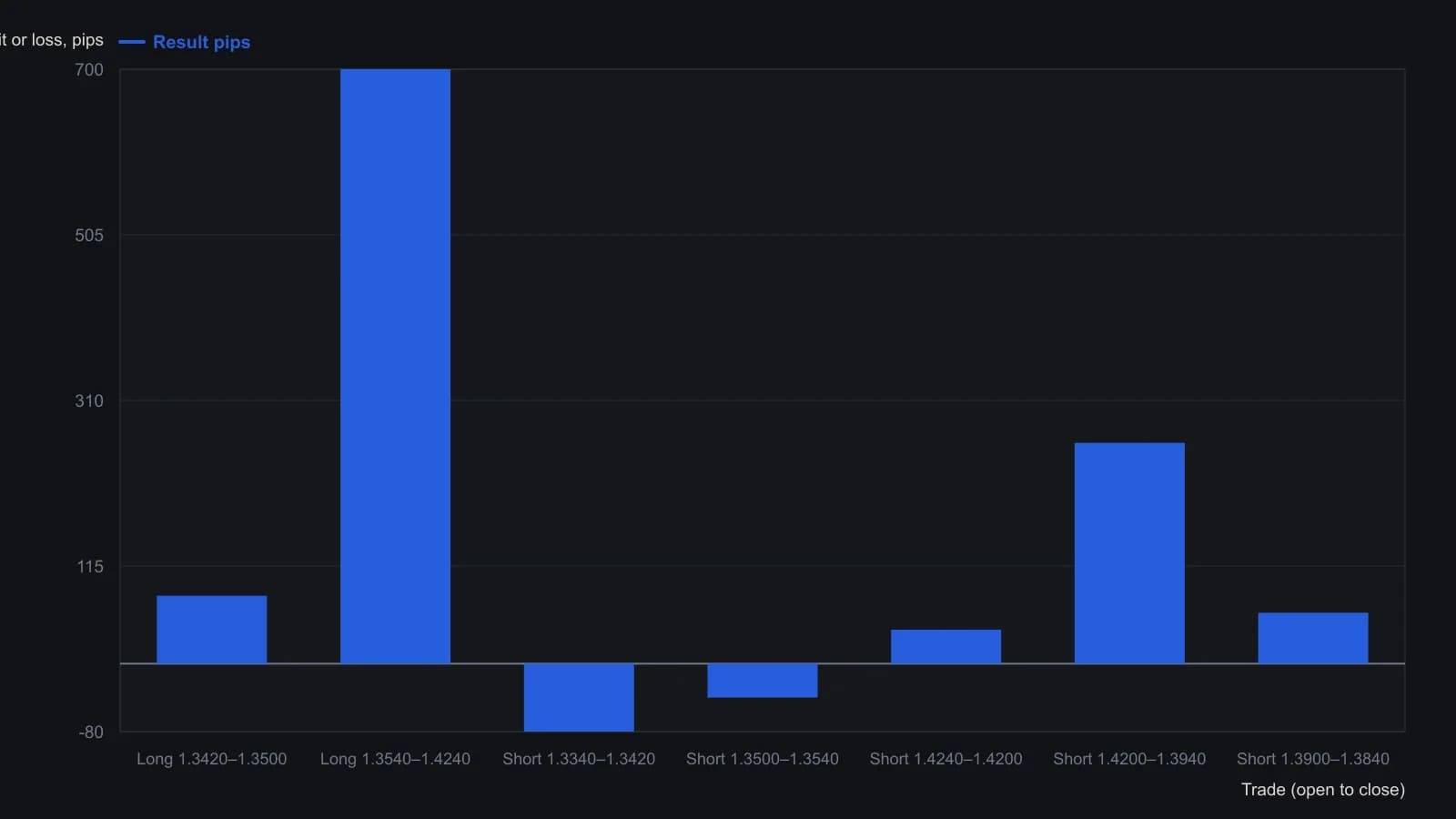
Fixed in the source: 200-tick (20-pip) modified Renko on GBPUSD, symmetrical 3-up/3-down brick count, 21-brick EMA of median price. A nearby sentence quotes 180 pips for the short-only run; the bars follow the table total of 240.
All readings on this track · 14 readings
- 2007Renko brick construction and breakout rules
- 2014Modified Renko brick size from tick inputs
- 2014Renko brick increment and open construction
- 2014Modified renko construction with RSI bands and a trend filter
- 2014Construction checklist for a brick-chart crossover and same-session breakout
- 2015Optimizing virtual bar size as a trend filter
- 2015Constructing Renko energy bands so support and resistance arrive as pre-marked leans
- 2018Five-rule entries and exits with Elliott waves and Renko bricks
- 2018Modified Renko charts as a filter for fake breakouts
- 2018V-Trade reversal, retrace, and continuation rules
- 2018A finished impulse, a Fibonacci target, and a reversing Renko brick as one test
- 2019Brick sampling changes what a volatility envelope can show
- 2019A consecutive Renko brick count as a mechanical entry-exit procedure
- 2019Renko brick scale as a falsifiable trend hypothesis