2011issue C1235-40
Same pullback rules, different market modes
A durable process needs a researched tool, a read of the current market mode, and a willingness to change style when that mode changes. The same declining-volume pullback can be kept, reduced, or set aside once the tape is sorted into bullish, bearish, or range conditions.
- A durable process needs three parts together: a researched tool, a read of the current market mode, and a willingness to change style when that mode changes.
- A declining-volume pullback is a series of lower highs on consecutive lighter-volume days, then a higher high that ends that sequence and serves as the entry trigger.
- The same pullback rules can look useful in one market mode and fail in another, so position count and even whether to trade follow the current mode.
- Vague pattern language produces inconsistent implementations; a system that is not defined tightly enough to test is effectively traded on hunches rather than as one procedure.
A tool is not enough on its own
A durable process needs three parts together: a researched tool, a read of the current market mode, and a willingness to change style when that mode changes.
Traders who only care whether the year ends higher or lower are often locked into one style. Adapting means keeping separate, previously tested tools for bullish, bearish, and range conditions.
Using one tool in every environment tends to produce repeated stop-outs and an account that oscillates. Risk can be adjusted by changing how many positions are held and how large they are as conditions change.
Specify the setup and the trigger
Pullback trading, as used here, is a defined setup-and-trigger procedure that looks for a pause inside an advance and only acts when a specified resumption signal appears.
Volume-price analysis reads consecutive lighter volume on a pullback as a chart condition that can be combined with a price trigger to form a testable hypothesis.
A declining-volume pullback is specified as a series of lower highs on consecutive lighter-volume days, then a higher high that ends that sequence and serves as the entry trigger.
Two liquidity filters used with that setup are a close above $5 and a 21-day simple moving average of volume above 200,000, intended to drop names that are hard to enter or exit.
Vague pattern language produces inconsistent implementations. A system that is not defined tightly enough to test is effectively traded on hunches rather than as one procedure.
Keep, reduce, or set aside the same scan
Market regime classification sorts the tape into bullish, bearish, and trading-range modes so a single tool can be kept, reduced, or set aside.
That is the regime-dependence of the procedure: the same pullback rules can look useful in one market mode and fail in another, so position count and even whether to trade follow the current mode.
In historical range windows the same declining-volume pullback scan still showed profits, but with a lower share of winning trades and lower annualized return than in bullish windows.
On that test record the author would use the scan in bullish periods, avoid it in bearish periods, and treat range periods as only potentially interesting if extra volume conditions are added.
Read the mode, or leave risk unmeasured
Current mode can be read from a one-year daily market chart, a five- and 20-period moving-average filter, or trendline analysis. Tools that were never tested across modes leave risk unmeasured.
NASDAQ Composite, 2007 test window
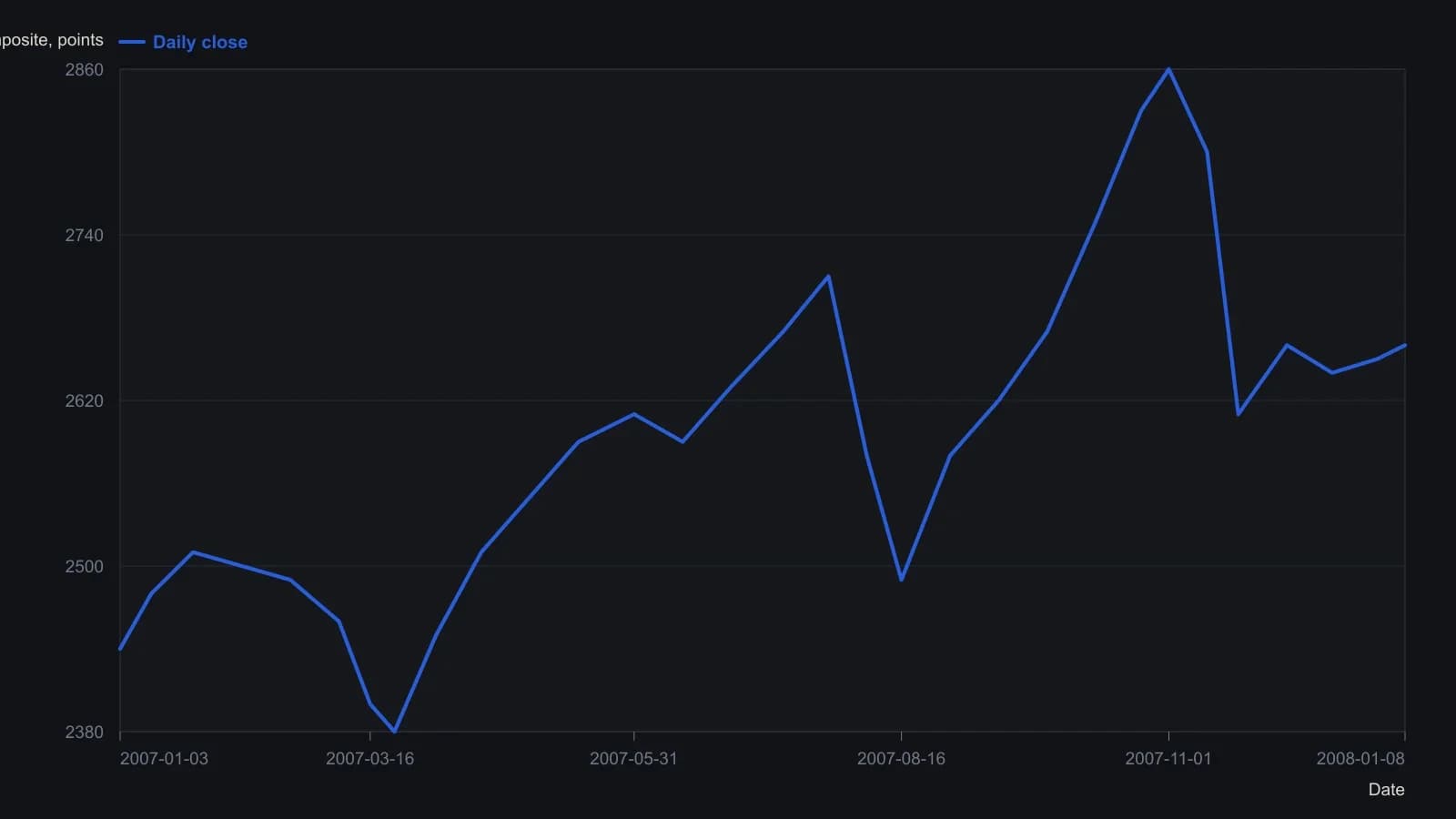
The source scale runs from 2304 to 2918.4 in steps of 51.2. Daily closes were sampled from the plotted candles, so levels are approximate to about 20 index points.
All readings on this track · 10 readings
- 1997A two-gate held-out test of hand-labeled pullback nets
- 2004A 50-day average touch as a screening procedure
- 2005Write a moving-average pullback as one procedure
- 2005How to write a short moving-average pullback as one procedure
- 2007Failed-breakout shorts with a half-width exit
- 2008Three-gate pullback entries from exchange tick breadth
- 2010Clear-method noise alerts for swing entries and exits
- 2011Same pullback rules, different market modes
- 2012Pixel-grid pullback and sector color alignment
- 2013Untested pullback entries need quantified exits