2007issue C041-4
Failed-breakout shorts with a half-width exit
A historical semiconductor-index sequence treated a failed-breakout short as one procedure: a pierce of a prior high that failed to hold, a pullback entry at a stated trigger, and a holding-period clock equal to half the width of the setup.
- A failed-breakout short is one procedure: a prior-extreme breach that fails, a rule-based-entry at a stated trigger, and a half-width-exit that also decides when to stand aside.
- In an advance the documented test is a pierce of a prior high, no follow-through, and an immediate drop back below that high. The inverse sequence applies after a breakdown.
- The half-width-exit sets the planned close-or-protect window at half the trading-session span between the two extremes that formed the test.
- In the semiconductor-index case, three of five breakouts failed and each issued a sell signal, yet none marked a durable trend reversal. The timed short was framed as an around-the-position-trade, not as proof the advance had ended.
When a breakout must hold or fail
A breakout-system is a testable procedure that treats a move through a prior extreme as an event that must either hold or fail, then binds that outcome to explicit entry, exit, and abstention rules over one holding period.
In the archive workflow, a failed-breakout is a move that clears a prior high or low and then retreats back through that extreme, often through the low of the first high in an advance, instead of continuing. A completed continuation-breakout was defined as one that clears the prior high and then never trades back below that high.
The reversal test and its clocks
In an advance, the documented reversal test requires a pierce of a prior high, a failure to follow through, and an immediate drop back below that prior high. The inverse sequence applies after a breakdown.
A rule-based-entry fires only when that stated condition is met. The same pattern was given different clocks by swing length. A 3-to-5-day swing was described as usually failing back through the prior extreme within one or two sessions. An intermediate swing was described as often doing so within 7 to 10 sessions after the new extreme.
Five breakouts, three failures
The semiconductor-index case counted five breakouts from mid-July to mid-December and labeled three of them failed because price later traded below the low of the prior high. Each of the three failed breakouts produced a rule-based sell signal. None of those signals marked a durable trend reversal. The later pullbacks also failed to print significant lower lows against the larger rally.
$SOX daily: three failed breakouts in the 2006 rally
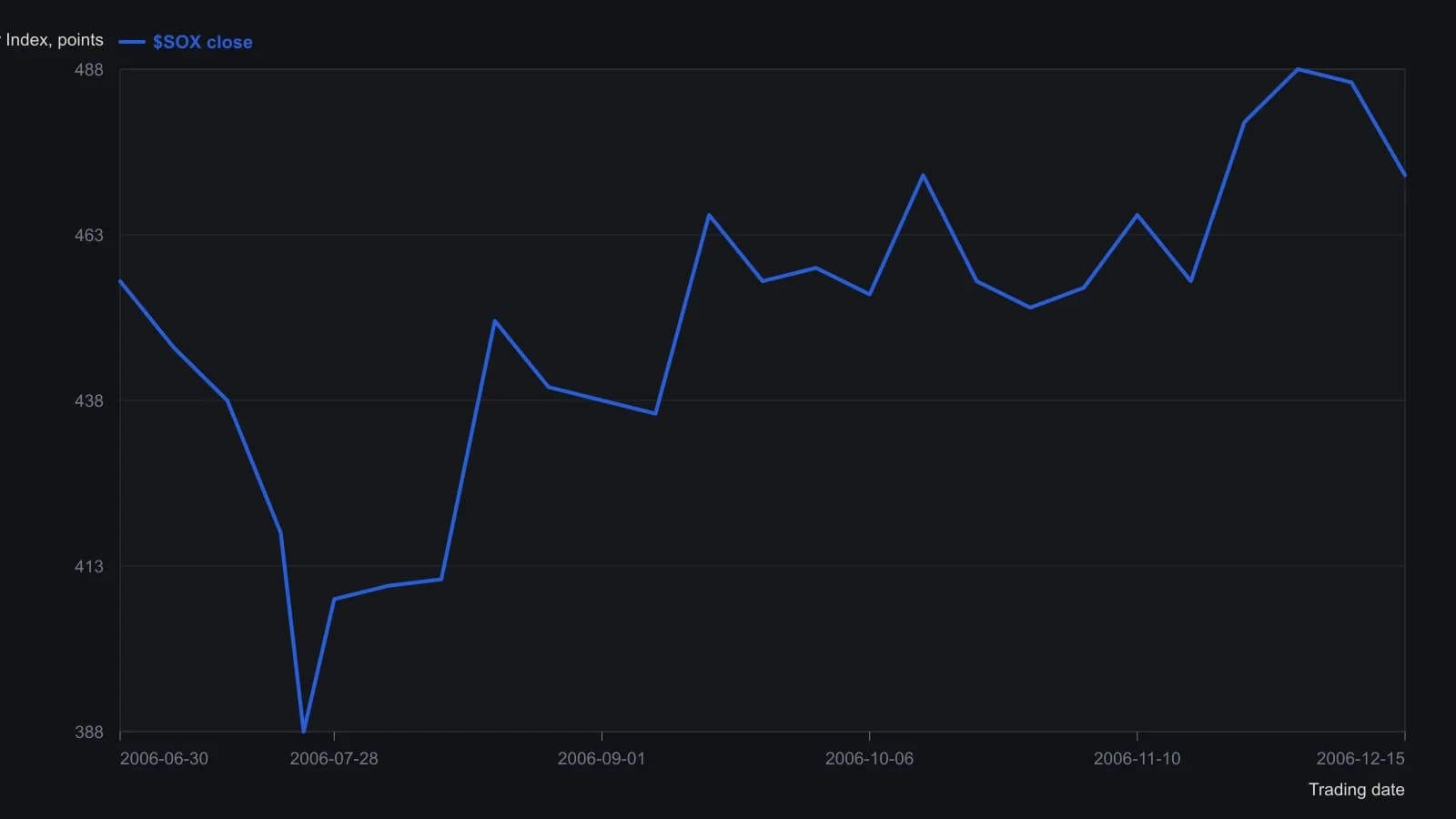
Raster resolution is about one index point, not intraday wicks, so these are approximate closes rather than official settlements. Penn’s clock is half the width of the two-high setup: five sessions after a 10-session 2B, ten after a 20-session 2B. None of the three failures made a significant lower low.
The half-width-exit
The exit rule of thumb set the planned close-or-protect window at half the trading-session span between the two extremes that formed the failed-breakout test.
Pullback-trading here is the short-horizon play that harvests the retreat after a failed-breakout and then exits or stands aside when that pre-set clock expires, including when the retreat is taken against a larger unchanged trend.
Three timed shorts
The August test used highs on August 17 and August 30, 10 trading sessions apart. The short trigger was 441.15 on September 5 at the low of the first high. The fifth-session mark fell on September 7, with a close of 435.58.
The September to October test spanned 20 sessions between September 15 and October 13 and triggered short at 462.38. By October 27, the tenth session after the later high, the close was 452.28, after earlier lower closes near the fifth session.
The November to December test ran 10 sessions from November 22 to December 7. It triggered short at 486.12 when price crossed the low of the first high and recorded a close of 467.01 on the fourth session inside the five-session half-width window.
A trade around a longer long
The timed failed-breakout short was also framed as a way to trade around a longer-horizon long initiated after the July low, rather than as a standalone assertion that the advance had ended. An around-the-position-trade is a brief countertrend or profit-protecting play taken without abandoning a longer-horizon stance in the same market.
All readings on this track · 10 readings
- 1997A two-gate held-out test of hand-labeled pullback nets
- 2004A 50-day average touch as a screening procedure
- 2005Write a moving-average pullback as one procedure
- 2005How to write a short moving-average pullback as one procedure
- 2007Failed-breakout shorts with a half-width exit
- 2008Three-gate pullback entries from exchange tick breadth
- 2010Clear-method noise alerts for swing entries and exits
- 2011Same pullback rules, different market modes
- 2012Pixel-grid pullback and sector color alignment
- 2013Untested pullback entries need quantified exits