2013issue C1052-58
How Heikin-Ashi close and typical-price form a two-average crossover
The archive describes a system of two exponential moving averages, one of typical-price and one of heikin-ashi-close. Entries follow that cross, with an optional close filter on the signal bar, chart painting from the same cross-value, and a stop-loss that can later become a breakeven-stop.
- Typical-price and heikin-ashi-close are defined first, then used as the inputs to the two exponential averages.
- A true-crossover also checks the prior bar and produces fewer signals than a simple above-or-below test.
- The same cross-value can paint price bars and fire long or short entries, with an optional bullish or bearish close on the signal bar.
- A stop-loss can later become a breakeven-stop after a target is reached, and some platforms must update Heikin-Ashi bar by bar.
Build the two averages first
The system is built from two exponential moving averages. One average is applied to typical-price, the four-point average of open, high, low, and close. The other is applied to heikin-ashi-close, a reconstructed close that averages typical-price with the prior Heikin-Ashi open and the bar extremes relative to that open.
Heikin-Ashi close is constructed from typical-price, the prior reconstructed open, and the bar high and low bounded by that open. Average lengths are treated as inputs. One charted example uses 4 for typical-price and 6 for heikin-ashi-close. Another formula set uses 5 and 8.
NFLX daily typical-price EMA versus Heikin-Ashi-close EMA
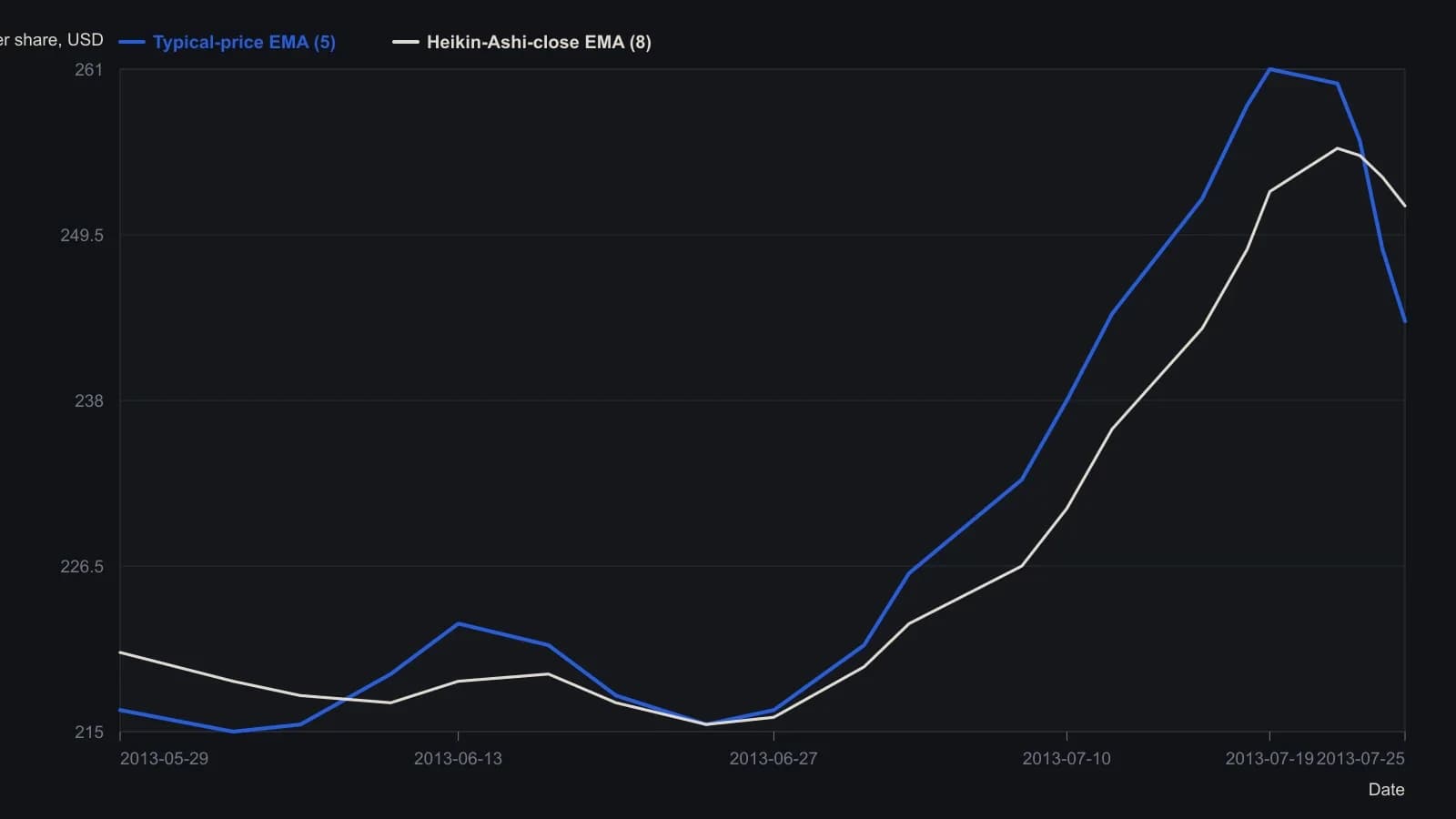
The AIQ contributor fixed typLen at 5 and haLen at 8 and omitted the stop-loss and breakeven exits. Session dates between the July axis mark and the 25 July window title are inferred from the daily bar count; prices are approximate to the nearest half-dollar.
Choose the cross and the candle filter
Long and short entries can be defined when the typical-price average crosses the heikin-ashi-close average. The rules may also require a bullish or bearish close on the signal bar.
A true-crossover is a stricter trigger. It requires the first average to be above the second now and at or below it on the prior bar. That check produces fewer signals than testing only whether one average is currently above the other.
The comparison can be stored as a cross-value, a binary state that flips when the typical-price average crosses the heikin-ashi-close average. Price bars can be painted from the same cross-value used by the strategy so entries are visible on the chart.
Place a stop, then advance it
The system can attach a stop-loss and later move that stop to a breakeven-stop after the trade reaches a target. Residual risk is reduced if price then reverses.
Update Heikin-Ashi bar by bar
Because Heikin-Ashi open depends on its own prior value, some platforms must update the series bar by bar rather than precompute it as a static indicator.
All readings on this track · 16 readings
- 2004Reconstructing Heikin-Ashi bars from smoothed OHLC
- 2004Heikin-Ashi candle construction as an OHLC transform
- 2004Stacking heikin-ashi, swing charts, and a moving average in strong trends
- 2007Constructing a Heikin-Ashi volume-price oscillator
- 2007A volume-price oscillator is a timing trigger, not a standalone entry
- 2008Heikin-Ashi OHLC construction and simplification
- 2008How a Heikin-Ashi candlestick oscillator is built from color, lag, and hold rules
- 2008Heikin-Ashi color-coded candles and smoothed trend filters
- 2010Heikin-Ashi smoothed percent b for divergence timing
- 2011Constructing Heikin-Ashi, moving-average, and MACD filters
- 2011Constructing candlestick, Elliott-wave, and Heikin-Ashi hypotheses
- 2012Constructing a three-state Heikin-Ashi trend filter
- 2012Heikin-ashi as a trend-state signal without candlestick-patterns
- 2013Heikin-Ashi volume gates, smoothing, and denominator floors
- 2013How Heikin-Ashi close and typical-price form a two-average crossover
- 2013Walk-forward tests for color-coded Heikin-Ashi crosses