2011issue C0625-27
Breakout side versus catalog labels on finished candle recipes
The archive workflow grades a completed multi-bar candle recipe by the first close beyond its high or low. Editorial reading treats the catalog reversal or continuation name as a hypothesis after that close and treats any ranking as fragile when the historical sample is only a handful of prints.
- The archive grades a finished multi-bar recipe by the first close beyond the high or low of the completed pattern.
- Editorial reading: keep the catalog reversal or continuation name as a hypothesis until that breakout close.
- A candlestick that ranks well after a completed breakout is not automatically a useful reversal candidate if the exit close contradicts the catalog label.
- Editorial reading: treat any ranking as fragile when the historical sample is only a handful of prints.
When a multi-bar recipe is finished
A multi-bar candlestick recipe is complete only after every required line has printed. A doji is a candle whose open and close are the same or nearly the same, leaving little or no real body. The four-price doji prints as a minus-sign mark when open, high, low, and close coincide, and it is associated with thinly traded names.
A collapsing doji star is complete only when a first candle gaps above a doji whose shadows do not overlap neighboring wicks and a later black candle then gaps below that doji. Until that later black gap prints, the recipe is not finished.
The first close outside the box
A breakout is a close beyond the high or the low of the completed candlestick pattern. The archive workflow uses that first close, not the catalog title, to grade the setup.
A candlestick that ranks well after a completed breakout is not automatically a useful reversal candidate, because the close that exits the pattern can contradict the catalog continuation or reversal label.
Crows, soldiers, and the easier exit
Three black crows is read after an advance as three tall black candles, each closing at a fresh low, with the last two opening inside the prior body and all closing near their lows. Tall is judged against average candle height over the prior week or two. Because the three-crow sequence already trends lower, a close beneath the pattern low is the easier downward breakout, so the setup is catalogued as a bearish reversal of the preceding rise. An upward breakout was the minority outcome in the sample, occurring 22 percent of the time.
Identical three crows differs from three black crows because the last two candles open at or near the prior close rather than merely inside the prior body. Of 921 cases, most exited downward and the pattern behaved as a bearish reversal 79 percent of the time.
Three white soldiers is the white counterpart of three black crows: three tall white candles in a decline, each closing higher and near its high, with the last two opening inside the prior body. Downward breakouts from soldiers were one-fourth as common as upward ones.
The bearish three-line strike often finishes near the top of its range, so a close above the highest line is mechanically easier than a close below the low. In the test it behaved as a bullish reversal 84 percent of the time rather than as the theoretical bearish continuation, and only 85 examples were found.
Rare recipes and look-alikes
The bearish breakaway is a five-line recipe after an uptrend: a tall white candle, a white body that gaps from the first body, a higher close of either color, another higher-close white, then a tall black that closes inside the first body gap, ignoring the first two shadows. The strict rules produced only 36 matches.
A concealing baby swallow is a downtrend sequence of two black marubozu, a third black candle that gaps lower with a long upper wick and trades into the prior body, and a final black candle that engulfs the prior bar including shadows. A marubozu is a candle with no shadows, so the real body spans the full high-low range. The search located four examples in 4.7 million lines.
Mat hold is distinguished from a rising three-methods look-alike by an upward gap on the second candle and is framed as a compact rise-retrace-rise.
Ten-day bull-market gains after upward candle breakouts
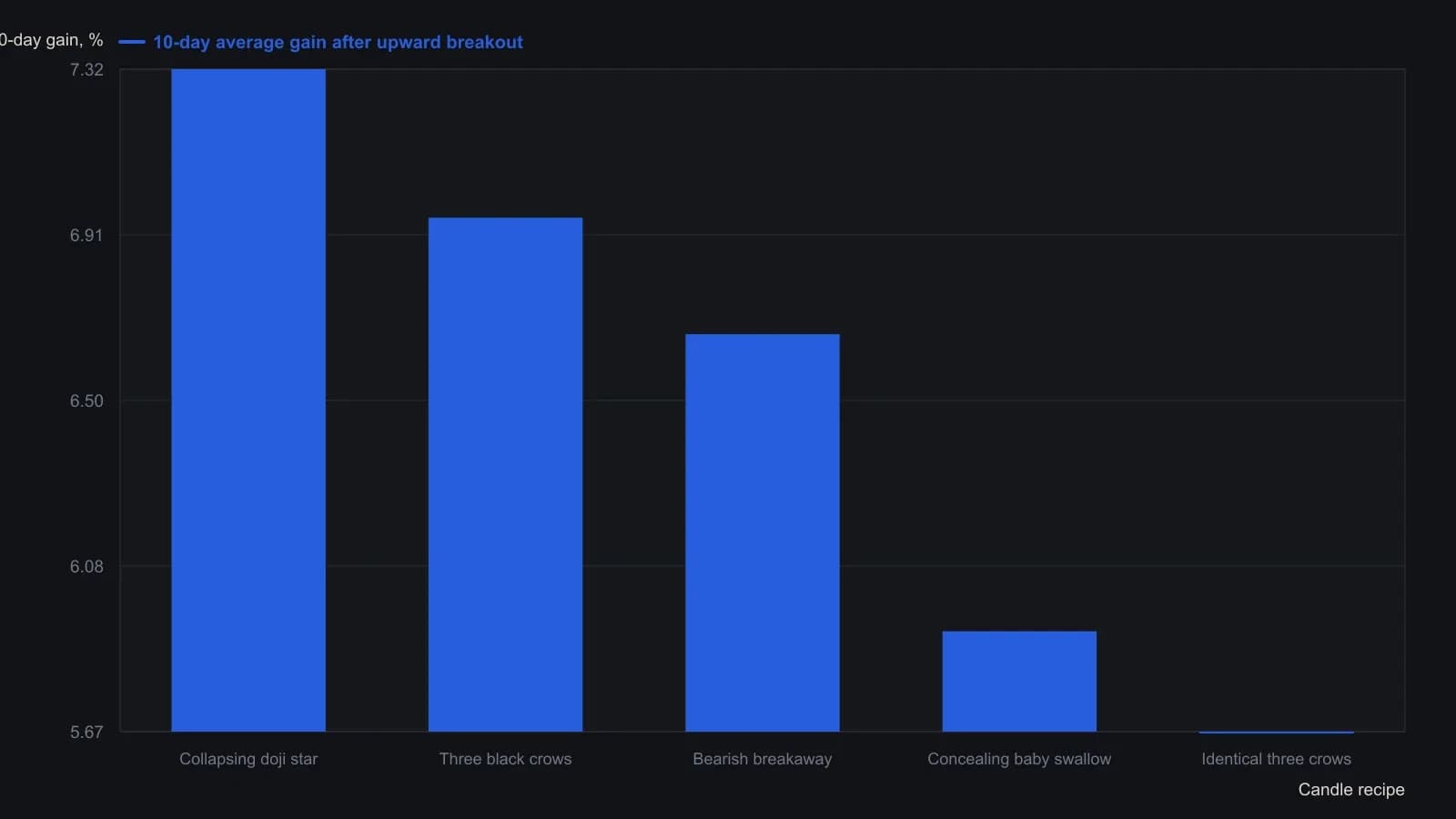
Gains are measured over the 10 trading days after the pattern ends. The source searched about 4.7 million price bars and found 16 collapsing doji stars and four concealing baby swallows; Bulkowski warns those averages are likely too high and will fall with more samples.
Catalog names after the exit close
The archive facts show that some recipes already lean toward one side of the box, that some catalog names disagree with the later exit, and that a few strict searches return only a handful of prints. Editorial reading keeps the catalog name as a hypothesis until the first close leaves the finished pattern, and it treats any ranking built on those thin samples as fragile.
All readings on this track · 11 readings
- 1992Constructing signed engulfing and doji detectors
- 1997Candlestick breadth timing on the 1996 S&P 100
- 2002Reading doji and engulfing after extended trends
- 2002A three-lock checklist for doji, gap, and stochastic reversals
- 2002Candlestick reliability after one-day follow-through
- 2004Constructing trendline calls with doji and engulfing
- 2004Doji construction, shadow geometry, and confirmation
- 2011Candlestick signals are not automatic trades
- 2011Breakout side versus catalog labels on finished candle recipes
- 2011Grading candlestick signals by frequency, trend, and breakout
- 2015Constructing candlesticks, doji, and hammer from OHLC