2017issue C0128-29
Classroom rotation across a short factor-ETF menu
This archive case uses factor investing to name a five-ETF menu, then applies rank rotation and momentum rotation so only the current leader is held. Leadership windows flip, so the holding sits in a rotation-sleeve until a moving-average or MACD exit.
- Factor investing defines the sleeves through systematic traits such as quality, value, and momentum, rather than a single capitalization-weighted hold.
- Rank rotation orders a small, fixed menu of factor ETFs and keeps only the top name eligible until an exit or abstention rule fires.
- Momentum rotation stays with the currently strongest sleeve over weeks to months and switches when a MACD or 100- or 200-day moving-average sell signal appears.
- Leadership windows can flip inside a year, so the case treats a longer horizon as required to capture a given factor’s intended benefit and lists expense, holdings, and liquidity checks first.
One menu, one eligible sleeve
This case treats a short list of factor ETFs as a single classroom menu rather than as separate permanent bets. A factor-ETF is an exchange-traded fund that targets one or more traits such as value, momentum, quality, size, low volatility, or dividend yield. Factor investing here means building or overlaying exposure through systematic security traits instead of a single capitalization-weighted hold.
Quality, value, and momentum were presented as primary security traits used to seek average-or-better return with lower risk than capitalization weighting. Low volatility, size, and dividend yield were ranked as weaker supporting traits.
How often leadership changed
A 30-year count ending in 2015 recorded small-cap beating large-cap in 13 years, value beating the market in 23 of 30 years, and momentum doing so in 18 years.
A year-by-year ranking from 2005 to 2014 placed momentum first in 2005, 2007, and 2013, value first in 2006 and 2012, size first in 2009 and 2010, and low volatility first in 2011 and 2014. A leadership-window is the span during which one factor ranks first. The case shows these windows can flip inside a year.
Later paths reversed as well. Momentum led from 18 July 2013 through 21 October 2016, while value led from the 11 February 2016 low through the same end date. The case states that a factor can move from leader to laggard over short spans and that a longer horizon is required to capture a given factor’s intended benefit.
Five factor ETFs on a shared window
Five factor ETFs were compared over a shared three-year window through 21 October 2016 because all five series existed across that span: minimum volatility, momentum, quality, value, and equal-weight large-cap. Equal-weight means giving each index constituent the same weight, used here as a simple alternative to capitalization weighting.
In that comparison, 20-day average volume ranged from 19,852 on the value ETF to 820,787 on the equal-weight ETF, with the momentum ETF at 28,292 and the minimum-volatility ETF at 723,362. Listed net expense ratios were 0.15% on the four single-factor funds and 0.40% on the equal-weight fund.
Stay with the leader until an exit
The case describes one rotation procedure. Rank rotation orders this small, fixed menu of factor ETFs and holds only the top name until an exit or abstention rule fires. Momentum rotation stays with the currently strongest factor sleeve and switches when leadership changes over weeks to months.
The rule applies MACD or a 100- or 200-day moving average to remain in the strongest of the five factor ETFs until a sell signal, then moves proceeds into the current strongest name. The rotation-sleeve is the limited portion of a portfolio reserved for that single strongest factor ETF under the tested rule set.
Checks listed before allocating
Checks listed before allocating to a factor ETF include expense ratio, holdings mix, sector-weight imbalance, liquidity, bid-ask spreads for active traders, and rebalancing frequency that can create short-term capital gains.
Three-year returns on the five-ETF factor menu
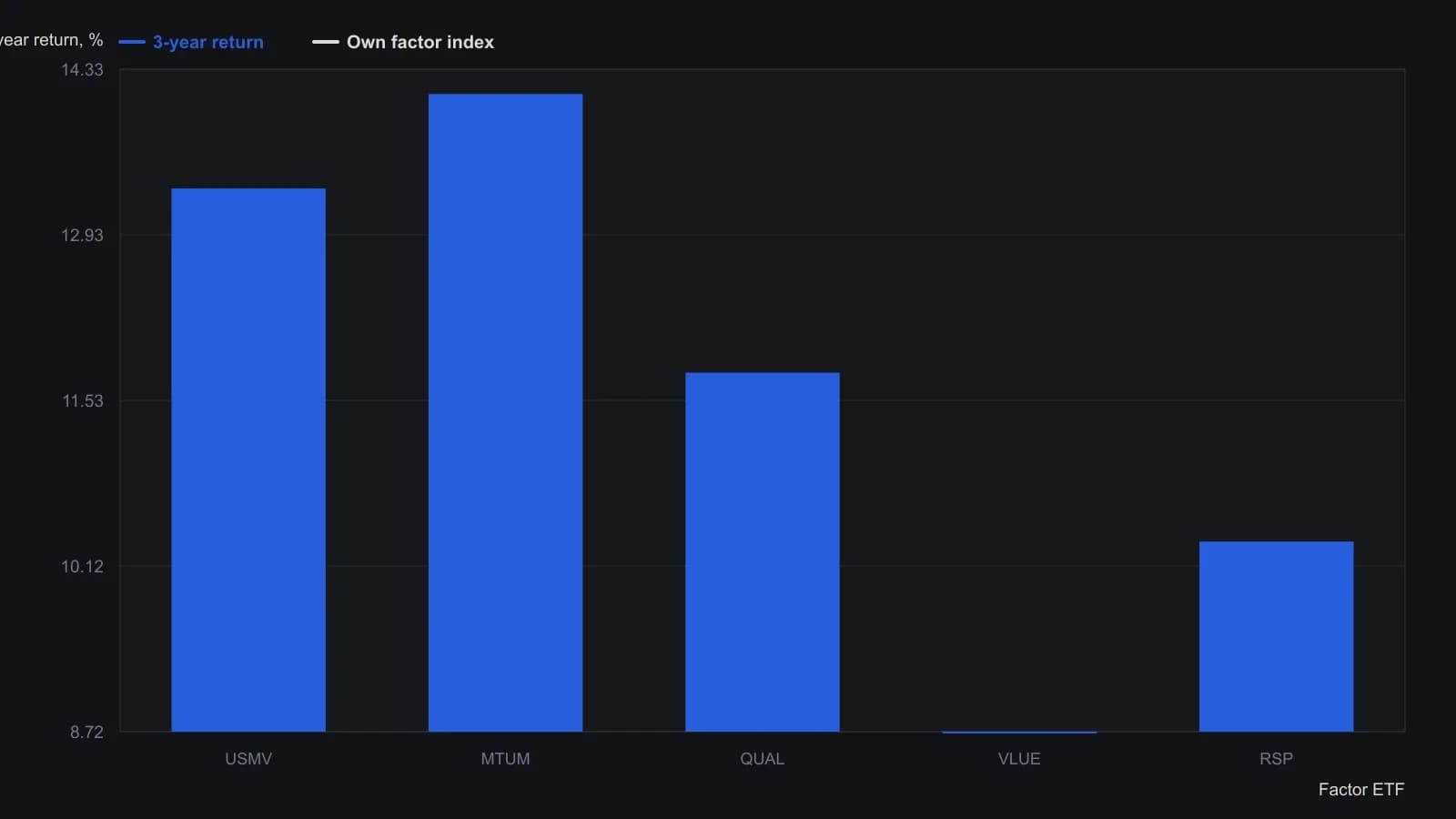
Trailing three-year returns as of 30 September 2016, the date on the comparison table. The later narrative uses a 21 October 2016 end date and cumulative rather than annualized figures. Each benchmark is that ETF's own factor index, not a shared S&P 500 series.
All readings on this track · 7 readings
- 1998Evaluating a binary relative-strength allocation
- 1999Rank-based sector-fund rotation with cash
- 2017Classroom rotation across a short factor-ETF menu
- 2017Evaluating momentum ETF rotation engines
- 2018Rotating international sleeves on relative-strength cycles
- 2019Rank-based sector rotation failed a late-2018 defensive-shift test
- 2020A five-phase compass for sector rotation and book context