1998issue C011-8
Evaluating a binary relative-strength allocation
A binary relative-strength switch funds only the leading class in a two-sleeve pair. The archive scored that book and a static mix over the same window with one Sharpe unit.
- Three allocation designs are distinguished: a strategic mix that holds fixed long-horizon weights, a tactical mix that makes large discrete weight changes, and a dynamic mix that relocates capital as conditions change.
- Dynamic allocation was defined as a complete binary transfer from one representative class into one alternate class, not a partial reweight of a multi-asset book.
- For every class and sleeve the study tabulated rate of return, monthly standard deviation, switches per year, fraction of time invested, Sharpe ratio, ulcer index, and maximum drawdown.
- Preferred pairings combined a higher Sharpe ratio with a low correlation between the primary class and its alternate, producing a two-state rotation rather than a simultaneously held multi-asset mix.
What the evaluation isolated
The archive distinguished three allocation designs. A strategic mix, or strategic-allocation, holds fixed long-horizon weights and rebalances back to them. A tactical mix, or tactical-allocation, makes large discrete weight changes from forecasts, sector-cycle knowledge, or a stock-versus-cash timing rule. A dynamic mix, or dynamic-asset-allocation, relocates capital across several classes as conditions change.
The evaluation defined dynamic allocation as a complete binary transfer from one representative asset class into one alternate class, not a partial reweight of a multi-asset book. That binary-switch keeps the entire stake in one class or the other, with no simultaneous multi-class holdings inside the test.
How the two books were built
Representative classes were formed by grouping funds by stated objective and geometrically averaging members on a daily basis as funds entered or left the database.
Alternate sleeves spanning lower to higher risk were tested against each primary class: a money-market sleeve, a long-term bond sleeve, a broad U.S. equity-index sleeve, an international-equity sleeve chosen for low U.S. correlation, and an aggressive-growth sleeve.
The historical window spanned more than one nominal business cycle. Reported statistics omitted commissions, transaction costs, and advisory fees, while fund-level management costs were already inside the prices used.
The rotation rule
The rotation rule is a momentum-rotation: it funds only the class whose smoothed daily percentage change currently leads its pair. The indicator is a relative-strength-switch. Each class’s daily percentage net-asset-value change is exponentially smoothed, the two smoothed series are subtracted, a shorter exponential average is applied to the difference, and the class with the higher relative strength is fully funded. Gaps that are small relative to the indicator’s peak are ignored.
The result is a binary-switch, a full transfer from one class into the other and back.
Scoring both books in the same unit
For every primary class and every alternate sleeve the study tabulated rate of return, monthly standard deviation, switches per year, fraction of time invested, Sharpe ratio, ulcer index, and maximum drawdown over the shared sample. The ulcer-index is the root-mean-square of equity retracements, used as a loss-only companion to standard deviation.
The Sharpe ratio was defined as yearly excess return over a money-market intercept, with monthly standard deviation converted to a yearly unit.
Cross-class correlations over the same window were used to screen pairs. Money-market and international-equity series were generally weakly related to most other classes, while like-equity groups moved more closely together.
Preferred pairings combined a higher Sharpe ratio with a low correlation between the primary class and its alternate, producing a two-state rotation rather than a simultaneously held multi-asset mix. Those preferred pairs form a dynamic-frontier, the return-versus-volatility envelope after the rotation rule is applied.
Sharpe ratio of buy-and-hold versus preferred binary DAA pairs
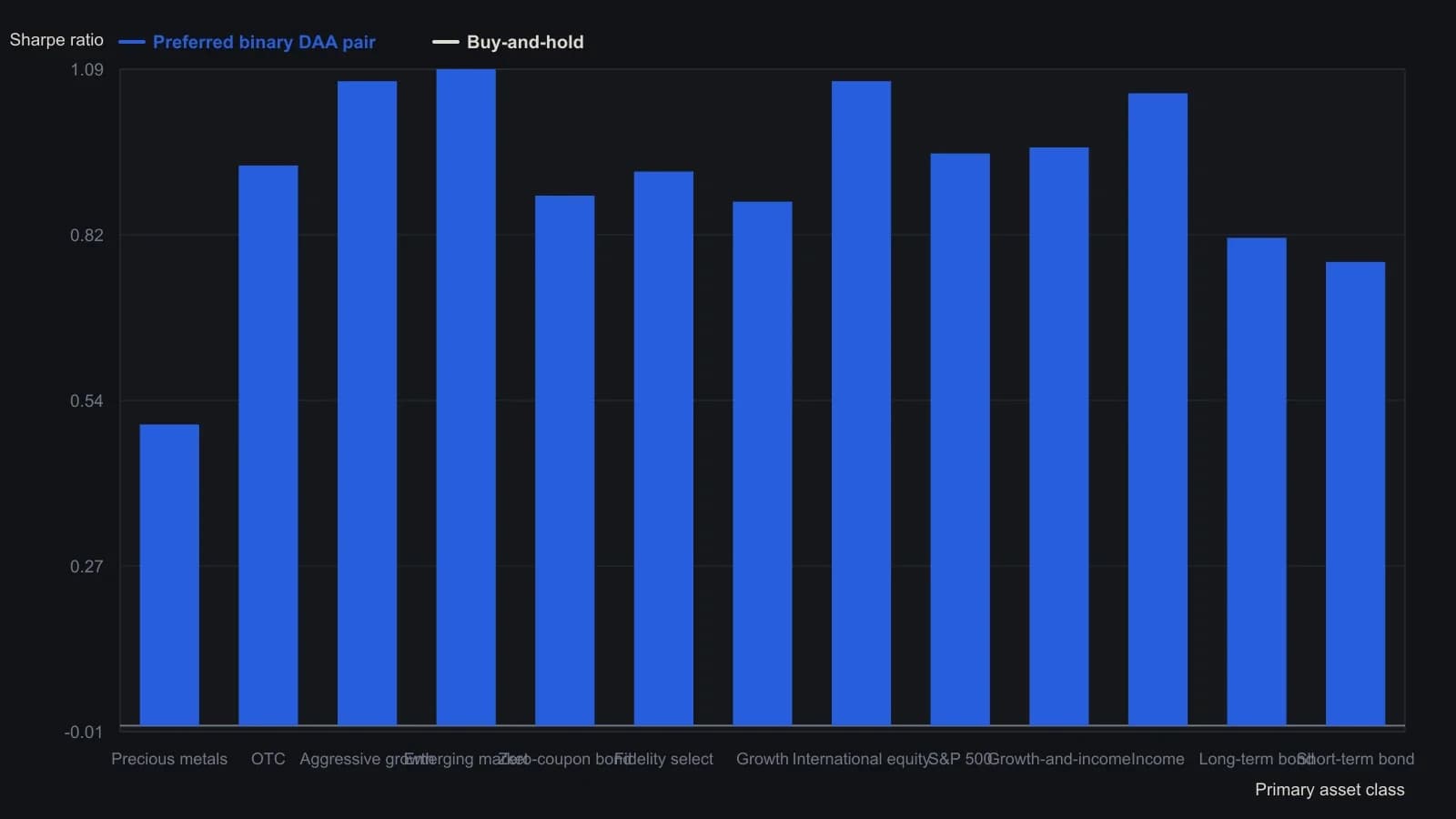
AccuTrack is a 48-period exponential smooth of daily percent NAV change minus the reference class, then a 12-day EMA; gaps inside 15 percent of the maximum are ignored. Sharpe is (yearly return minus 5.8 percent) divided by monthly standard deviation times square root of 12. Commissions and advisor fees are omitted; returns are not inflation-adjusted.
All readings on this track · 7 readings
- 1998Evaluating a binary relative-strength allocation
- 1999Rank-based sector-fund rotation with cash
- 2017Classroom rotation across a short factor-ETF menu
- 2017Evaluating momentum ETF rotation engines
- 2018Rotating international sleeves on relative-strength cycles
- 2019Rank-based sector rotation failed a late-2018 defensive-shift test
- 2020A five-phase compass for sector rotation and book context