2017issue C0527-29
Evaluating momentum ETF rotation engines
Treat a shared momentum label as a construction audit. Map each fund as its own rank-rotation engine by universe, lookback, cash permission, and rebalance clock before it becomes a portfolio sleeve.
- Funds that shared a momentum label still differed widely in assets, costs, holdings counts, and equity beta, a spread treated here as construction-dispersion.
- Each product ran its own momentum-strategy or rank-rotation book, fixed by universe, lookback, relative-strength-cutoff, and rebalance-cadence.
- A cash-sleeve or a factor-blend changed what the sleeve held, so the book was no longer a pure, always-invested momentum holding.
- With live histories short, the evaluation checklist started with objective, top holdings, selection methodology, and how often components change.
What the catalog placed under momentum
In the early-2017 catalog of momentum-tracking exchange-traded funds, construction traits were widely dispersed under one word. Momentum was described as a trend-following or relative-strength process that buys securities outpacing the market over a chosen window, commonly illustrated as six months to three years.
Twenty-seven momentum-based exchange-traded funds had launched since 2015, and the tracked set numbered 35. No leveraged or inverse product focused solely on momentum at that time. TradersWeek editorial view: read that catalog as a set of rotation engines, then decide whether any one of them belongs in a momentum-rotation sleeve.
Construction-dispersion behind the label
Assets ranged from about 1.3 million to 2.6 billion dollars, net expense ratios from 0.12 percent to 0.94 percent, holdings from four to 1,366 names, and equity betas from about -2.93 to 1.43. Construction-dispersion of that width means a momentum-strategy name does not fix size, cost, concentration, or market exposure.
Construction variables and benchmarks differed widely, so two products can share the label and still implement different books.
Each sleeve ran its own rotation rules
Rank-rotation ranks a closed universe, holds the top slice, and drops names that fall through a median or similar cutoff. A momentum-strategy is the testable rule set that uses price trend or relative strength over a stated lookback to decide what stays in the book. Momentum-rotation then places that book toward markets or funds that have recently outpaced peers, so a single idea sits inside a diversified or regime-aware sleeve.
One rank-rotation sleeve held five equally weighted funds chosen from a 25-fund family universe, refreshed relative strength weekly, and applied a relative-strength-cutoff that dropped a holding falling below the universe median.
A stock-level momentum sleeve weighted mid- and large-cap names by six- and twelve-month price performance and by low volatility over the latest three years.
A multi-cap tilt sleeve scored stocks on market capitalization and trailing eleven-month price momentum, placed them in 20 buckets, market-cap weighted the result, and reconstituted quarterly.
A tactical sector-rotation sleeve used a fixed book of four sector funds selected for the highest relative strength and could allocate part or all of principal to a cash-sleeve in a declining market.
A global fund-of-funds sleeve selected from a 50-fund universe using one- to two-year momentum, held 18 funds, and rebalanced monthly. The detailed ranking rules were described as proprietary, while holdings remained visible. Rebalance-cadence across these books ran from weekly screens to monthly or quarterly reconstitutions.
When momentum sits inside a factor-blend
At least one large-cap product combined momentum with value, size, and quality. That factor-blend was described as an unlike-for-like evaluation against momentum-only funds, because the sleeve is no longer a pure momentum book.
Common-window returns of six momentum ETFs
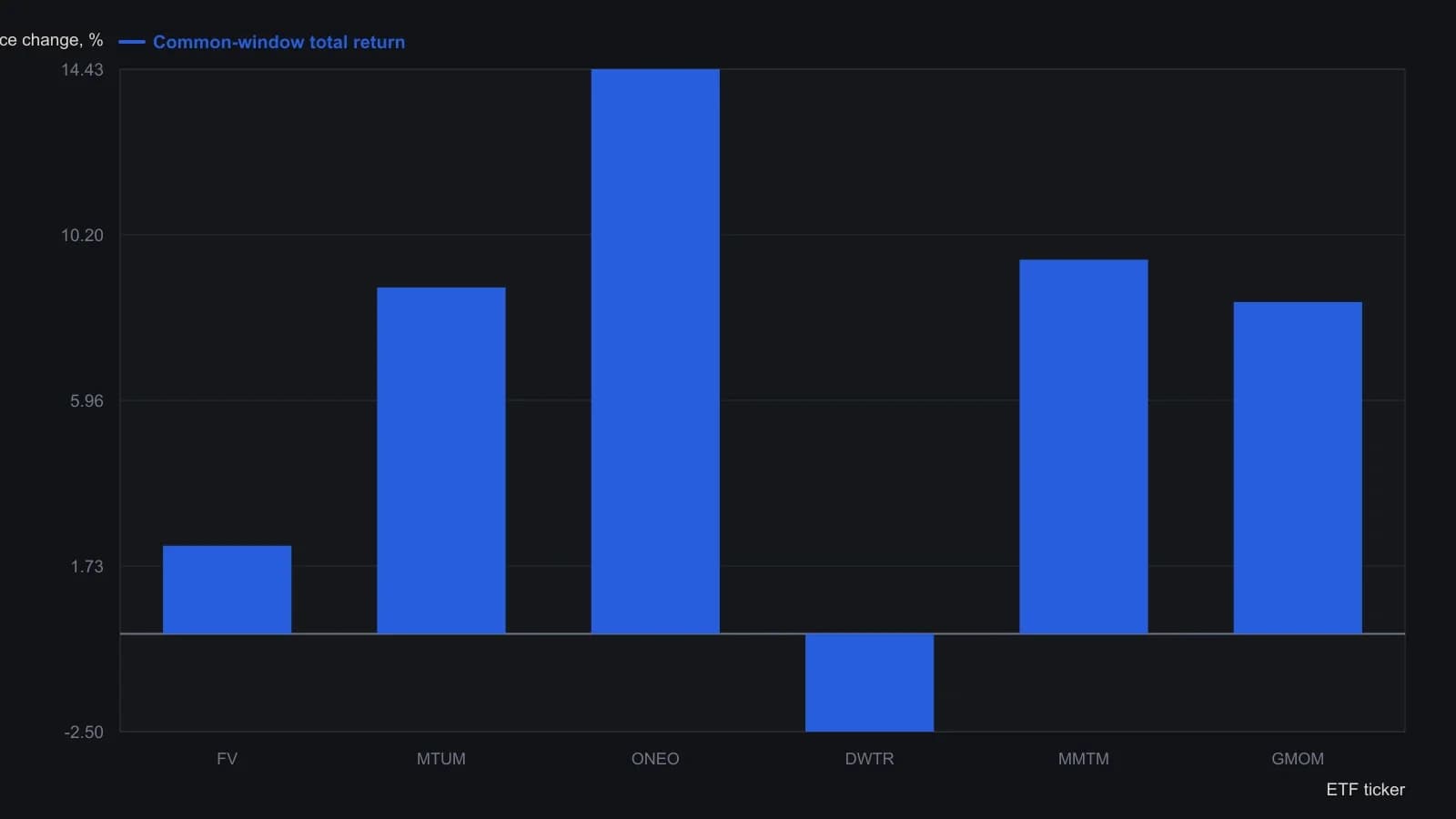
Window starts on the earliest date all six ETFs were trading. The source warns that the track records are too short for a long-horizon verdict.
A checklist before the sleeve is assigned
Live histories were short. A ten- to twenty-year record was described as the preferred basis for judging long-horizon behavior. The evaluation checklist included objective, top holdings, selection methodology, and how often components change.
TradersWeek editorial view: match the sleeve to the universe, the lookback, the cash-sleeve rule, and the rebalance clock before treating two momentum names as substitutes.
All readings on this track · 7 readings
- 1998Evaluating a binary relative-strength allocation
- 1999Rank-based sector-fund rotation with cash
- 2017Classroom rotation across a short factor-ETF menu
- 2017Evaluating momentum ETF rotation engines
- 2018Rotating international sleeves on relative-strength cycles
- 2019Rank-based sector rotation failed a late-2018 defensive-shift test
- 2020A five-phase compass for sector rotation and book context