1982issue C051-13
Swing charts, stop-loss orders, and good-till-cancelled covers in a bond-market coil
A bond-market coil was read with monthly, weekly, and daily swing structure first. Two mutually exclusive monthly outcomes framed the apex, a four-part daily sequence started a single-contract short with a working stop, and later re-entry split two good-till-cancelled covers between the larger downswing and a shorter release.
- The monthly swing chart pre-specified two mutually exclusive outcomes at a prior contract high: a break toward a higher resistance, or a double or lower top that could start a major decline.
- A four-part daily sequence was treated as a short-term sell signal, but higher daily swing lows kept the first short to a single contract.
- The sell and the protective buy-stop were entered together as day orders, then the stop was converted to a good-till-cancelled working order after the fill.
- Re-entry waited for a broken daily swing low, a reversal day in a pre-marked window, a minor double top, and a lower-high plus lower-low structure, then split the work across two good-till-cancelled stops.
Restricted decision tools
The case restricted its decision tools to a monthly swing chart, weekly and daily bar charts, a daily swing chart, time and price-range divisions, and a reading of price formation and trend. A swing chart is a record of successive swing highs and lows used to judge whether trend character is intact or has changed.
Two monthly scripts and a weekly coil
The monthly swing chart was used to pre-specify two mutually exclusive outcomes at a prior contract high: a break toward a higher resistance, or a double or lower top that could start a major decline. Editorial: Those two scripts were written before the weekly coil had to choose a direction.
A weekly coil, a narrowing symmetrical triangle, was built from two upward waves. Its approach to the apex was treated as a directional decision point, and the coil was treated as approaching culmination once price neared that apex.
A four-part daily sell signal
A four-part daily sequence was treated as a short-term sell signal. The sequence was a sharp rally, a close at or near that day's high, a next-session open that holds below the prior close, and a close that undercuts the prior day's low near the session low.
Because the daily swing chart still showed higher swing lows, the first short was limited to a single contract rather than a full-size entry. Editorial: Higher swing lows meant the downtrend script had not yet been confirmed, so the first short was a trial rather than a full-size commitment.
Day orders, then a working stop
Before the first short, a sell and a protective buy-stop were entered together as day orders. After the sell filled, the buy-stop was converted to a good-till-cancelled working order. A stop-loss is a pre-placed protective order that bounds loss before entry and while a position remains open. A good-till-cancelled order is a working order that stays active across sessions until it is filled or withdrawn.
The first protective stop was placed above the open of the sell-signal day, with a more conservative alternative noted above that day's new high. The first short was closed when a later rally broke the prior high and triggered the protective stop, after the last daily swing low had held.
Re-entry and two working covers
A later short was taken only after a daily swing low broke for the first time since a major February low, together with a reversal day in a pre-marked price and time window, a minor double top, and a lower-high plus lower-low configuration. A reversal day is a session that makes a new extreme and then closes back toward the opposite end of its range.
After re-entry, two shorts were assigned different jobs and different good-till-cancelled buy-stops. One was held for the larger downswing. One was sold on the next minor rally as a shorter-horizon release. A separate good-till-cancelled cover was left at a half-range support of the prior advance.
December 1983 T-bond marked prints from the February low to 31 May
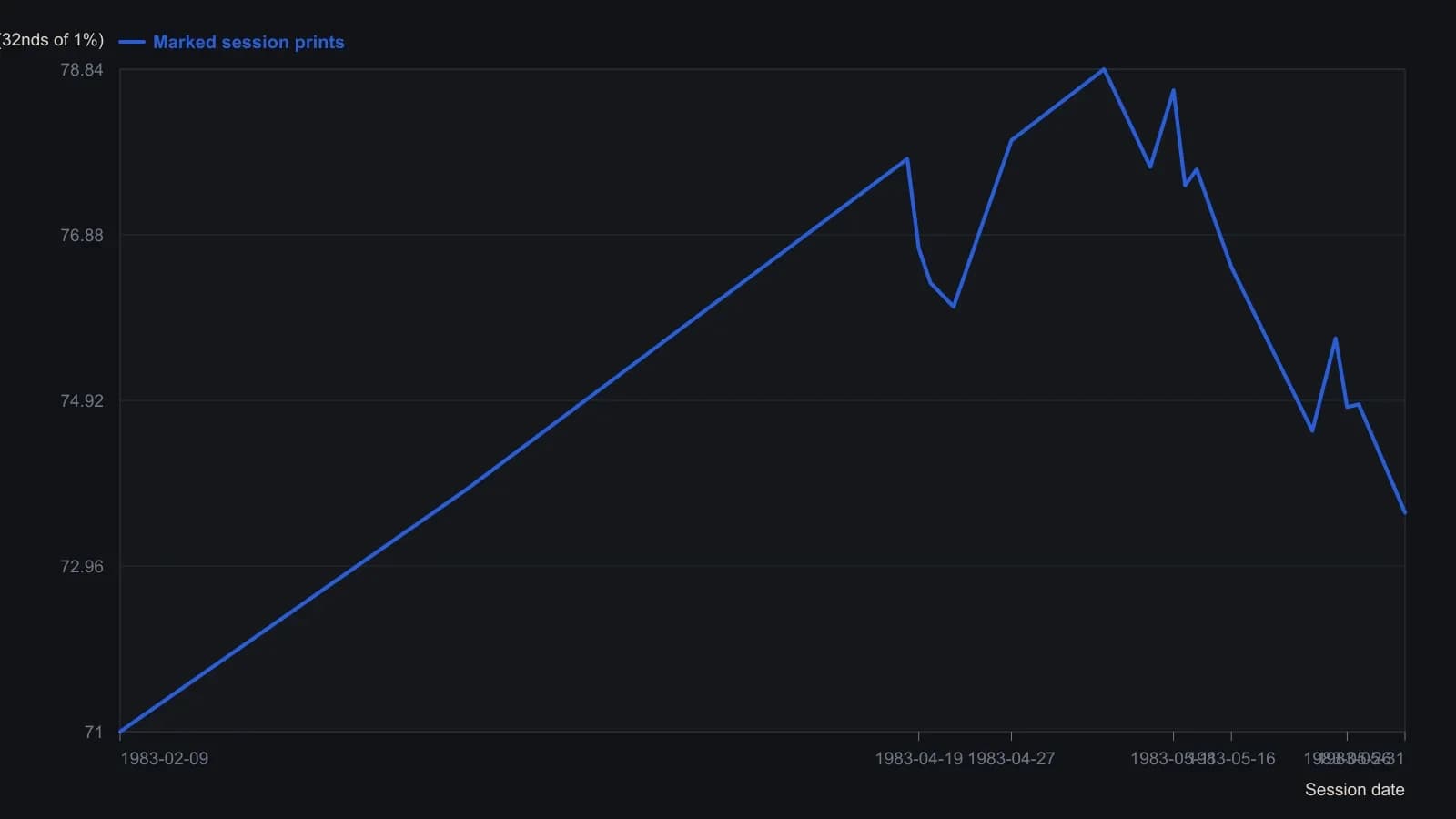
Quotes are converted from the source points-and-32nds notation (77-25 equals 77 + 25/32). Each point is the print the author specified for that date (high, low, close, or fill), not a uniform daily close. The 75-28 Point A low is omitted because no calendar date is given.
All readings on this track · 8 readings
- 1982Swing charts, stop-loss orders, and good-till-cancelled covers in a bond-market coil
- 1982Park good-till-cancelled targets after commissions at the chart bands
- 1987Write the danger-point stop before the trade is accepted
- 1989Christmas tree construction as a five-week monthly procedure
- 2006Constructing the single-price open from overnight flow
- 2008Overnight session routing for good-till-cancelled, limit, and market orders
- 2013Session cutoffs, good-till-cancelled orders, and exchange margin
- 2013Depth of market ladder versus resting order ticket