2012issue C1258-64
Weekly debit spreads and volatility regime matching
A name can swing hard from session to session and still finish a multi-session window with little net trend. This case study uses that gap between path and displacement to assign option buying or selling, then checks a weekly debit-spread procedure with explicit delta, premium-recovery, and short-leg buyback rules.
- Realized path and net displacement are not the same decision input: large daily percentage swings can still leave little net trend over a multi-session window.
- The teaching contrast assigns significant one-way trends to option buying and volatile trading ranges to premium-selling structures such as iron condors.
- A weekly debit spread reduces net outlay by pairing a high-delta in-the-money long with a short leg that collects more time premium than the long side pays.
- If the short sale cannot meet the premium target, the same checklist allows a nearer short strike, a naked long, or no trade.
Path and net displacement
A high-volatility name can post large daily percentage swings and still finish a multi-session window with little net trend. Realized path and net displacement are not the same decision input.
A low-variation one-percent-per-session advance over twenty sessions compounds to more than a twenty-percent net gain. A matching-length zigzag of ten-percent up and down days can leave price near its start.
Buying premium or selling premium
The teaching contrast assigns significant one-way trends to option buying and volatile trading ranges to premium-selling structures such as iron condors.
In the standard pricing model, a stock that rises one percent each day with no variation has theoretical volatility of zero. That is why consistent trends can make purchased premiums comparatively cheap.
Implied volatility is the volatility the market prices into options. In this workflow it is used to judge whether names are better candidates for buying premium in trends or selling premium in ranges.
Boeing put implied volatility against 30-day historical volatility
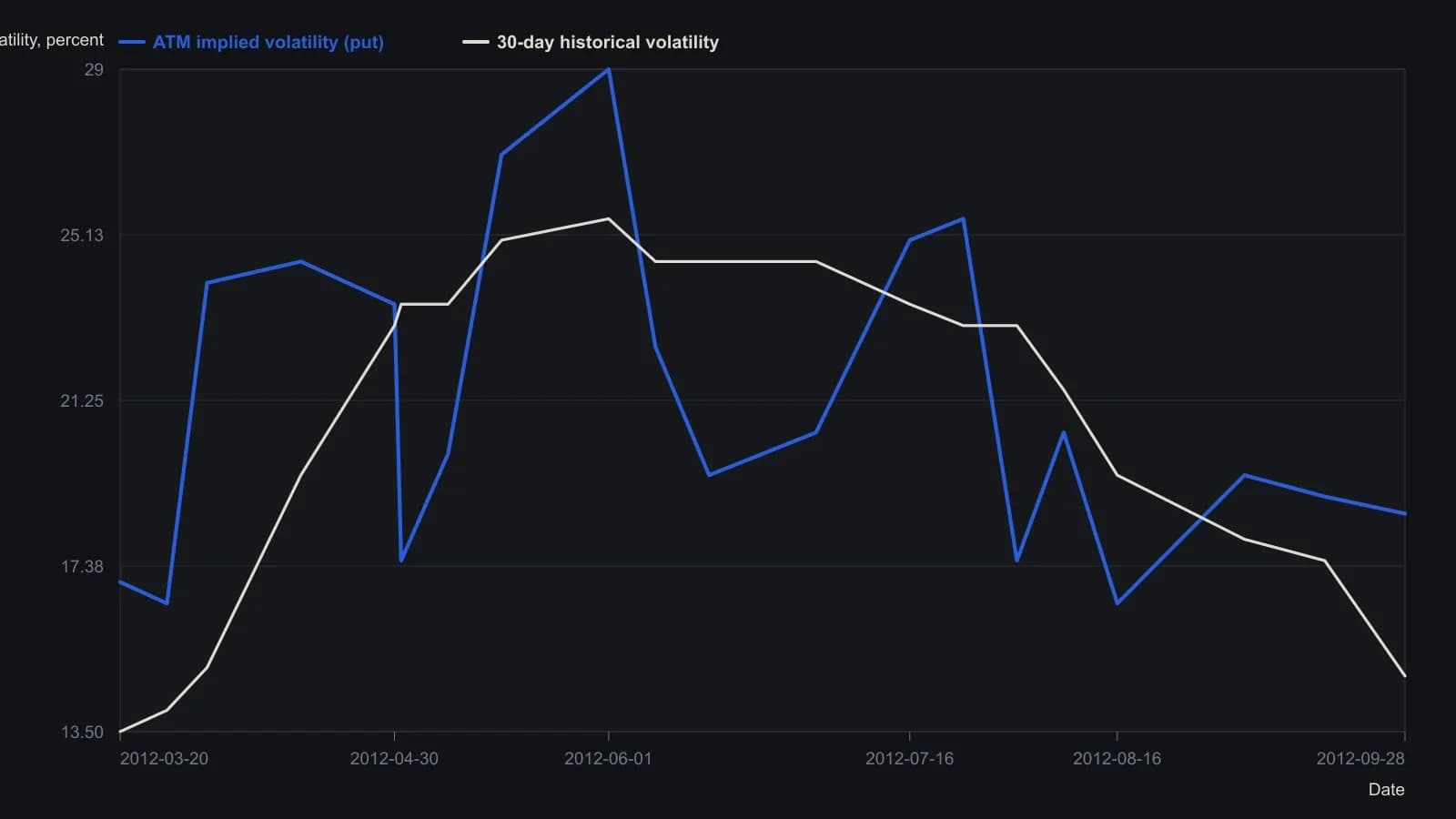
Plain and dividend-reinvested historical vol overlay on this snapshot (both print 14.8251 at 30 days). Option settle IV is 26.1100 as a short right-axis mark, not a history. The calculator footer says premium was below intrinsic, so live implied vol could not be computed. Digitized levels are approximate to about half a volatility point.
Weekly options and unused time
Weekly options are framed for holds of about seven trading days or less so buyers do not pay for unused calendar time. They can also complete time spreads or covered positions against longer-dated options or stock.
A weekly debit spread is presented as reducing net outlay. When it is constructed to the stated rules, it also removes time-decay exposure that is otherwise acute in short-dated options.
Delta, premium recovery, and abstention
An option spread is a defined-risk combination of a long option and a short option that reduces net premium paid or collected while shaping the payoff. A debit spread is entered by paying a net premium, typically a long in-the-money option funded in part by selling a farther out-of-the-money option.
The long leg is specified as a deeper in-the-money stock substitute with delta of at least seventy, raised to at least eighty in the final few days before Friday expiration. Delta is the approximate change in option price for a one-point move in the underlying and is used here as that stock-substitute threshold.
The short leg is an out-of-the-money option, or an at-the-money option in the last day or two, sized so collected time premium more than covers time value paid on the long side. Option premium analysis is that comparison, so the net debit is justified by remaining life and expected move.
In the worked numbers, a 100-strike call bought for 4.00 with five sessions left and the stock at 103.00 is paired with a 105 call targeted at 1.00 or more. If that sale cannot meet the target, the trader considers a nearer short strike, a naked long, or no trade.
Buying back the short leg
To avoid permanently capping a strong trend, the short call is considered for buyback when the stock reaches the written strike plus the premium first collected. A 105 call sold at 1.00 with the stock at 103.00 is reviewed at 106.00. A late-cycle buyback can still leave the combined debit spread profitable.
Editorial reading: those buyback and abstention checks keep entry, exit, and standing aside inside one procedure rather than a separate discretionary overlay.
All readings on this track · 10 readings
- 1998Strike selection from a return distribution and implied volatility
- 2004Constructing an index-options overlay with dividend premiums and open interest
- 2005Implied volatility and price divergence as a sentiment regime filter
- 2007Ranking short options by premium, margin, time, and delta
- 2008Bull put spread construction under elevated implied volatility
- 2008Net time-value ranking for conversion spreads
- 2008Out-of-the-money commodity credit spreads in a volatility regime
- 2012Far-spot option-elasticity and percent-theta limits
- 2012Weekly debit spreads and volatility regime matching
- 2018Constructing option strikes from intrinsic and time premium