2008issue C041-6
Bull put spread construction under elevated implied volatility
A bull put spread is built as a credit spread: sell an out-of-the-money put, buy a further out-of-the-money put, and keep the net credit if the underlying stays above the sold strike. This archive article walks through that construction when support, elevated implied volatility, and time decay are treated as joint inputs.
- A bull put spread sells an out-of-the-money put and buys a further out-of-the-money put so that a net credit is received at entry.
- Maximum credit is kept if the underlying remains above the sold strike and both puts expire worthless; maximum loss occurs if price falls below the purchased strike.
- Because profit is capped at the entry credit, higher implied volatility is treated as favorable: it increases the time premium collected on the short put.
- The preferred setup pairs an identifiable support level with implied volatility near the high end of a one- or two-year range, and PROVEST decides whether the spread is admissible.
What a bull put spread is
A bull put spread is constructed by selling an out-of-the-money put and buying a further out-of-the-money put so that a net credit is received at entry. The combination is a credit spread: more premium is collected on the short leg than is paid for the long leg.
The construction is positioned as a way to collect premium when the underlying goes nowhere, especially when high implied volatility makes buying options unattractive.
How credit and loss are bounded
Maximum credit is kept if the underlying remains above the sold strike and both puts expire worthless. Maximum loss occurs if the underlying falls below the purchased strike.
Reward-to-risk is the ratio of maximum credit collected to maximum spread-width loss. For this construction the ratio is typically less than one, so the position is described as requiring active loss control.
Why higher implied volatility is treated as favorable
Implied volatility is the market-implied volatility embedded in option prices. Here it is a gauge of how much time premium is available to collect. Time premium is the extrinsic portion of an option price. For out-of-the-money options it is the entire premium, and it fluctuates with implied volatility and demand.
Because profit on the spread is capped at the entry credit, higher implied volatility is treated as favorable: it increases the time premium collected on the short put.
Support as the line the short put needs
An identifiable support level plus implied volatility near the high end of a one- or two-year range is presented as the preferred setup for this credit spread.
A support setup is a clearly identified price floor. It gives the short put a defined line the underlying is expected to hold while time decay works on the position.
An illustrated 10-lot construction
In the illustrated 10-lot example, a December 50 put is sold at 1.00 and a December 45 put is bought at 0.15. That produces a maximum credit of 850 against a much larger defined loss.
The reward-to-risk ratio is less than 1. The same example presents the position as requiring active loss control rather than a hold that can be left unmanaged.
Expiration P/L of the 10-lot LLY December 50/45 bull put spread
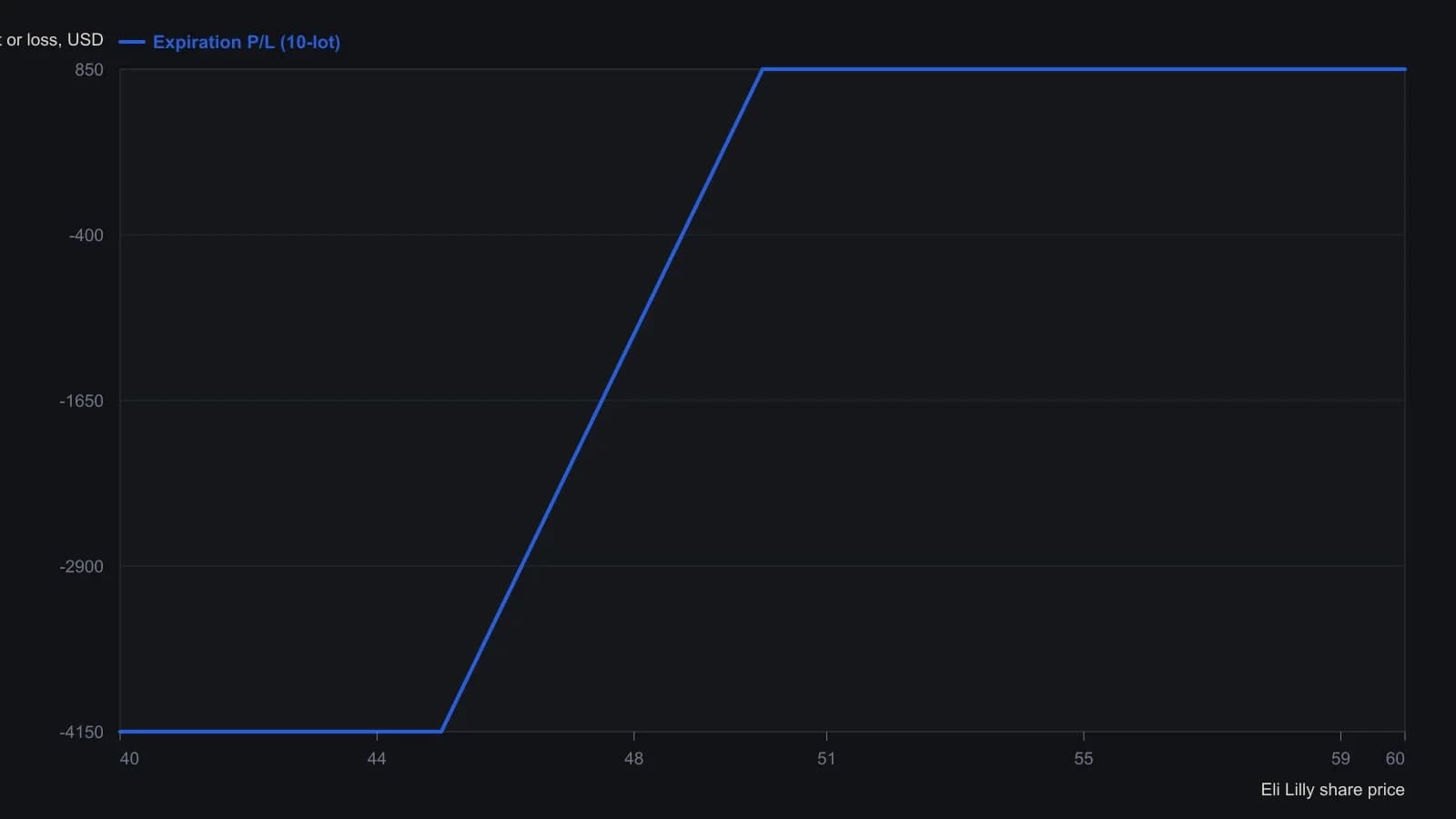
The construction arithmetic is a 0.85-point credit, or 850 dollars on a 10-lot. The same article later quotes maximum profit as 815 dollars in the Figure 4 caption and the results paragraph; this series uses the 850-dollar figure computed from the fills.
Time decay above the short strike
Risk curves for the construction show time decay working in the trader's favor while the underlying stays above the short strike as expiration approaches. Time decay here means the spread's marked value tends to improve along that path.
In the same example path, the underlying held above strike 50 through December expiration, both puts expired worthless, and the position realized its maximum credit.
PROVEST as the admission screen
PROVEST is a five-factor checklist used to decide whether a bull put spread is admissible: probability, volatility, expiration, skew, and timing.
The screen looks for short-put deltas near -20 to -45, implied volatility near the top of its one- or two-year range, and less than 60 days to expiration. Favorable volatility skew is optional. Timing is set against double or triple bottoms when buying options is hard to justify.
Editorial reading
Editorial: TradersWeek reads this construction as one procedure that can enter, hold, exit, or abstain, not as a directional bet that the underlying must rally. Support, elevated implied volatility, and time decay are treated as joint inputs that make the credit spread screenable.
That framing is editorial. The archive presents a construction, a screen, risk curves, and one example path to expiration. It does not claim results for present markets.
All readings on this track · 10 readings
- 1998Strike selection from a return distribution and implied volatility
- 2004Constructing an index-options overlay with dividend premiums and open interest
- 2005Implied volatility and price divergence as a sentiment regime filter
- 2007Ranking short options by premium, margin, time, and delta
- 2008Bull put spread construction under elevated implied volatility
- 2008Net time-value ranking for conversion spreads
- 2008Out-of-the-money commodity credit spreads in a volatility regime
- 2012Far-spot option-elasticity and percent-theta limits
- 2012Weekly debit spreads and volatility regime matching
- 2018Constructing option strikes from intrinsic and time premium