2015issue C0159
Mechanical trading systems as one testable procedure
Treat every candidate trading system as one mechanical procedure. Specify entry, exit, and abstention together, then use listing questions on markets, indicators, extra software, and support as due diligence, not as a popularity contest.
- A mechanical trading system issues automated buy, sell, or stand-aside signals from rules specified in advance, which can reduce discretionary interpretation at the moment of the trade.
- A system may be supplied as software, a real-time signal service, or a published rule set, and one procedure may combine several methods.
- A practical review asks which indicators are used, which markets are covered, whether extra applications are required, what support is offered, and what features are stated.
- A compiled listing may omit track records and rankings, view counts are not an editorial rating, and posted details can change after posting.
A trading system can reduce discretionary interpretation by issuing automated buy and sell signals from rules specified in advance. In the terms used here, a mechanical trading system is a procedure that maps rule inputs, market state, and execution constraints into buy, sell, or stand-aside signals over the system holding period. An automated signal is a buy or sell instruction generated from those preprogrammed rules instead of from discretionary interpretation at the moment of the trade.
How a system may be delivered
A trading system may be delivered as computer software, as a real-time signal service, or as a published set of rules to follow. That rule-set delivery is the form in which the system is supplied. It does not, by itself, complete the procedure.
One system may rely on a single method or on several methods at once, including indicator collections and custom rules. A multi-discipline system combines more than one method, such as indicator collections and custom rules, inside one procedure.
Questions that belong in a practical review
A practical review of a system asks which indicators it uses, which markets it covers, whether extra applications are required, what support is available, and what its primary features are. System due diligence is that pre-adoption check of indicators used, markets covered, extra applications required, support offered, and stated features.
What a compiled listing is not
A compiled listing of trading systems may omit track records and comparative rankings. Ordering systems by how often they were viewed is not an editorial rating or ranking. A click-frequency list is an ordering of products by how often they were viewed, which is not an editorial rating of quality.
Details in a vendor-submitted system listing are treated as current only at the time of posting and can change afterward. The party that posts a listing is responsible for its own representations.
Most-clicked trading systems on Traders’ Resource
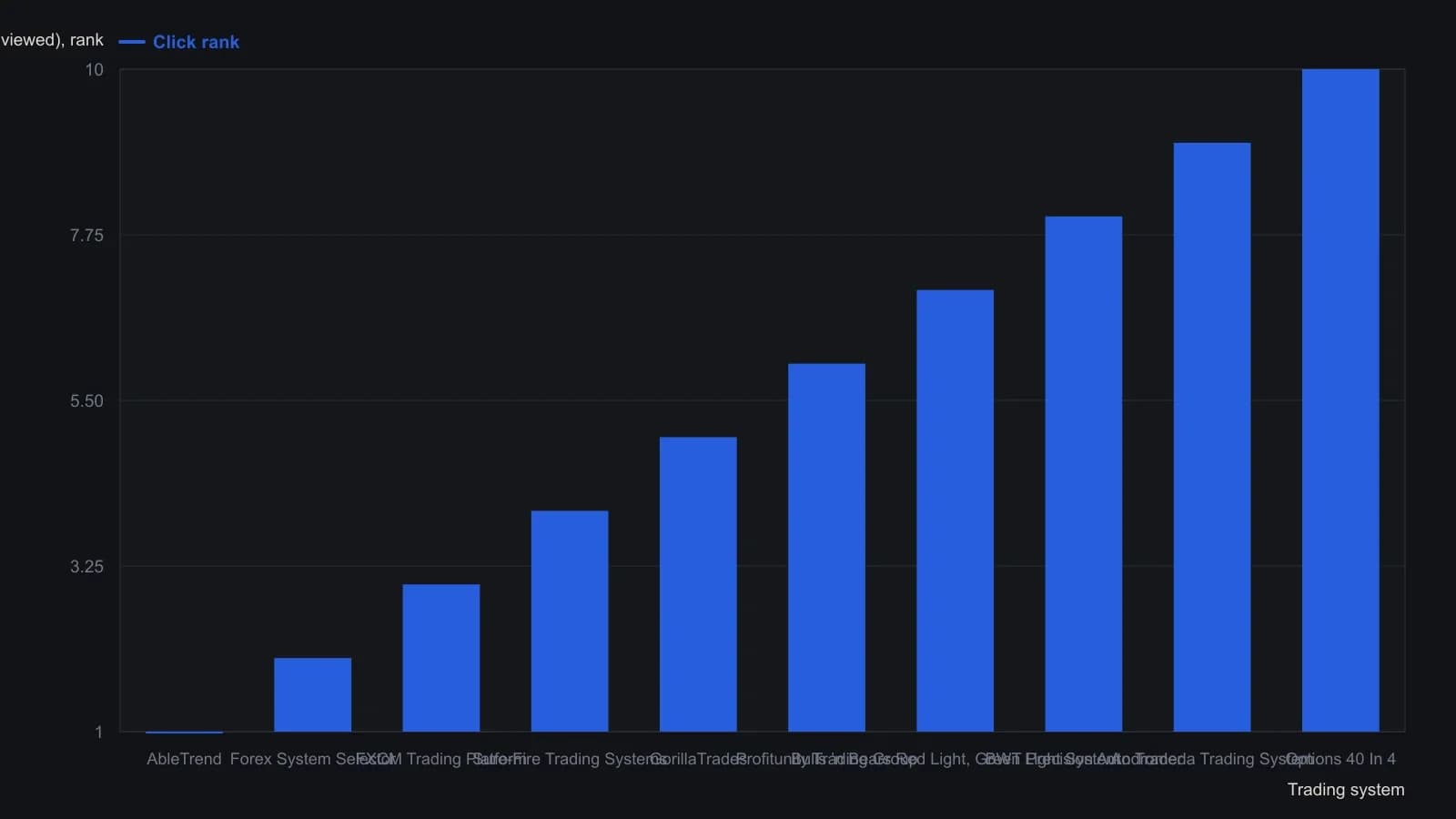
The magazine prints rank order only, not raw click counts. Y is inverted rank so rank 1 sits at the top of the bar chart. Track records are explicitly withheld from the listing.
All readings on this track · 22 readings
- 1985Treat a shared mechanical printout as a public script
- 1988Pessimistic margin ranking for mechanical systems
- 1991From a differenced-average sketch to coded rules
- 2003Commodity enthusiasm is not a complete system
- 2005Reader surveys as system evaluation checklists
- 2008Critiquing unchanged mechanical signals in evolving markets
- 2010Read a mechanical trading system catalog as a specification checklist
- 2011Specify mechanical system signals as one testable procedure
- 2012Treat a packaged mechanical system as one inspectable procedure
- 2013Mechanical trading systems as complete signal procedures
- 2013Testable cycle rules as one procedure
- 2014Evaluate mechanical trading systems as one procedure
- 2015Mechanical trading systems as one testable procedure
- 2016Evaluating mechanical trading systems as testable procedures
- 2016Reading a systems catalog as one mechanical procedure
- 2018Mechanical systems as testable signal procedures
- 2019Treat mechanical system listings as specification audits
- 2019Match the automation stack to mechanical system constraints
- 2019Bar size as a mechanical system construction constraint
- 2020Interrogating mechanical system listings as one procedure
- 2020Mechanical systems still need emotion rules
- 2020Comfort, not theory, keeps mechanical rules in use