2008issue C061-5
Critiquing unchanged mechanical signals in evolving markets
Teach the decision process as two layers: first write the mechanical moving-average signal as one testable entry, exit, and abstention routine; then use a trading psychology process to withhold or rewrite that routine when volume structure, lot composition, or crowded identical signals show the old market matrix has already started to change.
- A mechanical trading system is a fixed sequential rule set that can issue an entry, exit, or stand-aside signal, but it cannot rewrite those human-written commands when market structure changes.
- Familiar stochastic and MACD crossovers omit money flow, volume, lot composition, price velocity, and transaction quantity, so they can exit too early in fast moves and produce whipsaws in sideways, short-horizon action.
- Shared-signal crowding appears when many small accounts fire the same packaged on-or-off signal, creating a chart pattern larger counterparties can trade against.
- The trading psychology process notices preparation for change, resists identical-crowd signals, and revises or withholds the mechanical rule while the trader still makes the final decision on each trade.
A two-layer decision process
Editorial interpretation: teach the decision process as a two-layer procedure. First make the mechanical, moving-average signal fully testable as one entry, exit, and abstention routine. Then require a trading psychology process that withholds or rewrites that routine when volume structure, lot composition, or crowded identical signals show the old market matrix has already started to change.
A mechanical trading system is a fixed sequential rule set that turns stated inputs into an entry, exit, or stand-aside signal and does not rewrite itself when market structure changes. Automated mechanical systems follow a sequential list of human-written mathematical commands and cannot independently rewrite those commands when conditions change.
Fixed commands and a changed market matrix
Listed prices are described as the product of human decisions and emotions, not a fixed mathematical process of the kind computers execute instantly.
Volume acceleration on the Dow Jones Industrial Average, NASDAQ Composite, and S&P 500 is dated as starting in 1998 and is linked to internet access for trading. That change is described as a sudden structural shift: a slow or sudden change in how prices and volume form after a lasting change in market participation or trading technology. The same description says the shift changes cycles and how indicators should be used.
Packaged automated systems are described as relying mainly on older indicator constructions from the 1960s or 1970s written for a different market matrix, without a means to evaluate or absorb abrupt pattern shifts.
Dow Jones volume regime shift after 1998
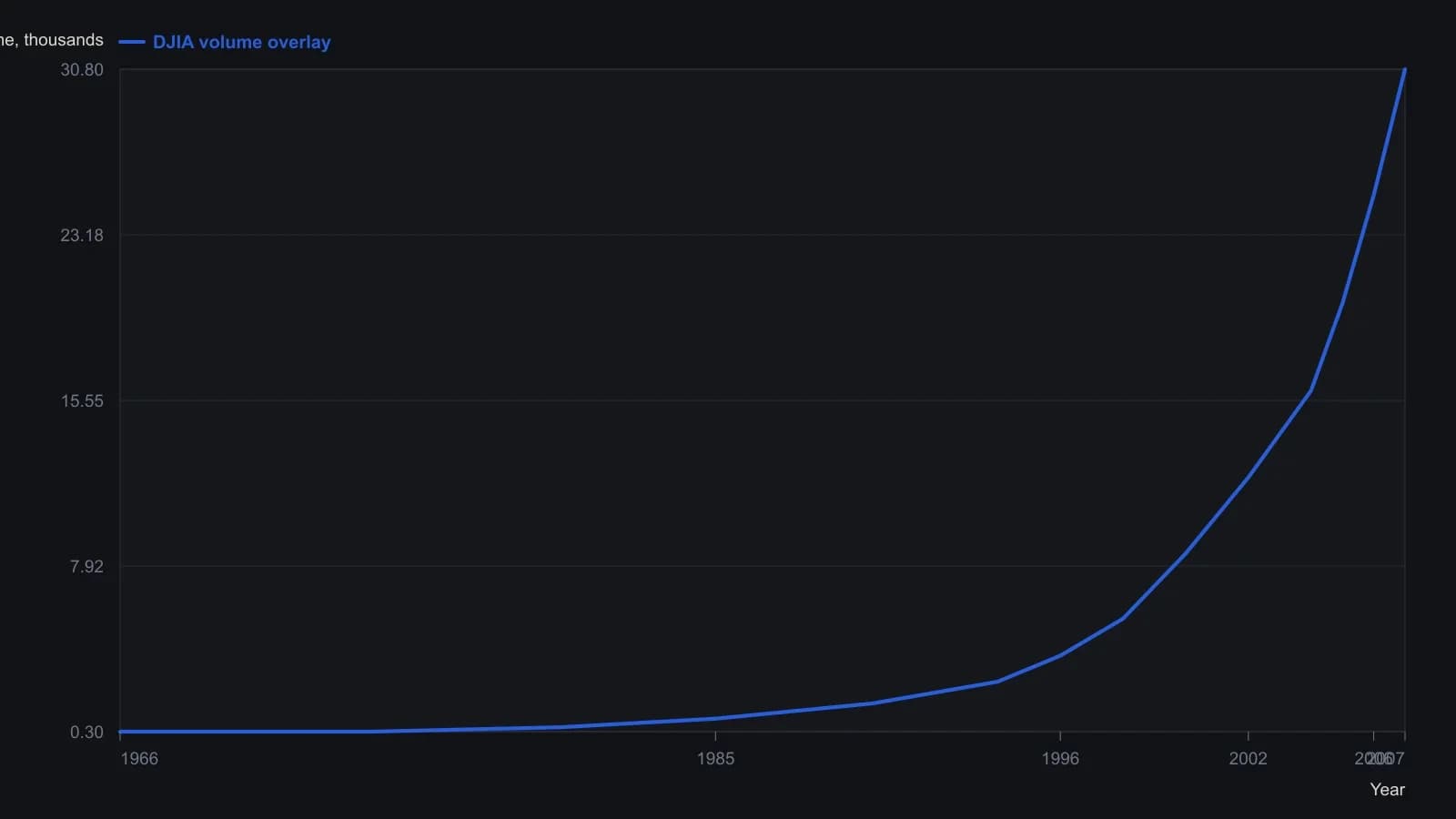
Only the latest volume reading (30.79K) is printed on the pane. Earlier points are approximate heights of the green volume overlay against that scale on a 1966–2007 weekly-or-longer chart; values are rounded to the precision the raster will support.
What familiar crossover engines omit
Stochastic and MACD are the usual mechanical engines because they are familiar and reduce to simple numeric crossover rules. The stochastic construction described omits money flow, volume, large-lot versus small-lot patterns, price velocity, and transaction quantity, and is said to issue premature exits when prices move quickly.
Treating MACD as a purely mechanical crossover is reported to produce frequent whipsaws in sideways, short-horizon conditions because it is a moving-average trend measure. A moving average is a lagging summary of past prices used in crossover constructions; combinations can shorten but not remove the delay versus raw price. A whipsaw is repeated opposite mechanical signals during sideways price action that produce frequent small losing trades.
Lot composition and shared-signal crowding
Institutional activity is stated as more than 75 percent of then-current market activity and as following different buy-sell behavior than small retail lots. Lot composition is whether transactions are dominated by large institutional size or small retail size, which can move price in opposite directions at the same time. One described pattern is a brief upside burst driven by small lots after large lots have started to sell.
Identical packaged on-or-off signals used by many small accounts create shared-signal crowding: the chart pattern created when many small accounts fire the same packaged on-or-off signal, which larger counterparties can trade against. Complex quantitative formulas are described as being refreshed as often as every three to four months.
When the psychology process rewrites the routine
The trading psychology process is the human decision layer that notices preparation for change, resists identical-crowd signals, and revises or withholds a mechanical rule when it no longer fits the tape. Editorial interpretation: that second layer is required when volume structure, lot composition, or crowded identical signals show the old market matrix has already started to change.
Automation is framed as a supporting tool that should not replace trader skill. A computer can be set to adjust after conditions have already changed, while the trader’s role is to recognize preparation for change, modify the procedure then, and still make the final decision on each trade.
All readings on this track · 22 readings
- 1985Treat a shared mechanical printout as a public script
- 1988Pessimistic margin ranking for mechanical systems
- 1991From a differenced-average sketch to coded rules
- 2003Commodity enthusiasm is not a complete system
- 2005Reader surveys as system evaluation checklists
- 2008Critiquing unchanged mechanical signals in evolving markets
- 2010Read a mechanical trading system catalog as a specification checklist
- 2011Specify mechanical system signals as one testable procedure
- 2012Treat a packaged mechanical system as one inspectable procedure
- 2013Mechanical trading systems as complete signal procedures
- 2013Testable cycle rules as one procedure
- 2014Evaluate mechanical trading systems as one procedure
- 2015Mechanical trading systems as one testable procedure
- 2016Evaluating mechanical trading systems as testable procedures
- 2016Reading a systems catalog as one mechanical procedure
- 2018Mechanical systems as testable signal procedures
- 2019Treat mechanical system listings as specification audits
- 2019Match the automation stack to mechanical system constraints
- 2019Bar size as a mechanical system construction constraint
- 2020Interrogating mechanical system listings as one procedure
- 2020Mechanical systems still need emotion rules
- 2020Comfort, not theory, keeps mechanical rules in use