2013issue C0224-27
A live-cattle call butterfly is a different risk object than an outright call
One February live-cattle call ladder can be held as a single 131 call or rebuilt as a 131/133/135 butterfly. The archive figures show a $150 defined debit and a body-centered expiration payoff for the three-leg structure, against a $540 debit for the outright 131 call and a different breakeven for a long 133 call.
- A CME live-cattle futures contract is specified at 40,000 pounds, so a February print near 130 cents per pound implies a notional near $52,000.
- The illustrated 131 call was a 1.35-cent, $540 debit. The 131/133/135 call butterfly paid 1.35 plus 0.225 and collected 0.60 twice, for a 0.375-cent, $150 defined debit.
- At expiration the butterfly breaks even at 131.375 and is worth $650 at 133, versus a long 133 call that breaks even at 134.35, is worth $260 at 133, and has unlimited reward.
- Near-maximum butterfly payoff requires the underlying near the short strike at expiration, and the cattle example is not framed as a general rule for every commodity.
The same ladder, two risk objects
The archive case study uses one February live-cattle call ladder to compare a single long call with a three-leg call butterfly. Both structures share the same CME contract and the same expiration month. They do not share the same debit, breakeven, or expiration payoff.
Editorial interpretation: a three-leg call butterfly is a different risk object than an outright call. The same contract specs and strike ladder can turn a directional idea into a defined-debit, target-at-the-body trade that only pays if price and time line up.
Contract size and the outright call
One CME live-cattle futures contract is specified at 40,000 pounds, so a February print near 130 cents per pound implies a notional near $52,000.
On the illustrated February live-cattle call ladder, the 131 call was 1.35 cents, which at 40,000 pounds equals a $540 debit for a single long call.
The three-leg butterfly debit
A long butterfly is defined as one long lower-strike option, two short options at a middle strike, and one long higher-strike option, all in the same expiration month. In this archive article, a butterfly-spread means a same-expiry three-leg vertical with long wings and a two-contract short body, so the net debit is the maximum loss until expiration.
The worked 131/133/135 February cattle call butterfly paid 1.35 plus 0.225 and collected 0.60 twice, for a net 0.375-cent debit, or $150 of defined risk on a 40,000-pound contract.
Expiration payoff at the body
In the same case study, that butterfly's expiration breakeven is 131.375 and its reward at 133 is $650 per contract, versus a long 133 call with unlimited reward, a 134.35 breakeven, and $260 at 133.
An option-spread lets those entry, cost, payoff, and exit figures be compared as one trade rather than as separate contracts. The archive presents the reward-to-risk figures as conditional: near-maximum payoff requires the underlying to be near the short strike at expiration, and price outside the strike zone can leave little or no residual value.
February live-cattle 131/133/135 call butterfly, expiration profit
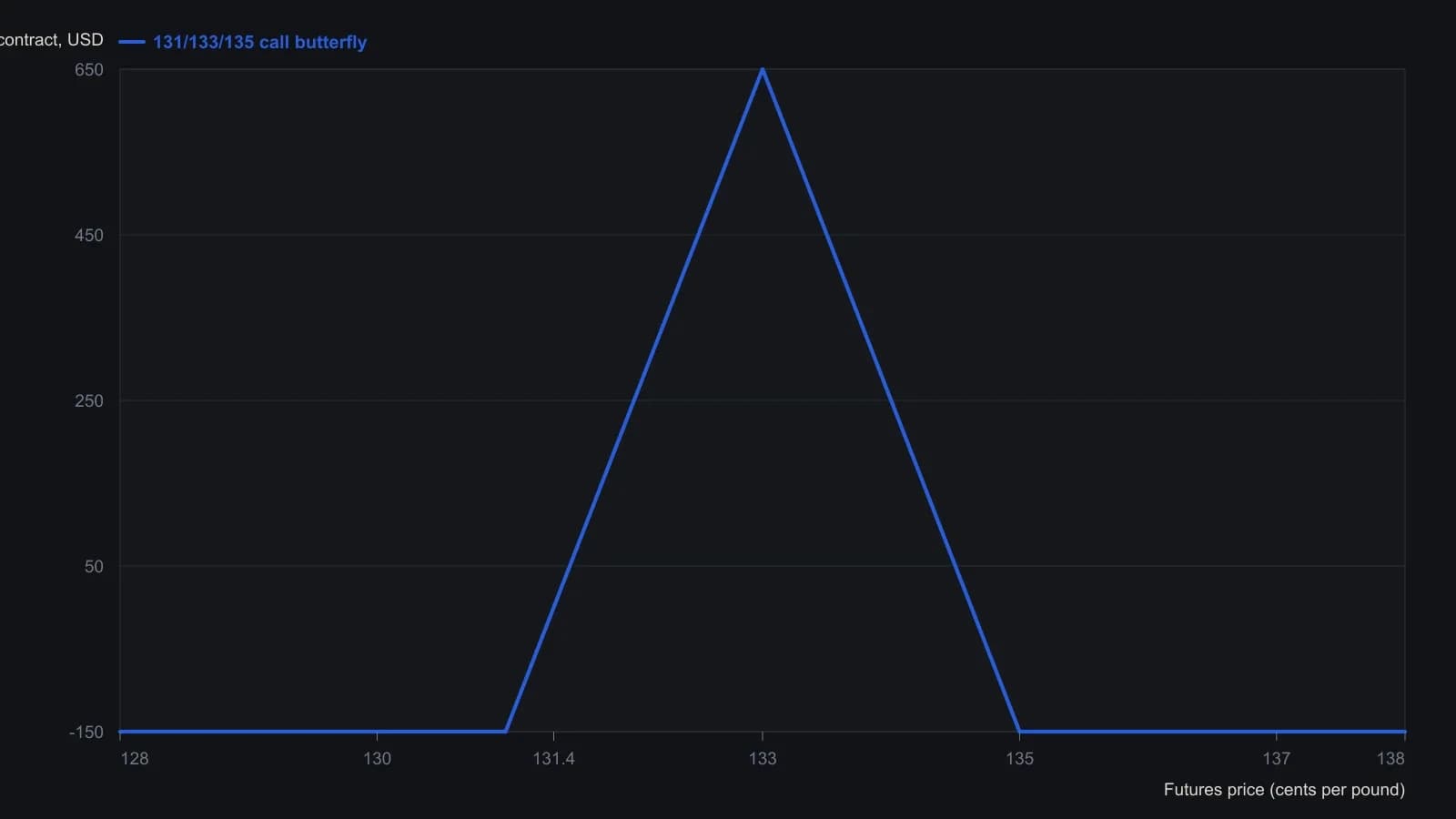
Expiration (0 DTE) profile only. The source also drew 35-, 24-, and 12-day live curves that cannot be read from the raster.
Channel placement and early exit
Entry guidance in the example favors placing buy and sell legs around an upward linear-regression channel and treating early arrival at the target as a reason to exit rather than hold for a larger residual.
The linear-regression step is a fitted price channel used to place butterfly wings around an expected path instead of around an isolated strike guess.
A liquidity-constrained example
The procedure is framed as liquidity-constrained: many futures option markets are too thin for multi-leg butterflies, so the cattle example is not a general rule for every commodity.
All readings on this track · 18 readings
- 2003Specify a butterfly as one range procedure
- 2006Index volatility alignment, skews, and butterfly construction
- 2006Oil proxies, volatility regimes, and bounded overlays
- 2007Pairing a double-diagonal overlay with an income butterfly
- 2008Range-bound butterfly debit versus iron credit
- 2008Iron butterfly payoff construction in volatile crude
- 2010Constructing directional out-of-the-money butterfly spreads
- 2010Modified butterfly and calendar spreads in high-priced names
- 2011Broken-wing put butterfly: credit, vega, and assignment
- 2013A live-cattle call butterfly is a different risk object than an outright call
- 2017Put butterfly payoff construction from an implied move and premium
- 2017One-day earnings volatility, ratio spreads and butterflies
- 2017Building a staggered broken-wing butterfly book
- 2017Below-the-money butterfly spreads sized by volatility regime
- 2018Why day-one option risk curves misread theta, calendars, and butterflies
- 2019An expected-value filter for defined-risk option spreads
- 2019Failed breakout as a setting for an out-of-the-money put butterfly
- 2020Limited-risk call butterfly construction in volatile oil