2019issue C0224-27
An expected-value filter for defined-risk option spreads
The archive converted platform probability of profit, maximum profit, and maximum loss into a two-outcome expected-value filter before size was added. Editorial reading: each defined-risk option spread sat as one bounded chip in a volatility-regime book.
- The expected-value filter formed a two-outcome screen as maximum profit times probability of profit minus maximum loss times one minus that probability.
- The basic probability assumption treated outcome probabilities as known with certainty and required those probabilities to sum to one.
- An unhedged short call sent the expected-return figure toward minus infinity, so a higher-strike long call was treated as required insurance that kept the structure defined-risk.
- Defined-risk structures were ranked by high expected return rather than high probability of profit alone, and many repeated trials were required before a long-run average was meaningful.
A two-outcome expected-value filter
A two-outcome expected-return screen was formed as maximum profit times probability of profit minus maximum loss times one minus that probability. In this archive that arithmetic is the expected-value filter: a pre-entry screen that weights maximum profit by probability of profit and subtracts maximum loss weighted by the complementary probability.
Platform-reported probability of profit entered the screen only as the win-weight. The basic probability assumption treated outcome probabilities as known with certainty and required those probabilities to sum to one.
Defined risk kept the screen finite
An unhedged short call was described as creating theoretically unlimited loss, which sends the expected-return figure toward minus infinity. A higher-strike long call was treated as required insurance.
A defined-risk spread is an option combination whose maximum loss is finite because long wings or a higher-strike option cap assignment risk. The archive used that cap so the expected-value filter stayed a finite number rather than running toward minus infinity.
Four archive screens
A short-put plus short-call-spread example used a 4.10 credit, 16 days remaining, and a 99.5 percent probability of profit, implying a 410 maximum profit and a 90 maximum loss. The screen was written as 410 times 0.995 minus 90 times 0.05, equaling 407.5.
A reverse iron condor, a four-leg structure that buys the inner options and sells the outer wings, kept both profit and loss capped. With equal 25 maximum profit and loss it placed wings near one standard deviation of a Gaussian density from observed prices, used a profit probability near 62 percent, and computed a screen of 6 with two days remaining.
An iron condor, a four-leg range structure that sells the inner options and buys the outer wings, was shown on a high implied-volatility name. It collected a 3.31 credit with a 61 percent probability of profit and a 1.69 maximum loss if price finished below 296.69. The per-structure screen was 331 times 0.61 minus 169 times 0.39, equaling 136.
A one-day sell-call butterfly showed a 2.21 credit as maximum profit and a 96 percent probability of profit, with maximum loss if price finished above 184.71 or below 185.30. The screen used 219 times 0.96 minus 281 times 0.04, equaling 199. That butterfly spread is a three-strike call structure that sells the wings and buys two middle-strike calls, producing a tightly bounded payoff around a narrow price band.
Ranking by expected return
Defined-risk structures were ranked by high expected return rather than high probability of profit alone, with many repeated trials required before a long-run average is meaningful, while the time-dependent error in those probabilities was left unresolved.
Editorial reading: the option-spread entry, hold, and abstention decision is one procedure over the remaining life, and the book is studied as a repeated-trial book of many small, similarly bounded structures rather than one large wager. Implied-volatility context is the surrounding price and volatility regime used to judge whether a short-dated defined-risk unit belongs beside other positions.
Expected return of four defined-risk option spreads
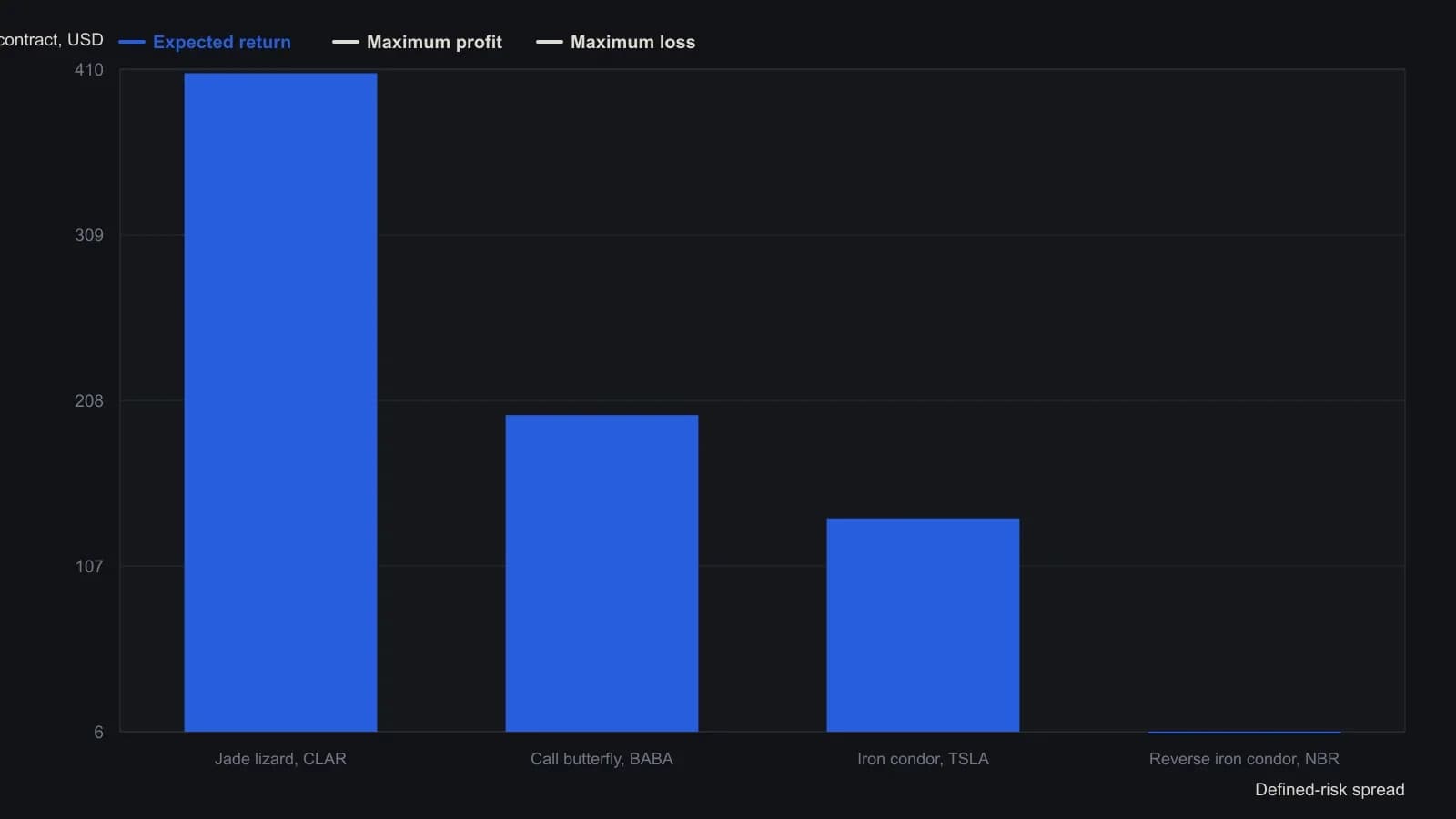
Nabors probability of profit was 62 percent on the platform screen and 60 percent in the formula. Alibaba maximum profit was entered as 219 dollars against a stated 2.21 credit.
All readings on this track · 18 readings
- 2003Specify a butterfly as one range procedure
- 2006Index volatility alignment, skews, and butterfly construction
- 2006Oil proxies, volatility regimes, and bounded overlays
- 2007Pairing a double-diagonal overlay with an income butterfly
- 2008Range-bound butterfly debit versus iron credit
- 2008Iron butterfly payoff construction in volatile crude
- 2010Constructing directional out-of-the-money butterfly spreads
- 2010Modified butterfly and calendar spreads in high-priced names
- 2011Broken-wing put butterfly: credit, vega, and assignment
- 2013A live-cattle call butterfly is a different risk object than an outright call
- 2017Put butterfly payoff construction from an implied move and premium
- 2017One-day earnings volatility, ratio spreads and butterflies
- 2017Building a staggered broken-wing butterfly book
- 2017Below-the-money butterfly spreads sized by volatility regime
- 2018Why day-one option risk curves misread theta, calendars, and butterflies
- 2019An expected-value filter for defined-risk option spreads
- 2019Failed breakout as a setting for an out-of-the-money put butterfly
- 2020Limited-risk call butterfly construction in volatile oil