1990issue C061-8
Implied economic forecasts from factor portfolio construction
Leftover macroeconomic factor loadings are either priced factor-investing bets or an implied forecast already sitting in the book. This archive article shows how to measure net exposure, convert its variance contribution into a required return, and decide whether that forecast is one the book is willing to own.
- A book that stays exposed to a pervasive economic factor is carrying construction risk that is coherent only if a compensating return is expected.
- Bottom-up reasons for owning names do not require keeping avoidable macroeconomic loadings. Opposite-signed stocks can cancel a factor while preserving the selection thesis.
- If a risk premium is not the rationale, leftover sensitivity is an implied forecast that the macroeconomic variable will move in a direction that lifts portfolio return.
- Ranking holdings by marginal variance contribution, including residual return, produces implied alphas that turn a factor view into weights or reveal the forecast already embedded in current holdings.
Leftover loadings are construction choices
Macroeconomic shocks move individual equities, and the same shock can raise expected returns for one industry group while lowering them for another. A book that stays exposed to a pervasive economic factor is carrying construction risk that is coherent only if a compensating return is expected.
Bottom-up selection reasons for owning names do not require keeping avoidable macroeconomic loadings. Opposite-signed stocks can cancel a factor while preserving the selection thesis.
Two reasons to keep a macroeconomic loading
A factor-investing rationale treats accepted macroeconomic sensitivities as risks the market may compensate over a long horizon, without requiring a directional forecast of the factor itself. Under that pricing view, a conventional equity index need not be mean-variance efficient relative to a complete market mix, a theoretical all-asset portfolio whose factor profile can differ from the index. Matching the index factor profile is therefore a distinct construction choice.
If a risk premium is not the rationale, leftover sensitivity is an implicit forecast that the underlying macroeconomic variable will move in a direction that lifts portfolio return. That leftover is the implied forecast: the macroeconomic move already embedded in a book once leftover factor exposure is treated as intentional.
How portfolio loadings were measured
One historical measurement design estimates each of 4,000 stocks against seven macroeconomic factors by regression. Each estimate produces a factor loading, a regression coefficient that maps a unit change in a macroeconomic variable into expected asset return, and a residual return for the portion of the stock return those factors do not explain. Portfolio loadings are then built as weighted averages of the stock coefficients.
From net exposure to a required return
Net exposure is the portfolio factor loading minus the same loading on the chosen benchmark. Incremental factor risk versus that benchmark is the variance contribution, equal to the squared net loading times that factor's own variance. A chosen mean-variance trade-off, a ratio that converts extra variance units into an equivalent required improvement in expected return, scales that increment into an implied required return.
What a year-end 1989 term-structure case implied
In a year-end 1989 worked case, a negative net loading on the term-structure slope versus the S&P 500 produced 205 variance units, an implied 146-basis-point return need, and an 18-basis-point flattening from a 40-basis-point slope.
Implied alphas already in the holdings
Ranking holdings by marginal variance contribution, including residual stock-specific risk, produces implied alphas. An implied alpha is the excess return a holding must be assumed to deliver to justify its current contribution to portfolio variance. Those implied alphas can turn a factor view into weights, or they can reveal the economic forecast already embedded in current holdings.
Implied alphas already sitting in the holdings
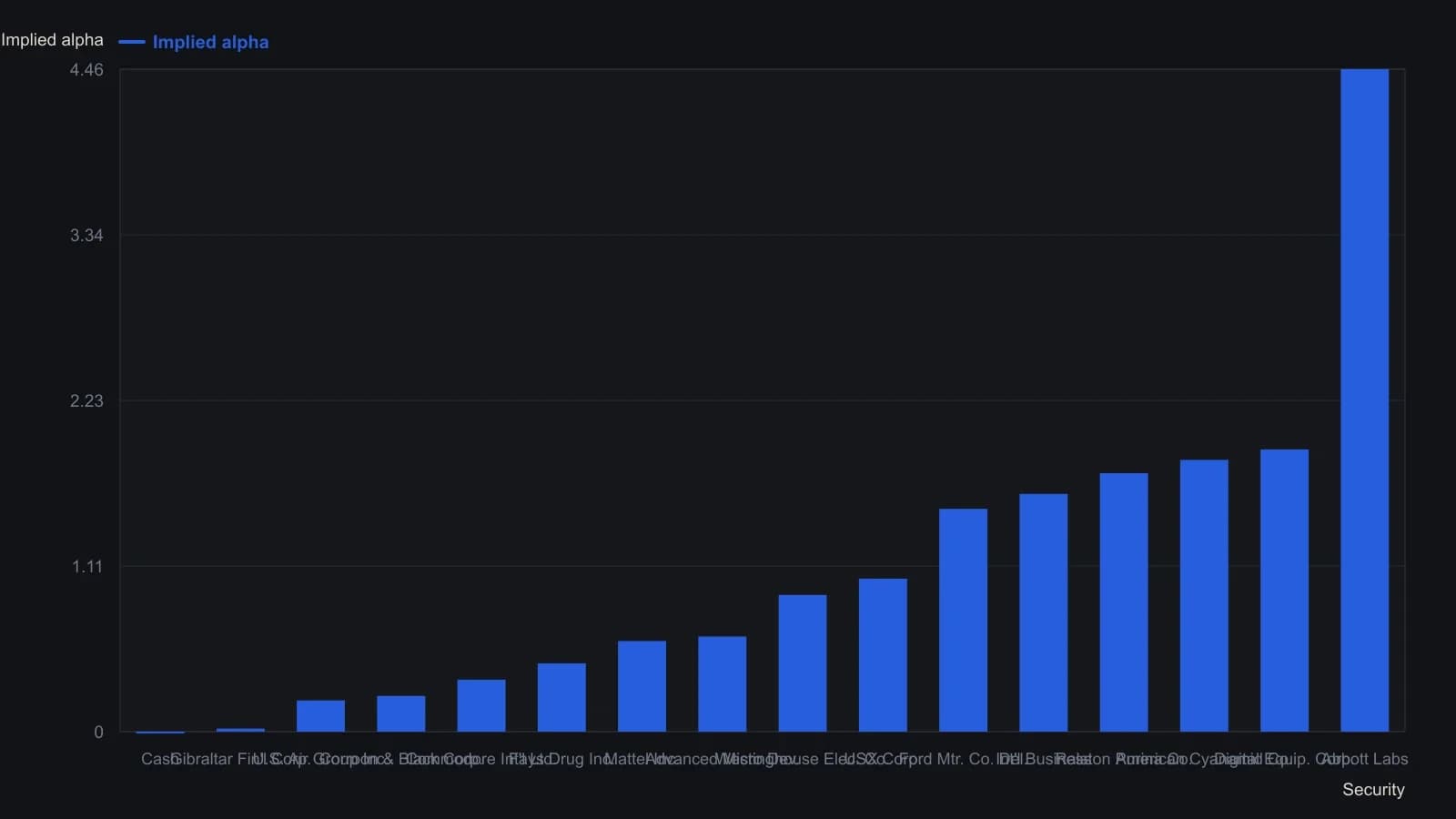
The source also folds stock-specific risk into each implied alpha, not only the name's macroeconomic factor loadings.
All readings on this track · 6 readings
- 1990Implied economic forecasts from factor portfolio construction
- 1994Alpha screening and regime-aware portfolio construction
- 2007Sizing a trend sleeve with a risk-aversion sweep
- 2010Portfolio construction as a pipeline: a 2010 classroom case
- 2013Classroom books, leftover beta, and diversification
- 2015Two layers for a managed-futures sleeve in a stock-bond mix