2012issue C1015-22
Halloween seasonal window with commodity overlay and leverage control
The archive describes a procedure that buys on October 1 and holds until May 1 of the following year, then pairs that window with a moving-average entry filter, a commodity allocation, and Leverage control. Editorial reading: those overlays should be judged as a possible change of regime, not as a simple scale-up of a calendar bet.
- The archive procedure buys on October 1 and holds until May 1 of the following year.
- The source pairs that window with a moving-average entry filter and a commodity allocation, including equal weights in a volatile commodity ETF and a 2x Dow ETF.
- Both selected ETFs were described as capable of drawdowns greater than 50% when held individually, and the source warns that leverage can magnify future losses if the seasonal pattern does not persist.
- Editorial reading: a commodity overlay and a leverage bound should be judged as a possible change of regime, not as a mere scale-up of the calendar window.
A holding-period procedure
The archive describes a procedure that buys on October 1 and holds until May 1 of the following year. Editorial reading: that rule set is Seasonal trading, with entry, hold, and exit tested as one procedure.
A 2001 to 2010 Halloween-window S&P 500 test was reported at about 7% versus -1% for buy-and-hold. That figure is archive context for the historical workflow. It is not a claim about later periods.
Commodity overlay and equal weights
The source pairs the seasonal window with a moving-average entry filter and a commodity allocation. Equal weights in a volatile commodity ETF and a 2x Dow ETF were presented as a way to cut combined volatility versus either fund alone.
Editorial reading: Seasonality analysis is how that overlay is judged. The question is whether the commodity sleeve and the portfolio weights change the market mix around the window, rather than only resize the same calendar bet.
Halloween-window trades in DBC and DDM
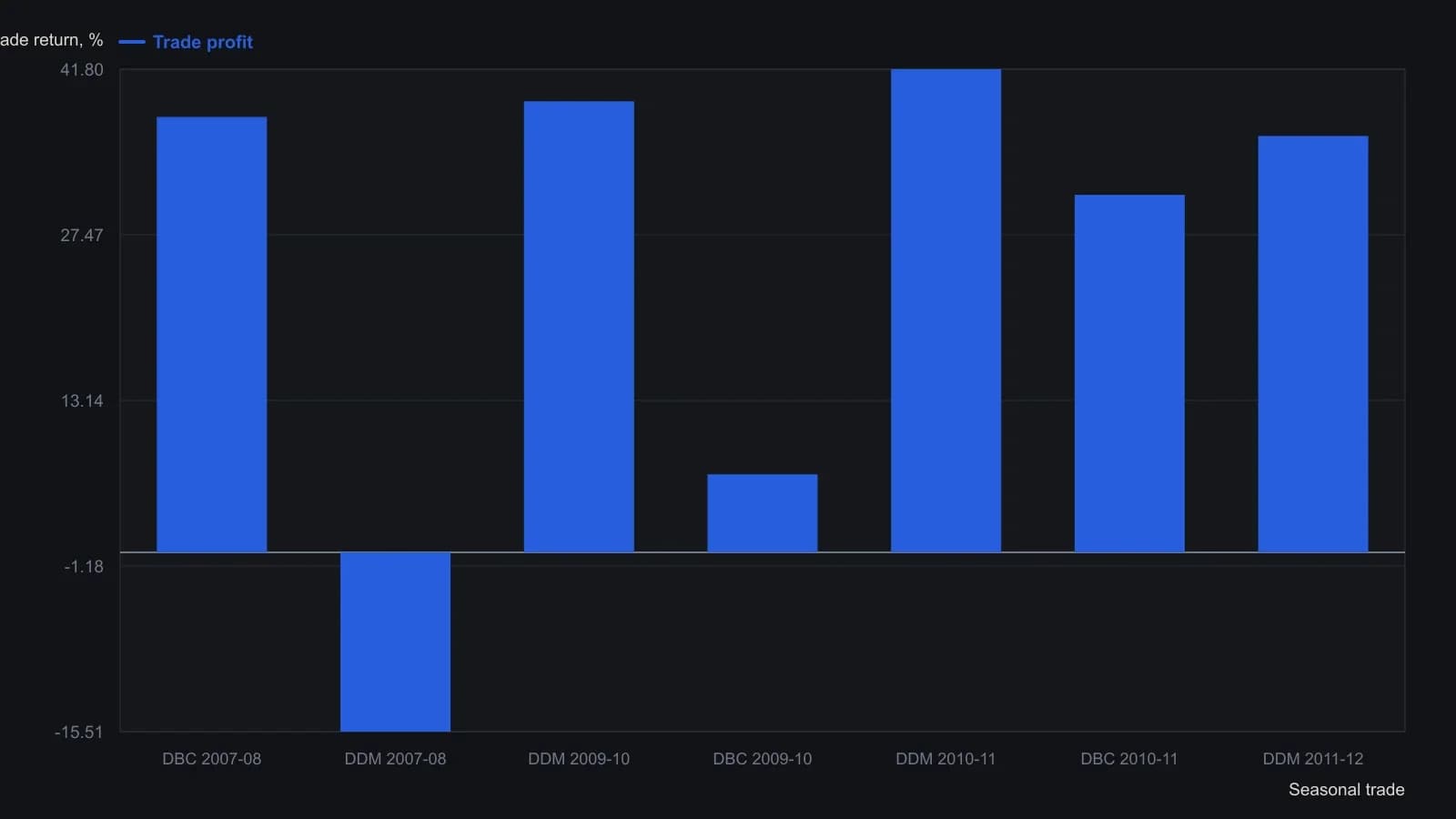
Buy only after October 1 when close is above the 50-day average; exit around May 1. Equal 50/50 weights and $50,000 starting capital. No seasonal trade in 2008.
Leverage control and drawdown bounds
Both selected ETFs were described as capable of drawdowns greater than 50% when held individually. The 2008 episode was cited as more than 50% loss in the S&P 500 and more than 60% in the commodity fund.
The source warns that leverage can magnify future losses if the seasonal pattern does not persist. A nonleveraged version of the same seasonal procedure was described as roughly half a leveraged version.
Editorial reading: Leverage control is a bound on that magnification before entry and through the hold, not a forecast that the Halloween window will repeat.
All readings on this track · 9 readings
- 1996Evaluate S&P 500 seasonal windows before using leverage
- 1998Combine seasonal, election, and yield rules as one procedure
- 1999Laddered beta exposure with leveraged index funds
- 1999Mechanical timing as an error budget, not an alpha story
- 2002Multiplier, margin, and stop discipline on cash-settled index minis
- 2008Harvest windows inside a commodity regime repricing
- 2011Daytrading as an incomplete decision process
- 2012Halloween seasonal window with commodity overlay and leverage control
- 2014A quiet tape is a regime test for trend-following, pairs, and leverage