2002issue C111-3
Multiplier, margin, and stop discipline on cash-settled index minis
A five-dollar cash-settled index mini turned an 8500 quote into 42500 dollars of notional while only 2700 dollars of initial-margin was posted, so equity moved much faster than the index. Editorial: treat multiplier, posted margin, and a point stop-loss as a three-input risk filter before a short-term cash-index swing is treated as a reason to trade.
- Smaller-multiplier cash-settled index futures were introduced so a retail-sized account could hold index exposure at a lower notional-value and lower outlay than a full-size contract.
- With a five-dollar contract-multiplier, a quoted level of 8500 implied a 42500-dollar notional-value, while 2700 dollars of initial-margin left most of that notional unfunded and let an adverse move exceed the deposit.
- A 100-point stop-loss on that contract mapped to a 500-dollar maximum loss, about 1.19 percent of unlevered notional and about 18.5 percent of the posted margin, and stops were treated as required discipline because margin does not cap the loss.
- Futures-contract-selection still meant checking live terms and the cash-futures-basis, and treating a 30-name industrial index as a path-size choice versus a single glamour stock, not as a safety guarantee.
A smaller cash-settled index future
Smaller-multiplier cash-settled index futures were introduced so a retail-sized account could hold index exposure at a lower notional and lower outlay than a full-size contract.
Editorial: that listing is a mini-index-contract, a reduced-multiplier, electronically traded index future that lowers per-contract outlay and notional versus a full-size contract.
Contract-multiplier and notional-value
With a five-dollar multiplier, a quoted level of 8500 implied a 42500-dollar contract value.
Editorial: notional-value is the quoted futures level multiplied by the contract-multiplier. The contract-multiplier is the dollar amount gained or lost for each one-point move in the quoted index future.
Initial-margin and the equity hit
An initial margin of 2700 dollars per contract left most of that notional unfunded, so a given index move changed account equity by a much larger percentage than it changed the index.
An adverse move on a leveraged contract can produce a loss larger than the initial margin deposit.
Editorial: initial-margin is the deposit required to open one contract, a fraction of full notional-value. Leverage-control means keeping notional exposure and posted margin inside a planned equity impact before entry and for as long as the position is open.
Stop-loss as required discipline
A 100-point stop on the five-dollar contract maps to a 500-dollar maximum loss because each point is worth five dollars.
In the worked adverse-move example, that 500-dollar stop loss was about 1.19 percent of unlevered notional and about 18.5 percent of the 2700-dollar margin.
Applying stops was treated as required discipline for leveraged index futures, not an optional overlay, because margin does not cap the loss.
Editorial: a stop-loss is a pre-committed exit distance, in index points, that converts to a bounded dollar loss through the contract multiplier.
Basis, live terms, and path size
The cash index and the mini future moved almost in step, with a small premium explained by financing cost versus dividends on the basket.
Editorial: that usual premium is the cash-futures-basis, the premium of the future over the cash index linked to financing cost versus dividends on the underlying basket.
Live contract terms were listed as items to check because they can change: multiplier, tick value, listed months, cash settlement, electronic hours, and successive 10, 20, and 30 percent daily limits.
A 30-name industrial index was argued to be less likely than a single glamour stock to move 75 to 90 percent in a year, which is a contract-selection point about path size rather than a safety guarantee.
Editorial: futures-contract-selection means choosing among index products by multiplier, margin, settlement, limits, and how closely the contract tracks the cash basket.
Cash Dow and September YM mini, daily, March–September 2002
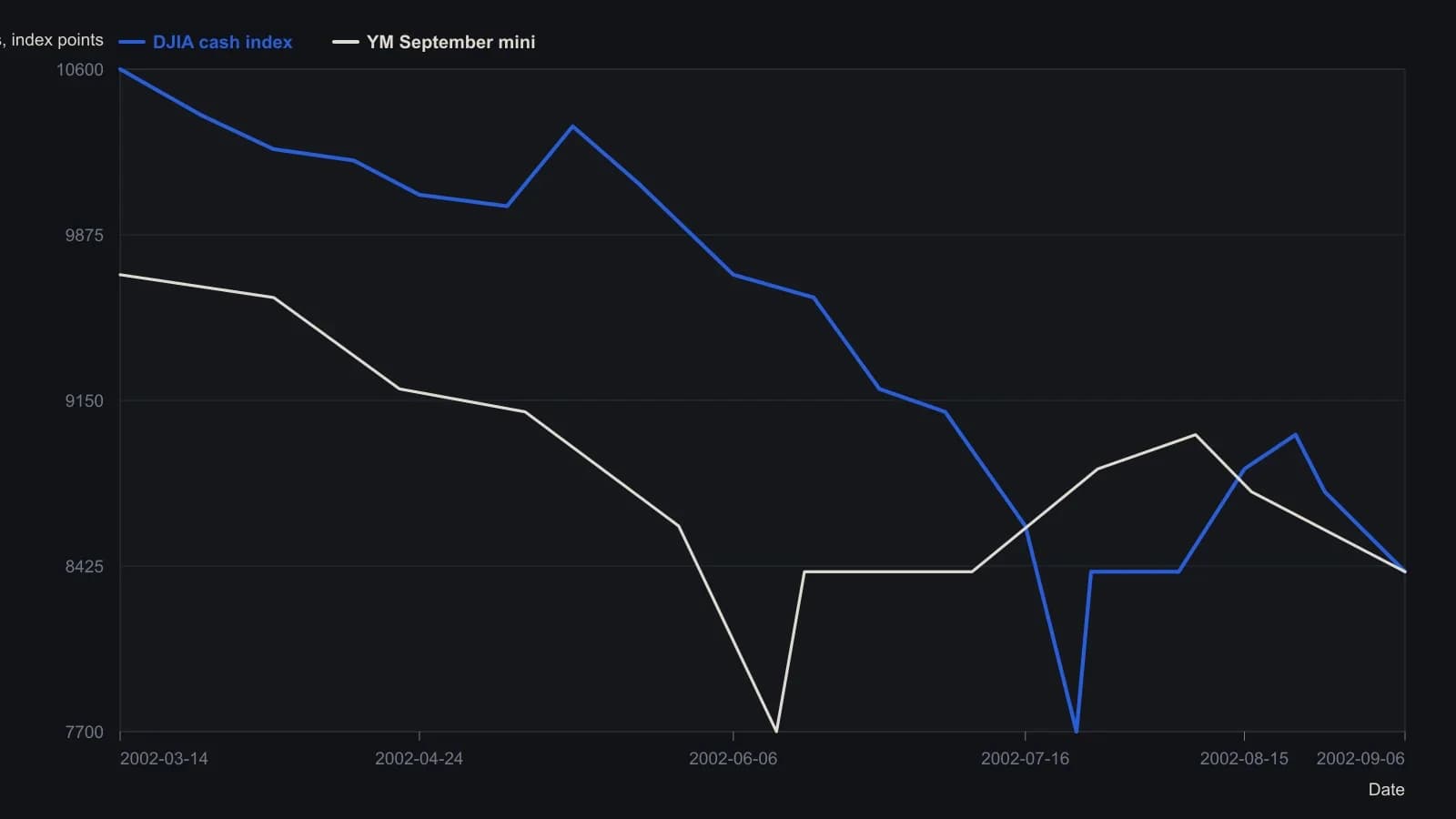
YM quotes before June 2002 are omitted because that pane only shows sparse dots pinned to the top of its scale. Axis ticks on the mini pane appear as 80000–100000 on the raster and were read as 8000–10000 index points to match the article’s 8500 quote and the cash-index scale. Overlapping dates use the same reading because a few-point basis cannot be separated on this image.
All readings on this track · 9 readings
- 1996Evaluate S&P 500 seasonal windows before using leverage
- 1998Combine seasonal, election, and yield rules as one procedure
- 1999Laddered beta exposure with leveraged index funds
- 1999Mechanical timing as an error budget, not an alpha story
- 2002Multiplier, margin, and stop discipline on cash-settled index minis
- 2008Harvest windows inside a commodity regime repricing
- 2011Daytrading as an incomplete decision process
- 2012Halloween seasonal window with commodity overlay and leverage control
- 2014A quiet tape is a regime test for trend-following, pairs, and leverage