2005issue C121-4
Constructing a signed, bounded market-breadth panel
A raw volume-per-issue breadth ratio rests at 1, so constructive and pressured counterparts cannot be averaged back to rest. Remapping that ratio, the issues line, and the volume line onto a shared zero rest state keeps every reading inside plus or minus 1 and lets the panel be stacked as explicit signals.
- The raw breadth ratio of average down volume per declining issue to average up volume per advancing issue rests at 1, with readings below 1 treated as constructive and readings above 1 treated as pressured.
- Constructive and pressured counterparts are reciprocals rather than sign flips, so 0.5 and 2 do not arithmetically average to the rest value of 1.
- A one-to-one remapping recenters rest at 0, confines readings to plus or minus 1, and turns those former counterparts into additive inverses that can be averaged with the issues line and the volume line.
- The remapped index and both component lines take the same value at the balance point, when the advancer-to-decliner count ratio equals the down-volume-to-up-volume ratio.
A rest state that does not average
Market breadth compares advancing versus declining issues and may weight each side by volume. The raw breadth ratio of average down volume per declining issue to average up volume per advancing issue is at rest at 1. Readings below 1 are treated as constructive. Readings above 1 are treated as pressured.
Constructive and pressured counterparts of that ratio are reciprocals rather than sign flips. The pair 0.5 and 2 does not arithmetically average to the rest value of 1. Raw issue counts and raw up or down volume sit on different scales, so they cannot be stacked with the ratio as if they shared one rest state.
Recentering the raw ratio
A one-to-one remapping subtracts the ratio from 1 and divides by the larger of 1 and the ratio. The map recenters rest at 0, confines readings to plus or minus 1, and turns former counterparts into additive inverses.
A single remapped breadth reading can arise from many different mixes of advancing issues, declining issues, up volume, and down volume.
Issues line, volume line, and the balance point
The issues line is a signed, bounded transform of the advancer-to-decliner count ratio. It is zero only when advancers equal decliners and is positive only when decliners outnumber advancers.
The volume line is zero only when up volume equals down volume and is positive only when up volume exceeds down volume. Editorial reading: that line is an up-down volume oscillator, a signed, bounded transform of the down-volume to up-volume relationship that sits on the same axis as the remapped breadth reading. It is taken from the up-volume ratio, the share of interval volume occurring in advancing issues, or from the paired down-to-up form.
When the advancer-to-decliner count ratio equals the down-volume-to-up-volume ratio, the panel is at its balance point. The remapped breadth index, the issues line, and the volume line then take the same value. The volume line sits above the issues line only when the advancer-to-decliner count ratio exceeds the down-volume-to-up-volume ratio.
A panel that can be averaged
The remapped index and both component lines share a zero rest state, remain inside plus or minus 1, and can be averaged arithmetically.
Unlike raw issue counts and raw up or down volume, the issues line and volume line are scaled so they can be compared across indexes and used as systematic inputs.
TRIN remapped to a signed, bounded BRIN
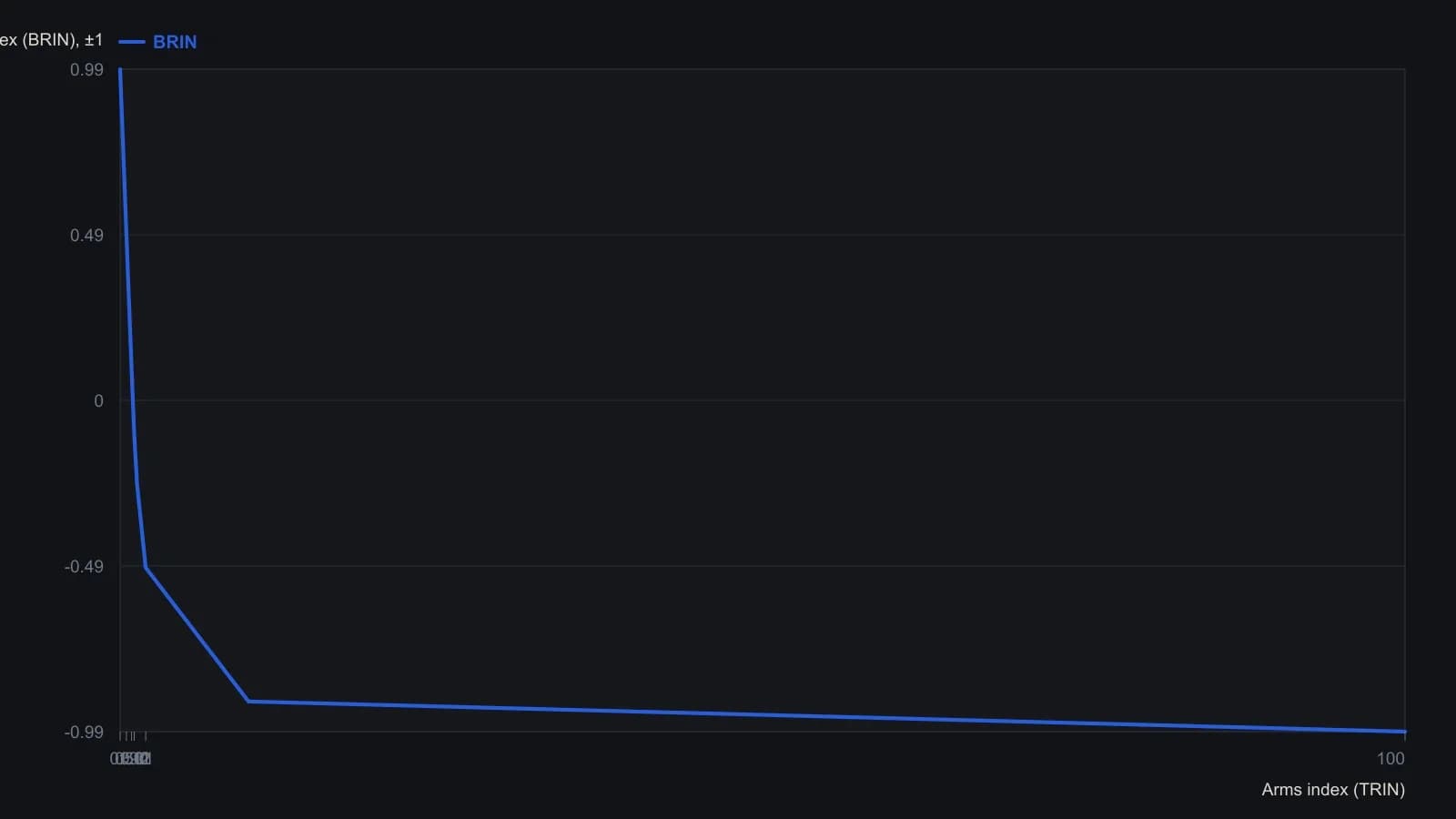
BRIN is the source’s second transform, (1 − TRIN) / max(1, TRIN). The article’s point is that TRIN 0.5 and 2 are opposites but do not average to 1, while the remapped pair −0.5 and +0.5 does.
All readings on this track · 6 readings
- 1990Evaluating a weekly up-volume ratio and an hourly oscillator
- 1993Score one swing with volume, bands, and price divergence
- 1993Constructing smoothed stochastics and an up/down volume oscillator
- 2001Constructing volume breadth with a negative volume index and up/down ratios
- 2005Constructing a signed, bounded market-breadth panel
- 2013Constructing an up/down volume oscillator from a web price series