2008issue C031-2
Perfect prints before the chart
The tape is the live quote and print stream of a listed continuous-auction. Successive perfect-prints that match advertised ask size can be treated as evidence of an aggressive buyer, while a chart-only view may register only an eight-cent rise. A wedge-position sits ahead of a larger order-filling-pattern and is held only while that pattern remains active.
- The tape typically shows symbol, last price, last trade size, net change, bid, ask, bid size, ask size, high, low, and volume, and the listed market is presented as a continuous-auction.
- Three successive perfect-prints that each match advertised ask size at 25.25, 25.29, and 25.33 are treated as evidence of an aggressive buyer, while a chart-only view would register only an eight-cent rise.
- A wedge-position of 500 to 10,000 shares is characterized as having little market impact and as able to sit ahead of a larger order-filling-pattern until that pattern is exhausted.
- Specialist-held orders and the uptick rule are described as sometimes producing fills 20 or 30 cents from the intended price, while later electronic routing is described as filling within pennies.
What the tape shows
The tape is the live quote and print stream. It typically shows symbol, last price, last trade size, net change, bid, ask, bid size, ask size, high, low, and volume.
The listed market is presented as a continuous-auction. In that format, aggressive buyers can lift offers and drive price higher, while aggressive sellers can hit bids and force price lower.
Charts as products of the tape
Charts, indicators, and color trade signals are treated as products of tape activity. They are not treated as data that can exist independently of the tape.
A perfect-print sequence
A perfect-print is a trade that consumes exactly the size advertised on the bid or ask at that price, rather than a partial or unmatched print.
Three successive trades that each match advertised ask size at 25.25, 25.29, and 25.33 are treated as evidence of an aggressive buyer. A chart-only view would register only an eight-cent rise.
The order-filling-pattern and the wedge-position
An order-filling-pattern is a repeatable sequence of prints associated with how floor traders and electronic routes work a large order. Those patterns are said to last anywhere from 30 seconds to six and a half hours, depending on order size.
A wedge-position is a comparatively small holding, described in the range of 500 to 10,000 shares. It is characterized as having little market impact and as able to sit immediately ahead of a larger, pattern-driving order until that pattern is exhausted.
Futures comparison and fill distance
Comparing S&P futures movement with the equity being tape-read is offered as a way to form a feel for both the stock and the broader market.
Specialist-held orders and the uptick rule are described as sometimes producing fills 20 or 30 cents from the intended price. Later electronic routing is described as filling within pennies.
XYZ perfect prints at three rising asks
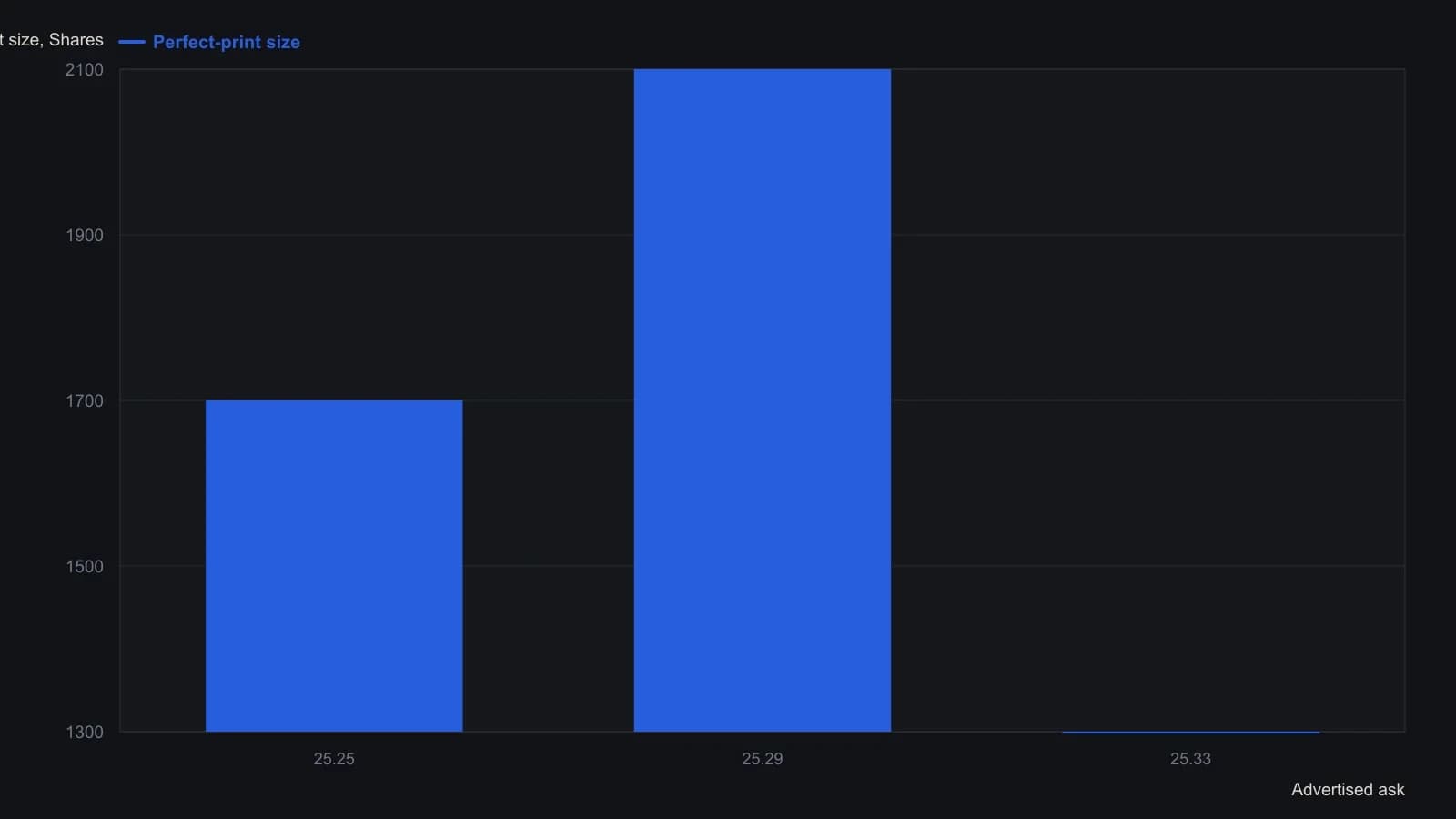
XYZ is the article’s teaching sequence, not a timestamped extract from a named session.
All readings on this track · 20 readings
- 1986Open outcry hand signals as order routing
- 1989Finishing a market order in a first index-pit session
- 2001Ticket charges, internalization, and hidden size on the tape
- 2003Opening auction indications, premium and print size
- 2003Listed open order routing and the short-sale tape
- 2003Opening indication, one-sided envelope, and the sector tape check
- 2003Opening auction fills and the post-print tape
- 2004Specialist prints, opening exits and live tape filters
- 2005A tape-reading case study of support, resistance, and breakout confirmation
- 2005Tape flips versus idle capital: a process critique
- 2005Read the tape, name the liquidity job, then route for price
- 2006Fill entitlement, hybrid routing, and pairs sequencing
- 2006Alerts over resting stops, with tape-reading at the exit
- 2006When crowd levels diverge from Fibonacci support
- 2008Perfect prints before the chart
- 2008Hidden size, tape delay, and pairs shorts belong in the trade rule
- 2010Inside the spread: why OHLC bars hide the buy-sell shift
- 2010Specialist pair books sized for dividends and tape
- 2016Tape reading as judgment under distraction
- 2018Tape-reading breakouts with increment stops