2007issue C061-4
Rewriting calendars and iron condors when volatility regimes shift
A calendar overlay can be opened when implied volatility is compressed, then rewritten after price proves a new level. An iron condor is handled the same way: keep the shorts near one standard deviation and rewrite when delta, leftover credit, or a fresh at-the-money volatility reading no longer matches the book.
- The archive workflow opens a single calendar at the current price in a compressed implied-volatility setting and adds the second calendar only after the underlying has moved.
- Double calendars are described as fitting a low-volatility setting; after a move, a calendar can be rewritten into a diagonal so the remaining short sits farther from the new price.
- An iron condor combines a call credit spread above the market with a put credit spread below it and is kept near one-standard-deviation short strikes until a rewrite cue appears.
- Specified rewrite cues are a short-call delta of 25, a short-put delta of 20, a credit spread that can be closed for 0.20 or less, or 50 to 60 percent of the net credit already captured.
Treat the overlay as a regime instrument
The editorial reading of this archive is that a calendar or an iron condor is a regime overlay rather than a range bet left untouched until expiration. The archive workflow opens time spreads when implied volatility is compressed, then adds or converts a wing only after the underlying has already shown a new level.
A double calendar pairs a call calendar above the current price with a put calendar below it. Each calendar spread sells a nearer expiration and buys a farther one at the same strike. One presented workflow starts a single calendar at the current price and adds the second calendar only after the underlying has moved, instead of opening both wings at once.
HDI call diagonal after the 50.93 rewrite
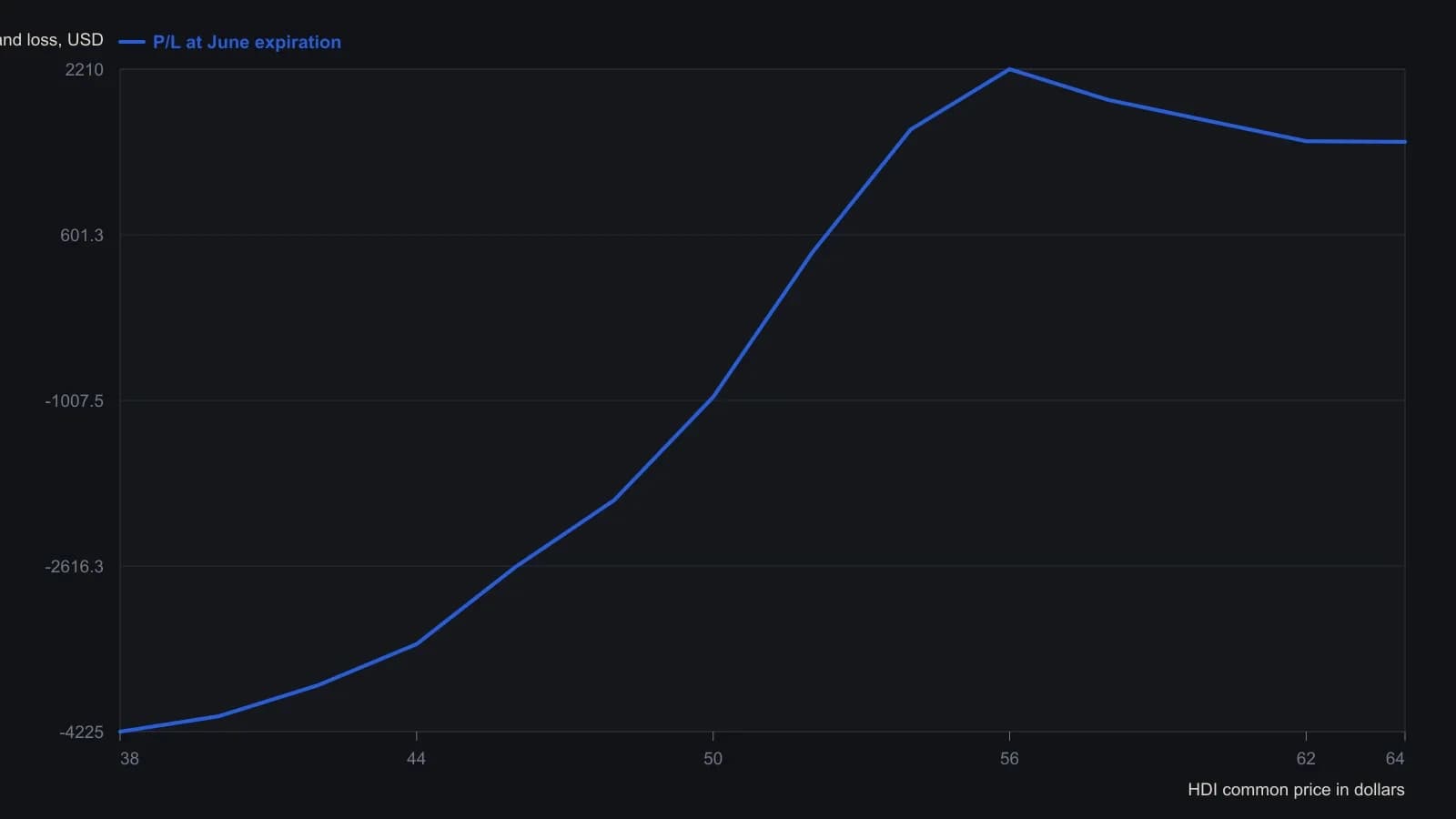
Ten-lot; projection date 17 June 2006 with a 0 percent volatility shock; original requirement 4,460 dollars. Only the expiration profit-and-loss row from the on-screen table is used.
Choose the structure from implied volatility
Double calendars are described as working best in a low-volatility setting. Double diagonals are described as usable in both low-volatility and high-volatility settings. Implied volatility is used here to choose calendar versus diagonal construction, and later to reset strike placement after a move.
After an upside move to 50.93, a calendar can be rewritten into a diagonal by selling the near 50 call, buying the far 50 call, and leaving the near 55 short call in place. The long and short options then no longer share the same strike. Further profit requires a larger additional advance. That sequence is the archive example of converting only after price has proved a new level.
Keep the iron condor inside one standard deviation
An iron condor is a call credit spread above the market plus a put credit spread below it. Limited risk is framed as the strike width minus the net credit received.
Index condors in the material are opened about 49 days before expiration and aimed at an exit one to two weeks early. Short strikes sit near one standard deviation, with short-call deltas around 7 to 8, short-put deltas around 6 to 7, and one extra strike of room on the put side. Standard-deviation placement locates those shorts near one standard deviation from the market and buys the next strike farther away.
Rewrite when the inventory no longer matches
Four adjustment cues are specified: a short-call delta trigger of 25, a short-put delta trigger of 20, a credit spread that can be closed for 0.20 or less, or 50 to 60 percent of the net credit already captured.
On September 29, 2006 a Russell 1000 condor was opened at 725.60 with 49 days to the November 2006 expiration. After a rise from 725 to 757 the put credit spread was closed for a 0.20 debit and replaced at higher strikes.
When strikes are rolled, a new standard deviation is calculated from the implied volatility of the at-the-money call. New shorts are not sold above a 10 delta. The structure is exited if the loss reaches one to one-and-a-half times the original credit. Editorial reading: leftover credit, delta, and a fresh at-the-money volatility print are the cues that the old wings no longer match the book.
All readings on this track · 15 readings
- 2003Implied volatility regimes and range-condor context
- 2007Rewriting calendars and iron condors when volatility regimes shift
- 2008Option spreads, mental stops, and volatility regimes
- 2010Index condor overlays and delta repair
- 2010Equal and unequal strike geometry in a four-leg credit book
- 2010Sizing reserves for condors and pair layers
- 2012Iron condor adjustments when a favorite index breaks
- 2013Earnings-week implied volatility crush and iron condor wings
- 2013Iron condors, butterflies, and stops as one risk budget
- 2014Friday expiry as a weekly butterfly and iron-condor laboratory
- 2014A static iron condor is a market-regime overlay, not an expected-value filter
- 2014Weekly option income adjustments with iron condors and butterflies
- 2014Inverted iron-condor payoffs and misplaced reversal candles
- 2017Patient short-volatility income as a written procedure
- 2020A short iron condor is a weeks-to-months range-regime statement