2008issue C041
Option spreads, mental stops, and volatility regimes
The archive prefers mixed long-and-short option structures to long-only options, replaces a live stop-loss with a monitored mental stop when option bids and asks are wide, and places an iron condor in a cyclical stretch of sharp swings. Editorial reading: rebuild the payoff, treat the stop as a liquidity filter, then judge the structure against multi-week unstable volatility rather than a single tick.
- The archive treats the choice between commodity options and commodity futures as a risk-tolerance and style decision, with a general preference for mixed long-and-short option structures over long-only options.
- A construction habit is to sell at least one option, and possibly two, against each option purchased, which can move an expiration breakeven while still leaving theoretically unlimited risk on an uncovered short option.
- Option volume is more sporadic than futures volume, so a resting stop-loss, especially on a spread, can fill before the underlying reaches the intended exit; a monitored mental stop is offered instead, with no assurance of a preferred-price fill.
- An iron condor is identified as a limited-risk, no-margin structure that can dampen volatility exposure and relocate breakevens, yet short-option approaches were frequently stressed in a stretch of unusually sharp commodity and equity swings.
Options, futures, and risk tolerance
The archive treats the choice between commodity options and commodity futures as a risk-tolerance and style decision. It states a general preference for mixed long-and-short option structures over long-only options.
A stated construction habit is to sell at least one option, and possibly two, against each option purchased, on the premise that more options expire worthless than not. An option spread is a long-and-short option combination whose net delta, breakeven, and payoff differ from a single option or an outright futures stance.
A futures position is assigned a delta of one, while option spreads are described as typically having much lower deltas and therefore smaller value swings as the underlying moves. Delta is the amount the position value changes when the underlying futures price changes.
A corn payoff rebuilt with short options
In a corn payoff sketch, a long 4.00 put bought alone for 20 cents needed the market below 3.80 at expiration to profit. Financing it with a 4.50 short call and a 3.50 short put at 10 cents each moved that expiration breakeven to 4.00, while leaving theoretically unlimited risk above 4.50 and capping profit at 3.50.
An uncovered short option is a short option with no offsetting long option. Uncovered short options are described as carrying theoretically unlimited risk and a margin requirement.
Editorial reading: the financed put can expire solvent at the 4.00 breakeven even if the original long-put view is wrong, but the short call above 4.50 is still an uncovered short option. Rebuilding the payoff is the first step, not a complete risk bound.
Corn put-spread payoff versus a lone long put
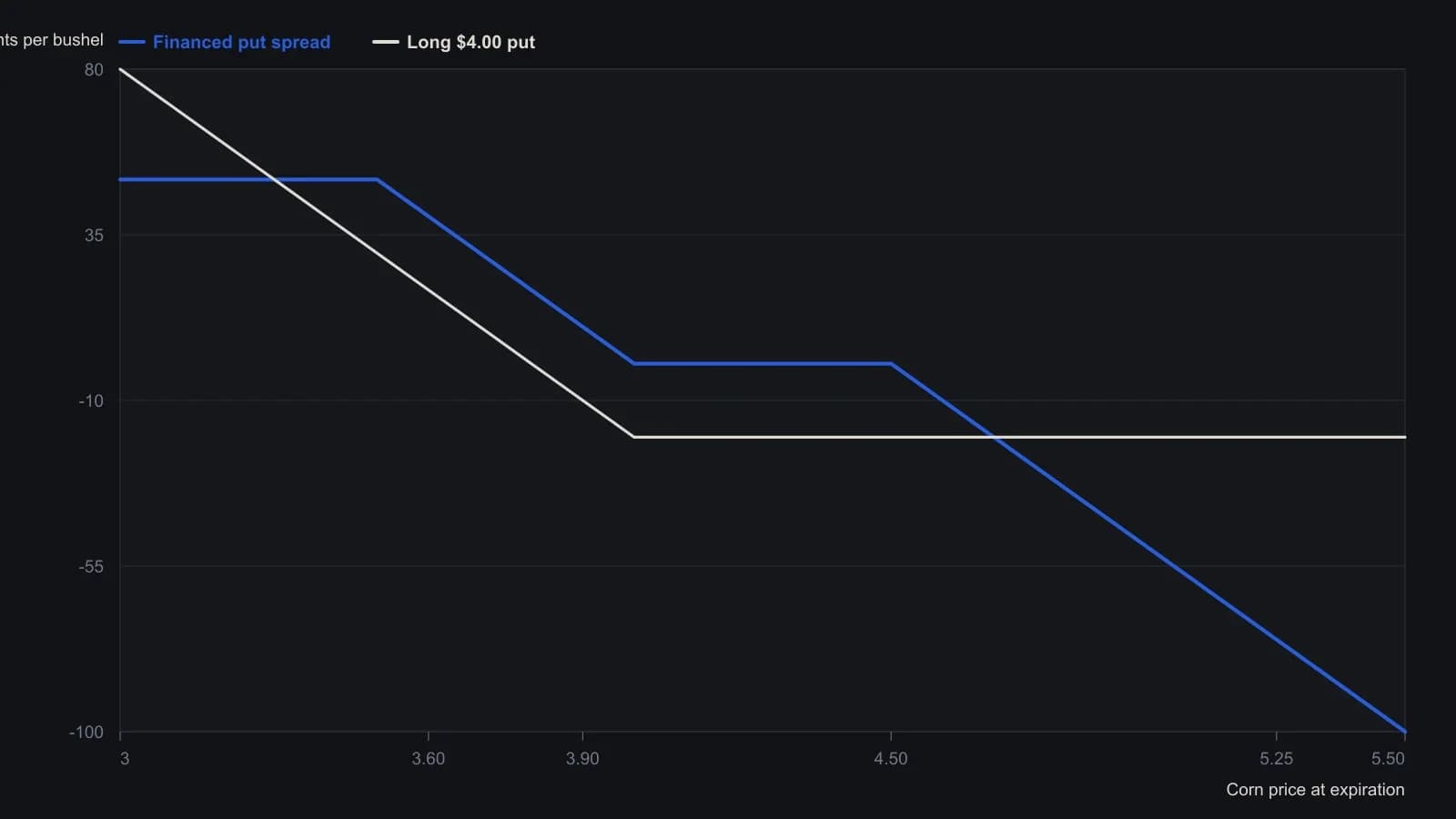
Garner gives the example without transaction costs and treats the short $4.50 call as theoretically unlimited risk above that strike.
A mental stop when volume is sporadic
Option volume is described as more sporadic than futures volume, so bid/ask spreads can be wide enough that resting stops, especially on spreads, fill before the underlying reaches the intended exit.
A stop-loss is a pre-planned loss bound that may be a live resting order or a monitored exit threshold held throughout the position. A monitored mental stop is offered instead of a live stop order. A mental stop is an exit threshold the trader must execute by hand because a live order may fill on the option's own spread rather than on the underlying.
The caveats are that the position must be watched, a fill at the preferred price is not assured, and exit still depends on the trader closing a losing trade.
Editorial reading: treat a resting stop-loss as a liquidity filter rather than a price filter. On an option spread it can fill on the option's own bid and ask before the underlying reaches the intended exit.
An iron condor in a stretch of sharp swings
An iron condor is identified as a limited-risk, no-margin structure that can dampen volatility exposure and relocate breakevens. Editorial definition: an iron condor is a defined-risk, multi-leg option structure used to place one trade in a limited-volatility, limited-margin context over weeks rather than ticks.
Results for both option and futures methods are characterized as cyclical. A stretch of unusually sharp commodity and equity swings is cited as a regime in which short-option approaches were frequently stressed.
Editorial reading: judge the iron condor against that multi-week stretch of unstable volatility instead of a single tick. The same stretch is the archive's example of a regime that frequently stressed short-option approaches.
All readings on this track · 15 readings
- 2003Implied volatility regimes and range-condor context
- 2007Rewriting calendars and iron condors when volatility regimes shift
- 2008Option spreads, mental stops, and volatility regimes
- 2010Index condor overlays and delta repair
- 2010Equal and unequal strike geometry in a four-leg credit book
- 2010Sizing reserves for condors and pair layers
- 2012Iron condor adjustments when a favorite index breaks
- 2013Earnings-week implied volatility crush and iron condor wings
- 2013Iron condors, butterflies, and stops as one risk budget
- 2014Friday expiry as a weekly butterfly and iron-condor laboratory
- 2014A static iron condor is a market-regime overlay, not an expected-value filter
- 2014Weekly option income adjustments with iron condors and butterflies
- 2014Inverted iron-condor payoffs and misplaced reversal candles
- 2017Patient short-volatility income as a written procedure
- 2020A short iron condor is a weeks-to-months range-regime statement