2012issue C0730-34
Iron condor adjustments when a favorite index breaks
When the Russell 2000 fell 43 points inside a July-to-October stretch described as a 25 percent decline, the case study asked whether an income-style iron condor still had a written next step. The later procedure specified entry window, wing width, short-delta, and adjustment-rolls after an earlier discretionary account had held into expiration.
- The 43-point Russell 2000 session was judged manageable because the index already looked oversold, the catalyst had been visible for months, and short-delta only reached the stated minus 16 adjustment line later in the day.
- The later option income strategy sold iron condors 80 to 88 days out, used 30-point wings, and wrote short-delta, adjustment-rolls, and profit-taking as one procedure instead of holding to expiration.
- An earlier discretionary account grew from 20000 to 28000 in about half a year, then lost 14000 after the trader held into expiration on assurances that the shorts were likely to expire worthless.
- The income procedure budgeted one to three losing or breakeven months a year and capped a monthly loss at 100 to 150 percent of typical monthly credit.
A process test on one index
This case study centers on an iron condor used as the main income vehicle on the Russell 2000 index. The four-leg structure sold both a put credit spread and a call credit spread so premium was collected if the index stayed between the short strikes.
The archive follows a session when that index fell 43 points during a broader July-to-October stretch described as a 25 percent top-to-bottom decline. The record is less about whether one session was pleasant and more about whether the option income strategy still had a next step once the shorts came under pressure.
Why that session looked manageable
The trader judged the 43-point session manageable because the index already looked oversold, the catalyst had been visible for months, and the short put only moved from about minus 8 delta to minus 14 at the open and minus 16 later.
Minus 16 was the stated adjustment line. Short-delta, the option-greek reading on the short strikes, was the trigger for whether the condor was still inside its planned range or needed an adjustment-roll.
What holding to expiration had already cost
An earlier discretionary iron-condor account grew from 20000 to 28000 in about half a year, then lost 14000 on a large down move. The trader had held into expiration on assurances that the shorts were likely to expire worthless.
The later self-directed method treated stay, adjust, and stand-aside rules as one option income strategy rather than a one-off trade. It sold Russell 2000 iron condors about 80 to 88 days before expiration, with short puts near 8 delta and short calls near 12 delta. Long wings sat 30 points away, aiming for about a 4-point credit versus 30 points of defined risk.
That method differed from a classic high-probability condor template that entered 45 to 60 days out, sold 8-to-10 deltas on both sides, used 10-point wings, and targeted a 1.00 to 1.50 credit.
How the adjustment-roll was written
Adjustments were planned at about minus 16 delta. The threatened put credit spread was bought in and resold 30 index points lower, often at 150 percent of original size, to rebuild credit after an adverse move. The cap was two or three rolls before scratching or taking the loss.
Editorial note: that relocation of strike is the calendar-spread-options role in this workflow. Remaining risk is moved after the original short strikes come under pressure, instead of being left in the first expiration window.
Profit-taking rules included covering a winning call credit spread at 0.40 or less rather than reselling it, exiting around three weeks before expiration, and targeting 70 to 80 percent of the initial credit.
What the income budget allowed
The income procedure budgeted one to three losing or breakeven months a year and capped a monthly loss at 100 to 150 percent of typical monthly credit. The archive treats 2011 as a year with no monthly losses under that framework.
RUT iron condor: classic vs Meissner parameters
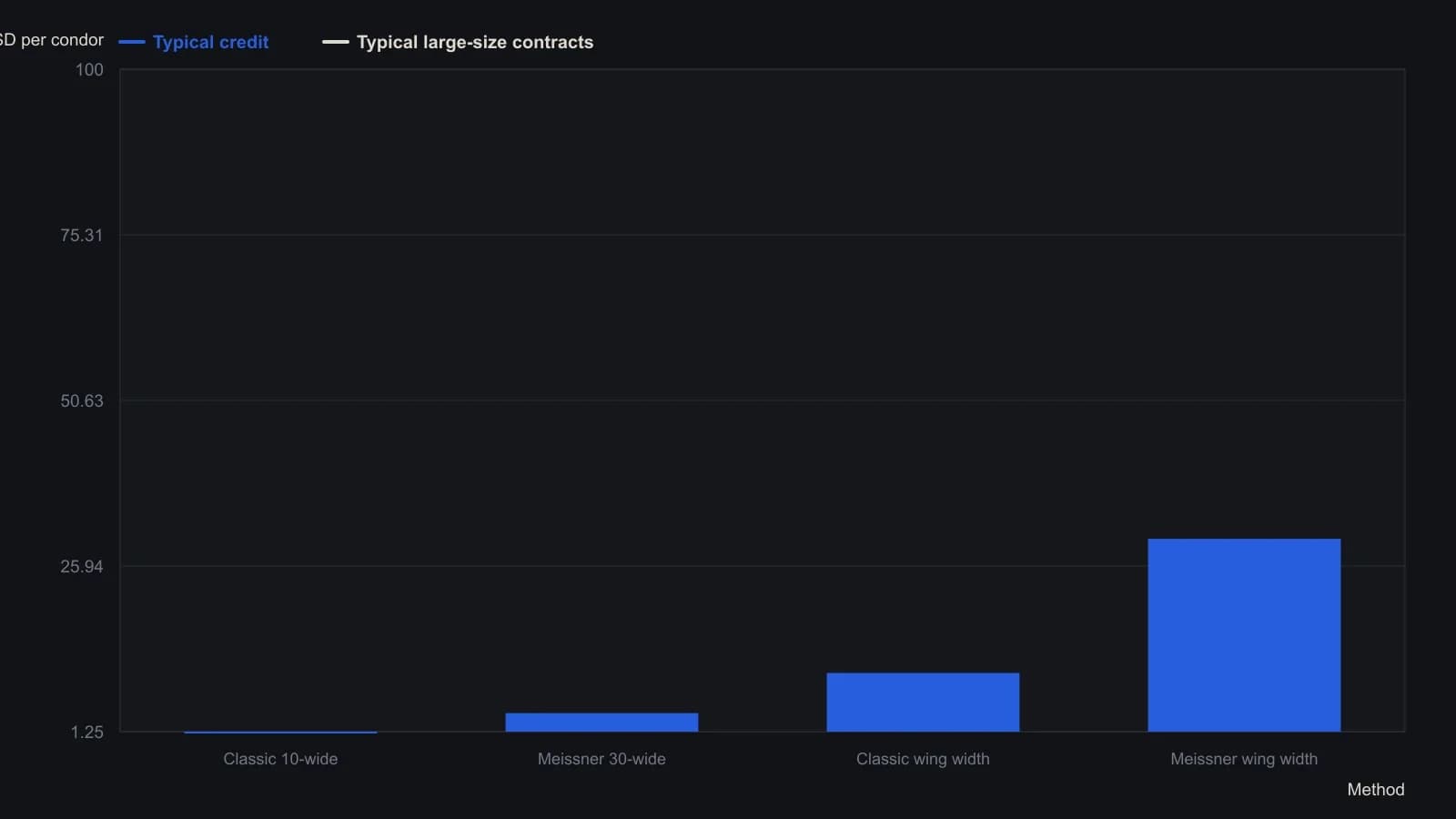
Funds-at-risk values are midpoints of the table ranges ($85,000–$90,000 classic; $52,000–$65,000 Meissner). Typical credit is the stated dollar credit per condor, not the $4,000 cash credit on 10 contracts.
All readings on this track · 15 readings
- 2003Implied volatility regimes and range-condor context
- 2007Rewriting calendars and iron condors when volatility regimes shift
- 2008Option spreads, mental stops, and volatility regimes
- 2010Index condor overlays and delta repair
- 2010Equal and unequal strike geometry in a four-leg credit book
- 2010Sizing reserves for condors and pair layers
- 2012Iron condor adjustments when a favorite index breaks
- 2013Earnings-week implied volatility crush and iron condor wings
- 2013Iron condors, butterflies, and stops as one risk budget
- 2014Friday expiry as a weekly butterfly and iron-condor laboratory
- 2014A static iron condor is a market-regime overlay, not an expected-value filter
- 2014Weekly option income adjustments with iron condors and butterflies
- 2014Inverted iron-condor payoffs and misplaced reversal candles
- 2017Patient short-volatility income as a written procedure
- 2020A short iron condor is a weeks-to-months range-regime statement