1994issue C081-10
Equal-weight holding count as a construction control
The number of equal-weight names decides whether one winner or one stopped-out loser can still move the book, or whether leftover returns collapse into market-level moves. Holding count is treated here as a construction control, not as a search for one right size.
- An equal-weight book of 20 names puts 5 percent in each holding, so a 20 percent drop in one name cuts portfolio return by 1 percent if the rest are unchanged.
- With 20 or more equal-weight names and a 20 percent initial stop, a full stop-out in one name reduces portfolio return by 1 percent or less.
- Past 100 equal-weight names, even a 100 percent gain in one stock adds 1 percent or less to portfolio return, so selection effects fade into market-level moves.
- For individual traders, 10 to 50 names was framed as enough diversification to blunt one bad bet without making a doubled stock almost invisible, after time, costs, and follow-up load.
Count as a construction control
An equal-weight book turns the number of holdings into a size decision. Each name gets the same weight, so adding names shrinks how much one stock can help or hurt the whole book.
Diversification, in this setting, means adding more holdings so that one name’s move has a smaller effect and leftover risk looks more like market risk than single-stock risk.
Editorial view: treat that count as a construction control. It decides whether one winner or one stopped-out loser can still move the book, or whether returns collapse into the market regime.
A hard cap on one name
A position-concentration-limit is a hard cap on how much one name can hurt or help the book, set by equal-weight size plus a stop or by how much capital sits in the largest holdings.
An equal-weight book of 20 names puts 5 percent in each holding, so a 20 percent drop in one name cuts portfolio return by 1 percent if the rest are unchanged.
With 20 or more equal-weight names and a 20 percent initial stop, a full stop-out in one name reduces portfolio return by 1 percent or less.
Single-name impact versus equal-weight holding count
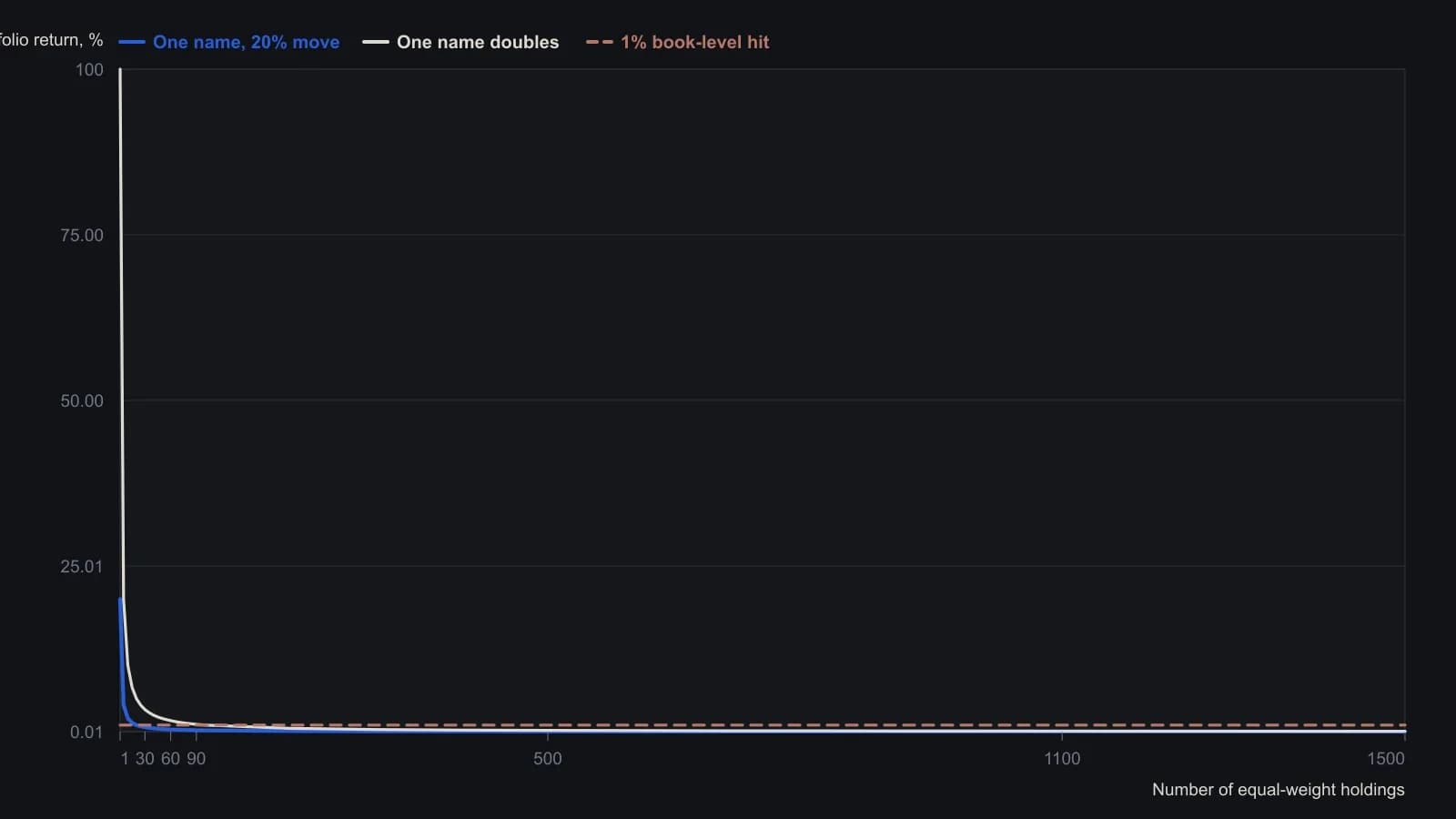
Equal starting weights; only one name is assumed to move. The 1 percent line is the book-level hit Chande flags for a 20 percent initial stop at 20 or more names.
When selection fades into the market
The same size math works in the other direction. Past 100 equal-weight names, even a 100 percent gain in one stock adds 1 percent or less to portfolio return, so selection effects fade into market-level moves.
If names can be selected for 20 percent or better annual gains, more than 50 equal-weight holdings leaves each such winner contributing only 0.4 percent to portfolio return.
Holding count as one test
Tradeoff-analysis here means testing holding count as one procedure that jointly sets opportunity cost, winner impact, stop-loss damage, follow-up time, and how much the book tracks the market.
In a 50-name hypothetical draw of returns between -30 percent and 50 percent, 36 percent of names were negative and 30 percent returned more than 30 percent.
Random portfolios built from those 50 names had the highest average return at five holdings. Adding names then cut average return or left it roughly flat while steadily lowering the standard deviation of portfolio returns.
Fund books and individual books
A survey of 40 funds put 25 percent of assets, on average, in the 10 largest holdings, with typical five-sector exposure at 47 percent of assets and about 1 percent in the average name.
For individual traders, 10 to 50 names was framed as enough diversification to blunt one bad bet without making a doubled stock almost invisible, after time, costs, and follow-up load.