2019issue C0826-27
Option strategy optimization beyond peak profit
An option system can be specified as a systematic rule set and ranked after a joint search over rules and setups. Editorial view: keep that ranking only if the chosen strikes are liquid and premium richness matches the intended path.
- Specify a systematic rule set so entry, exit, and stand-aside conditions can be historically tested as one procedure.
- Jointly vary profit and stop-loss percentages, strike selection, expiration, and strategy type, then rank with profit factor, efficiency, and profit or loss per day, not only win rate and total profit.
- After that ranking, check option liquidity on the chosen strikes and review implied volatility, intrinsic and extrinsic value, and the expected move.
- Cheap premium is preferred for directional plans, and rich premium is preferred for sideways, nondirectional plans.
Specify a systematic rule set
An option system is specified by objective, repeatable entry and exit conditions so the full procedure can be historically tested rather than left to discretionary judgment. A systematic rule set is that complete, repeatable specification of when to enter, exit, or stand aside.
Test historically, then optimize jointly
Historical testing can start on one liquid name over a limited window, then extend across a full market cycle and additional symbols before parameters are optimized. Strategy optimization jointly varies profit and stop-loss percentages, strike selection, expiration choice, and strategy type rather than tuning a single parameter. Strategy construction includes a risk-reward comparison of taking smaller versus larger profits and then optimizing those choices across alternative setups.
Compare candidates under a metric tradeoff
Candidate rule sets are compared with profit factor, efficiency, and profit or loss per day in addition to win rate and total profit, because those extra metrics can change the ranking. The metric tradeoff is the evaluation problem that arises when win rate and total profit point to one rule set while profit factor, efficiency, and profit or loss per day point to another. A 50 percent profit target can outrank a higher-dollar target when efficiency, profit factor, and profit or loss per day are the deciding metrics rather than total profit alone.
Win rate and efficiency across profit-target rules
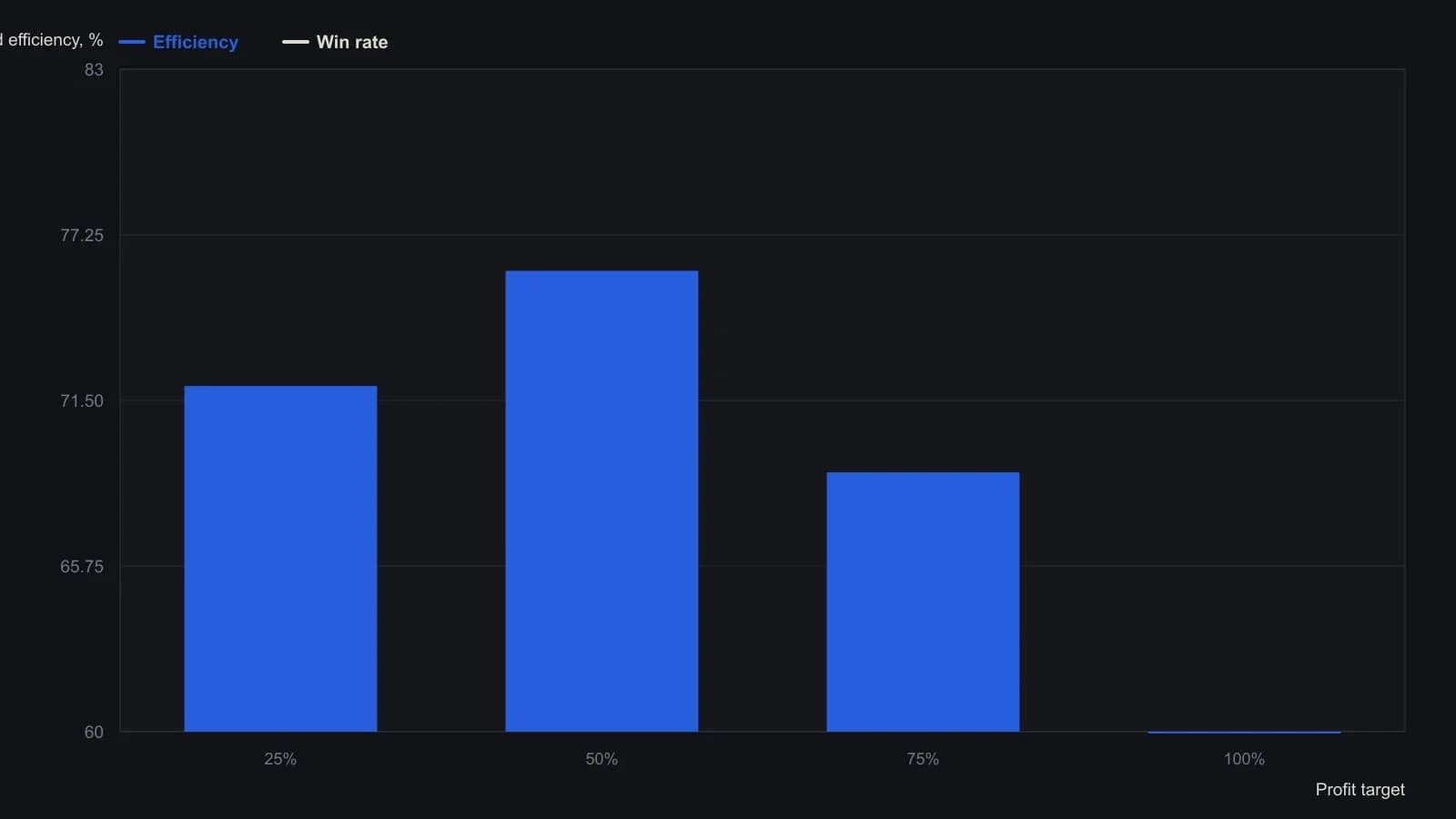
The same table also ranks the 50 percent target first on profit factor (4.84) and P/L per day ($29.17), even though total profit is higher at the 75 and 100 percent targets.
Recheck liquidity and implied volatility context
After optimization, a live candidate still requires a liquidity check on the chosen strikes and expirations plus a review of implied volatility, intrinsic and extrinsic value, and the expected move. Option liquidity is judged from available strikes and expirations, bid-ask width, volume, and open interest, and the workable threshold differs with typical trade size. Implied volatility context is that live check of current implied volatility, intrinsic and extrinsic value, and expected move. Expected move is a market-implied displacement used, with those value components, to judge whether a candidate is overpriced or underpriced at entry.
Match premium richness to the intended path
The market path that can justify an option trade is structure-dependent: a long call needs upside movement, while an iron condor needs choppy, range-bound movement. Cheap option premium is preferred when the plan seeks directional movement, and rich premium is preferred when the plan seeks sideways, nondirectional movement. Premium richness is whether options look cheap or expensive relative to that intended path.